
Why Do Cats Purr? Science Isn't Fully Sure
A cat's purr is far more than a happiness signal. New research shows it may be self-medication: a healing frequency machine built into every cat.
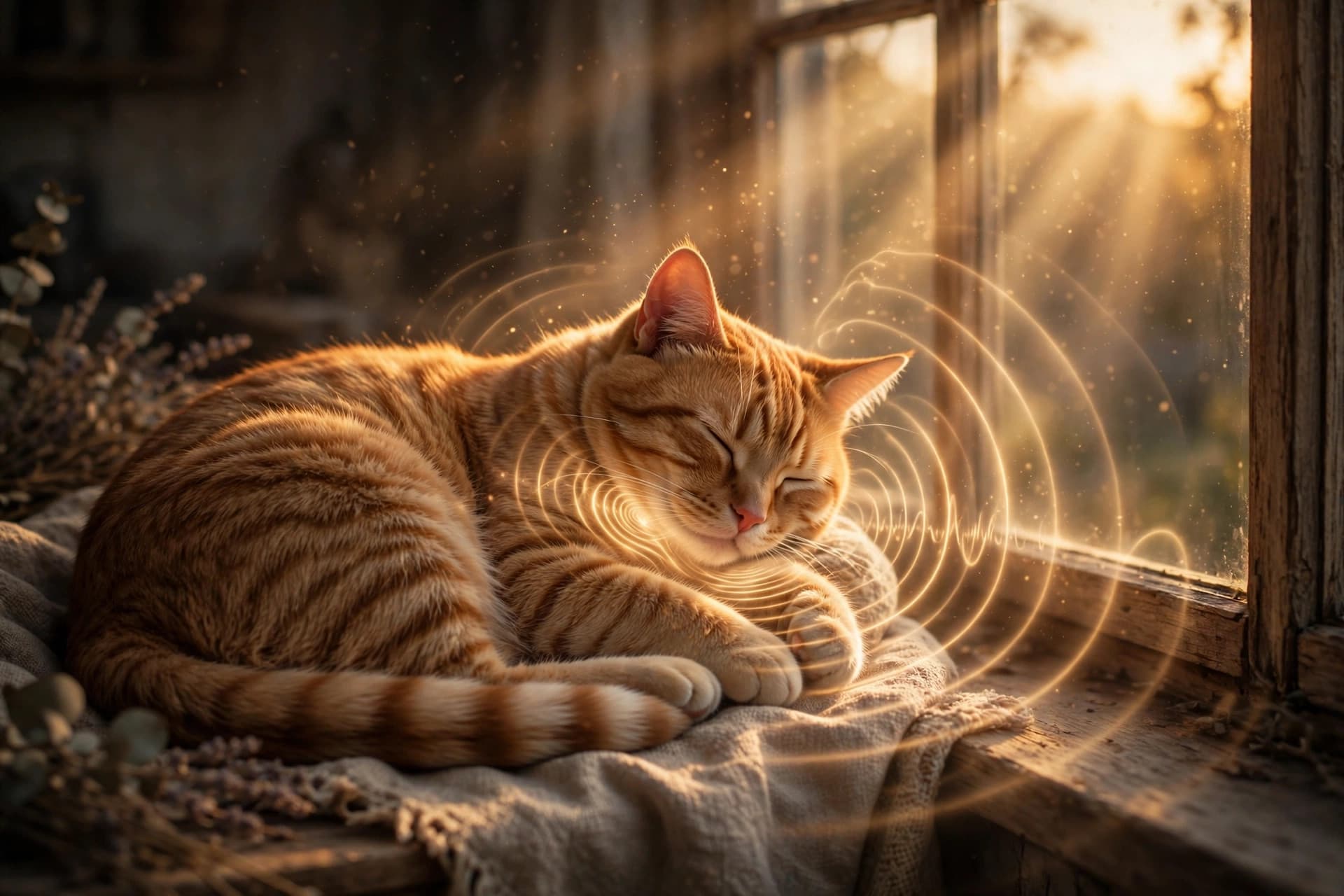
A cat's purr is not a happiness meter. The same cat that purrs on your lap in the evening may also purr through childbirth, through injury, and even through pain — and scientists now suspect that in those dark moments, the purr is not an expression of feeling at all. It may be medicine. The most surprising discovery in purring research is that the sound barely seems to need the brain to exist, and that its frequencies overlap almost exactly with the vibrations doctors use to heal human bones.
That leaves us with a strange picture: a sound everyone knows, that almost no one truly understands.
How the purr is actually made
For decades, the standard explanation came from electromyographic studies of cats' laryngeal muscles, most famously by Remmers and Gautier in 1972 and later by Frazer-Sisson, Rice, and Peters in 1991. The story went like this: a "neural oscillator" — a rhythm-generating circuit in the cat's brain, located in a region connected to the hypothalamus — fires rhythmic signals to the muscles of the larynx. Those laryngeal muscles contract and relax rapidly, repeatedly narrowing and opening the glottis, the space between the vocal cords.
As the cat breathes in and out through this rapidly opening and closing gap, the airflow becomes turbulent, and that turbulence is the purr. Because the cat produces it on both the inhale and the exhale, the sound never pauses — it is a continuous, low rumble, usually described as a "tonal buzz," generated at frequencies between 25 and 150 Hertz. The laryngeal muscles twitch within that same range, dozens of times per second, for as long as the neural signal keeps firing.
There is a neat corollary here. The hypothalamus is also the part of the brain that interprets whether sensory input is pleasant or painful, and it releases endorphins — the body's natural opiates — in response to both pleasure and pain. That double role has been proposed as the reason purring shows up in such contradictory emotional states: contentment triggers it, and so does suffering, possibly as a self-soothing reflex.
This account held for decades. Then, in 2023, a team of bioacousticians did something that rewrote it.
The discovery that rewrote the mechanism
Christian Herbst and Tecumseh Fitch, working at the University of Vienna, published a study in Current Biology that asked a brutally simple question: does purring actually require the brain at all? Working with larynges from eight domestic cats that had died of terminal disease, they pumped warm, humid air through the isolated voice boxes — and every single one purred.
No brain. No neural oscillator. No active muscle contractions. Just airflow.
The finding suggested that once the vibration starts, purring may be a passive, flow-induced oscillation — the same physics that lets a brass player's lips buzz or a flag flap in the wind. The researchers found that domestic cats possess unusually thick pads of connective tissue embedded in their vocal folds, which allow the folds to keep vibrating at purr frequencies (around 20 to 30 Hertz in these experiments) without any further neural input. The brain may only be needed to flip the switch; the throat keeps the machine running.
This challenged the old Active Muscle Contraction model, which had rested heavily on that single 1972 electromyography study. It also explained something the old model struggled with: how cats can purr for hours — sometimes while asleep — without apparent effort. A passive oscillation costs almost nothing to sustain.
But solving how the purr works only deepened the mystery of why it exists.
The healing frequencies
The boldest theory of why cats purr comes from the bioacoustics researcher Elizabeth von Muggenthaler and her colleagues at Fauna Communications. Recording and analyzing purrs from 44 individual cats across five species — domestic cats, cheetahs, ocelots, pumas, and servals — they found that every single animal produced strong frequencies between 25 and 150 Hertz, with prominent harmonics at 25, 50, 100, 125, and 150 Hertz. The work was published in The Journal of the Acoustical Society of America in 2001.
Those numbers matter because they sit squarely inside the frequency ranges used in human vibrational medicine. Frequencies between 25 and 50 Hertz are the sweet spot for stimulating bone growth and healing fractures. Harmonics around 100 Hertz line up with frequencies used therapeutically for pain relief, wound healing, and reducing swelling and breathlessness.
Independent veterinary research has established that low-frequency vibrations in exactly this range stimulate bone density and improve skeletal strength. And cats, notably, suffer remarkably few of the chronic bone problems — hip dysplasia, stress fractures — that plague their canine counterparts. Their bones famously heal fast, and cats are legendarily good at surviving falls from great heights, the phenomenon veterinarians call high-rise syndrome.
The hypothesis, then, is that purring is a built-in maintenance system: a low-dose, daily vibrational therapy the cat administers to itself. Cats sleep much of the day, often purring through rest, which would mean their skeletons receive a gentle strengthening treatment several times a day, every day, for their entire lives. That would also neatly explain the paradox of pain-purring: a hurt cat purring is not being cheerful — it may be trying to heal.
Researchers are careful to call this a hypothesis rather than a proven fact. But the frequency match is striking enough that the idea has survived decades of scrutiny.
Why purr when you're hurting?
If purring were simply a sign of contentment, it would be easy. But cats purr when frightened, when injured, when giving birth, and when dying — states that share nothing with a warm lap. This is where context becomes everything.
A mother cat purrs almost continuously while nursing, and kittens are born blind and deaf: the vibrations are believed to guide newborns to the milk source and to calm the whole litter. That is purring as communication — a signal of safety, literally felt more than heard. In distress, the same sound may function as self-comfort, a feline equivalent of rocking back and forth.
As New Scientist has pointed out, your best clue to why your cat is purring is never the sound alone but the body around it. A cat purring first thing in the morning, weaving between your legs, is probably asking for breakfast. One purring in a carrier at the vet's office is almost certainly not happy. The purr is a multi-tool, and treating it as a single emotion is like assuming a human smile always means joy — it can also mean nerves, politeness, or pain.
This is the same kind of bodily mystery as other involuntary signals — why we get goosebumps when we're moved or cold, or why onions make you cry through a chemical reflex rather than sadness. The body speaks in a language older than intention.
What science still doesn't know
For all this progress, the deepest question remains open: which function came first? Did the purr evolve as a mother-kitten signal that cats later repurposed for self-therapy, or did it begin as a physiological maintenance vibration that happened to be communicative? Nobody knows. Research into feline behavior has lagged far behind dog research, and the purr — common, quiet, unglamorous — simply hasn't attracted the funding that flashier animal mysteries have.
What we can say is this: a cat's purr is produced by a throat that can vibrate on its own once airflow passes through it, at frequencies that happen to match the ones medicine uses to knit bone. The sound that humans read as "I'm happy" may be, at its core, the cat running a quiet repair program — on itself, on its kittens, and, if you're lucky enough to be the warm surface it chose, perhaps a little bit on you.