The Green Children of Woolpit: A Medieval Mystery
In 12th-century Suffolk, two green-skinned children appeared at a wolf pit, speaking an unknown tongue. Their story became England's strangest medieval mystery.
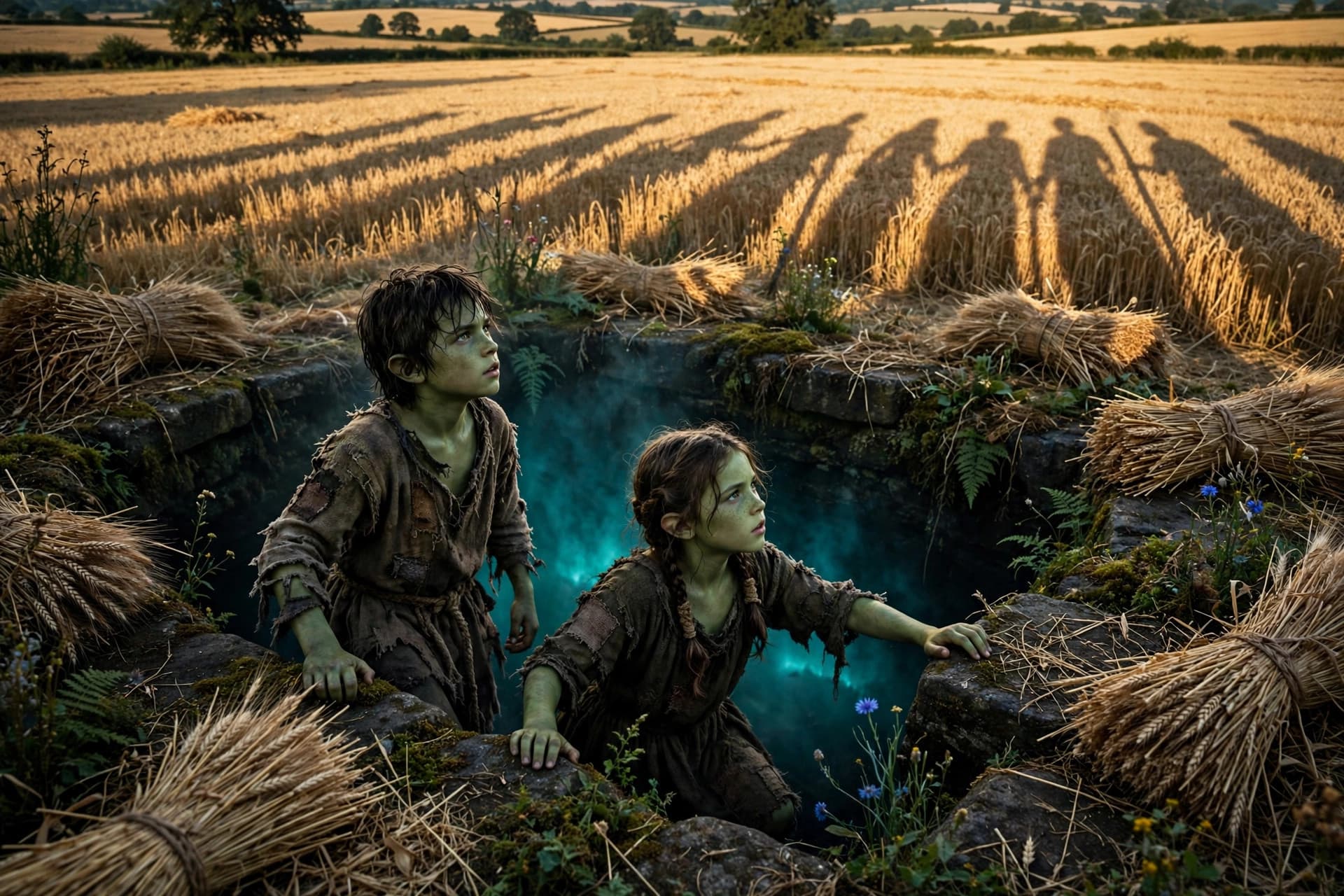
At harvest time in twelfth-century Suffolk, in the village of Woolpit, reapers found two small children — a brother and a sister — beside one of the wolf pits that gave the village its name. Their skin was green. Their clothes were made of an unfamiliar material. And when they spoke, nobody could understand a single word.
What makes this more than a folk tale is that two of the most respected historians of medieval England wrote it down as fact. Yet eight centuries later, no one can fully agree on who the children were, where they came from, or why their skin was green. The Green Children of Woolpit remain the closest thing medieval England has to an unsolved case file.
What the chroniclers actually recorded
The story survives in two independent sources. William of Newburgh (1136–1198), a canon of the Augustinian priory at Newburgh, included it in his Historia rerum Anglicarum (History of English Affairs). Ralph of Coggeshall (died around 1228), sixth abbot of Coggeshall Abbey in Essex from 1207 to 1218, recorded it in his Chronicon Anglicanum (English Chronicle). Both men were serious historians documenting what they believed were genuine marvels of their age — and significantly, the two accounts agree on the core details.
According to William, the discovery happened during the reign of King Stephen (1135–1154). The villagers brought the children to the home of a local landowner, Richard de Calne. The pair refused all food for several days — until they were shown some raw broad beans, which they ate eagerly, at first trying to open the stalks rather than the pods, as though they had never encountered beans before. Gradually they adapted to ordinary food, and as they did, their green color slowly faded until it disappeared entirely.
It was decided to baptize the children. But the boy, apparently the younger of the two and sickly from the start, died before or soon after the baptism. The girl survived.
The accounts differ on the small details — William's version has the children hearing a loud noise, "like the sound of the bells of Bury St Edmunds Abbey," while herding their father's cattle, and suddenly finding themselves by the wolf pit; Ralph's has them becoming lost following the cattle into a cave and, guided by the sound of bells, eventually emerging into our world. Historians note the dating problem: the Anglo-Saxon Chronicle, which records English history — including its popular "wonders" — up to King Stephen's death in 1154, never mentions the green children at all, suggesting the incident may have happened early in the reign of Henry II rather than Stephen's.
The girl's story: St Martin's Land
Once the girl learned English, she told her story — and it was stranger than anything the villagers had imagined. She said she and her brother came from a place she called St Martin's Land, a world where the sun never shone and the light was a perpetual twilight. Everything there was green. There was no blinding sun, only a dim, dusk-like glow; across a river, she said, a brighter, luminous land could be seen.
They had been tending their father's cattle when they heard the bells, entered a cave, and walked through darkness — and then emerged, dazzled, into the harvest fields of Woolpit, with no way to return.
Ralph adds domestic details the other chronicler omits: after her brother's death, the girl worked as a servant in the de Calne household for several years — during which, he notes dryly, she was "rather loose and wanton in her conduct." She was eventually baptized, given a new name, and married. Some translations of William's account give her name as Agnes Barre and say she wed a man from Lenna — others read it as Lynne — both pointing to King's Lynn in Norfolk. She lived, by all accounts, an ordinary English life afterward, her strange origin fading into village memory.
That quiet ending is part of what makes the tale so haunting: not a grand finale, but a green girl absorbed into everyday medieval England, the way the Dancing Plague of 1518 ended not with explanation but with exhaustion, and the Loch Ness Monster lingers not as a solved case but as a story that refuses to die.
The leading theory: Flemish orphans of 1173
Of all the explanations proposed over eight centuries, the one most historians take seriously comes from Paul Harris, writing in Fortean Studies 4 in 1998. Harris suggested the children were Flemish orphans — possibly from Fornham St Martin, a village near Woolpit separated from it by the River Lark.
The context is real and bloody. In the twelfth century, large numbers of Flemish immigrants had settled in England, and under King Henry II they were persecuted. In 1173, during the rebellion against Henry, Flemish mercenaries were slaughtered near Bury St Edmunds at the Battle of Fornham. Civilians would have fled.
Harris's reconstruction is this: two Flemish children, orphaned and displaced by the violence, escaped into Thetford Forest. To frightened children hiding in dense woodland and perhaps in the region's old mine passages and caves, the world would indeed have seemed a place of perpetual twilight — matching the girl's description of St Martin's Land, a name that echoes their home village of Fornham St Martin. They emerged starving at Woolpit dressed in unfamiliar Flemish clothing and speaking Flemish, a language utterly unintelligible to Suffolk villagers. What the chroniclers recorded as a marvel from another world may have been the arrival of two traumatized refugee children.
This reading gains force from a detail scholars have pointed out: the dialect of someone from a non-local village would already have been nearly unintelligible to Woolpit's people — and Flemish entirely so. The "unknown tongue" proves nothing supernatural.
The medical theory: green sickness
But what about the green skin? Here medicine offers a plausible answer: chlorosis, also called hypochromic anemia, a condition once known as "green sickness." The name comes from the Greek chloris, meaning greenish-yellow. Severe iron-deficiency anemia from a terrible diet can give the skin a pallid, greenish tint — and, crucially, it reverses with proper nutrition.
The chroniclers' account fits this like a glove: the children were starving, ate almost nothing but raw beans at first, gradually adapted to a normal diet — and as their nutrition improved, the green faded completely. Modern scholars note that lost, starving children hiding outdoors would be exactly the population most vulnerable to chlorosis.
Alternative medical theories exist. One East Anglian legend tells of two young heirs poisoned with arsenic by a wicked guardian in Wayland Wood near Thetford Forest — and arsenic poisoning, which is not always fatal, can turn the skin green. Others have speculated about copper exposure or severe vitamin deficiencies from a diet of nothing but beans.
Beyond medicine, literary scholars read the tale differently. Jeffrey J. Cohen has argued the story is an allegory of cultural difference in Norman England — the green children as marginalized outsiders, like the Welsh or indigenous Britons, assimilated or destroyed under Anglo-Norman rule. Folklorists point to the story's symbolic furniture: broad beans were associated with death and the underworld in some medieval cultures, and St Martin's Day — Old Halloween, marking the transition from autumn to winter — carried its own liminal weight. Even the custom of knocking on wood shows how thin the boundary was between daily life and superstition in the medieval mind.
Why the mystery refuses to die
The story's afterlife is itself part of the puzzle. Robert Burton mentioned it in The Anatomy of Melancholy in 1621, where the suggestion that the children "fell from heaven" launched centuries of otherworldly speculation. Thomas Keightley's The Fairy Mythology (1828) gave it a folklore treatment. In the twentieth century, the rise of science fiction turned the green children into proto-aliens — little green visitors from another planet, centuries before the phrase existed. A supposed second sighting in "Banjos," Spain, in 1887 turned out, on inspection, to be a straight retelling of the Woolpit story, first printed in John Macklin's Strange Destinies (1965); there is no Banjos in Spain.
Woolpit itself still embraces the legend: the village sign depicts two green children emerging from a pit.
That is probably the real answer to why the mystery endures. The Woolpit story sits at a perfect crossroads — a genuine historical event recorded by genuine historians, wrapped in details too strange to ignore and too thin to resolve. Strip away the twilight world and the bells, and you are left with the most plausible version: two starving Flemish orphans, green-tinged with hunger sickness, stumbling out of the forest into a Suffolk harvest. Keep the bells and the green, and you have the first alien encounter in English literature. The documents support both readings, and neither can finally defeat the other. Eight hundred years on, the green children are still exactly where the reapers found them — beside the wolf pit, unexplained.