Why Do Stars Twinkle While Planets Shine Steadily?
Why do stars twinkle but planets don't? Turbulent air bends starlight on its way down, so pinpoint stars flicker while planets' tiny disks shine steadily.
Key takeaways
- Stars twinkle because Earth's turbulent air bends their pinpoint light; the stars themselves shine steadily.
- Astronomers call the flicker scintillation. It can make a star's brightness wobble many times per second.
- Planets shine steadily because their tiny disks let the air's distortions cancel out across the disk.
- Stars near the horizon twinkle harder because their light crosses a much thicker slice of atmosphere.
- Even Betelgeuse, the widest star disk ever measured (0.055 arcseconds), is about 655 times narrower than Jupiter's disk.
Stars are not actually flickering. Earth's atmosphere is. Stars are so far away that they appear as single points of light, and moving pockets of air bend those beams enough to make them shimmer. Planets look like tiny disks instead, so the wobbles average out and their light stays steady. That makes the twinkle a great planet detector.
- On a clear, dark night, the naked eye can pick out about 6,000 stars, and nearly all of them are shining steadily; the flicker is added by Earth's air on the way down. NASA StarChild
- A star arrives as such a tiny image that the "clumpy" atmosphere can split that single point into multiple ever-shifting copies, which astronomers call speckles. NASA
- The real brightness wobble runs about ten times faster than the slowed-down time-lapse NASA shows, so the flicker is nearly continuous. NASA
- Even through large telescopes, stars stay pinpoints while planets resolve into tiny disks, so turbulence tugs opposite edges of a planet's disk in opposite directions and the distortions cancel. EarthSky
- The widest stellar disk ever measured belongs to Betelgeuse: about 0.055 arcseconds, first imaged by Hubble's Faint Object Camera in 1995. Astronomy
- On November 3, 2026, Jupiter's disk measured 36.05 arcseconds across, Saturn's 19.40 and Venus's 58.70, computed from JPL-derived ephemeris data. Show Me The Sky
Why do stars twinkle at all?
The short version is motion. Air is always moving: pockets of warmer and cooler air slide past each other, and each pocket bends light by a slightly different amount. By the time a star's light has crossed the full depth of the atmosphere, it has been tugged sideways dozens of times. Because the beam arrives from what is effectively a single point, every little bend moves the whole image, and the star shimmers, jumps and changes brightness several times a second.
NASA explains that turbulence tilts the incoming rays, so part of the starlight lands on your eye and part is steered just off it, and your eye reads the difference as a flicker. Astronomers give the effect its own name: scintillation. The effect strengthens near the horizon. Low in the sky, starlight slices through far more air than it does overhead, so the bending piles up. NASA notes that stars close to the horizon twinkle more for exactly this reason. Sky watchers who chase the green flash at sunset already know the horizon air plays strange tricks with light. Modern telescopes fight back with adaptive optics, flexible "rubber" mirrors that reshape themselves to undo the air's distortion. From space, the problem disappears entirely: above the atmosphere, stars shine with the steady light they were emitting all along.
Why do stars twinkle but planets don't?
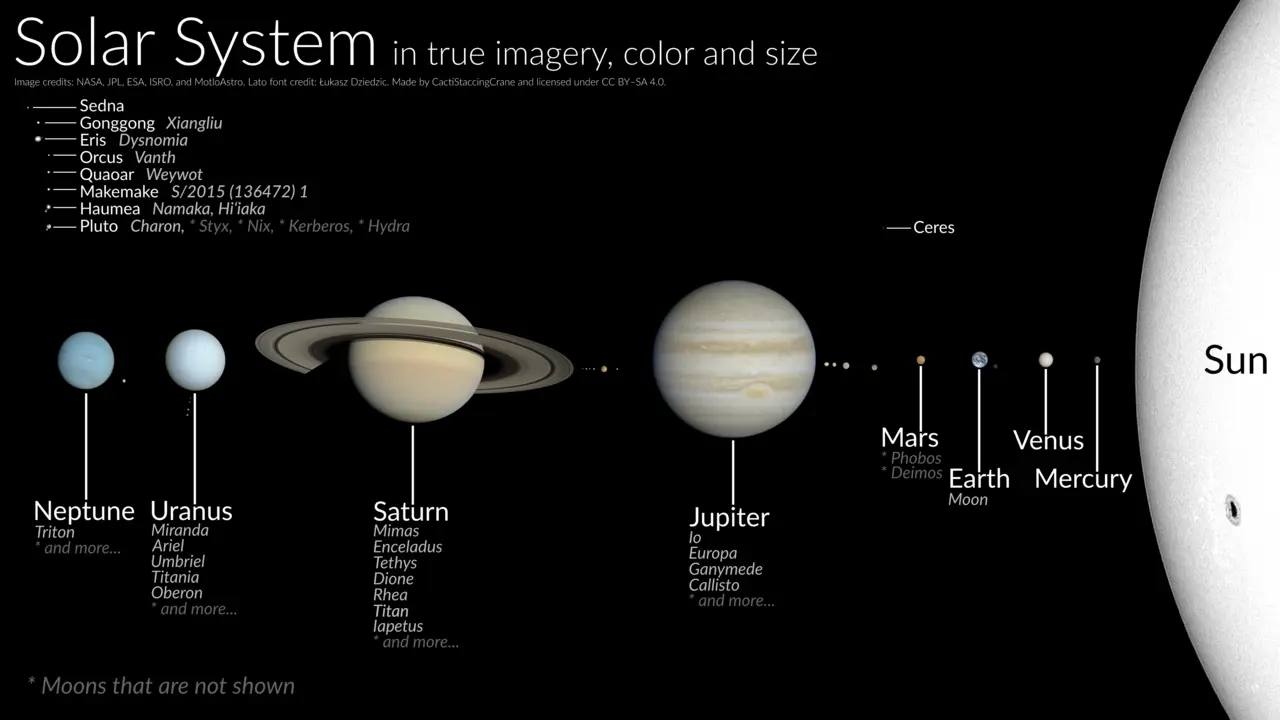
Distance is the whole story, but in an indirect way. Stars are enormously farther away than planets, so each star's face shrinks to a single point by the time its light arrives. Planets are near enough to keep some width. On November 3, 2026, Jupiter spanned 36.05 arcseconds, Saturn 19.40 and Venus 58.70. These are small angles, but they are real: planets are disks, not points. A planet's width is its defense. When turbulence shoves the light from one edge of the disk sideways, it is simultaneously shoving light from the other edge the other way, and the wobbles largely erase each other. That is why the classic planet test works: steadiness means disk, twinkling means point. EarthSky reports that experienced observers routinely make exactly this call. But planets are not exempt. Catch Venus or Mars hugging the horizon, and their light crosses so much turbulent air that even a disk can flicker. And from above the atmosphere, the difference vanishes completely: astronauts see stars and planets shining with equal steadiness.
How much smaller is a star than a planet in our sky?
Here is the answer as a single number. Betelgeuse, the red supergiant in Orion, has the largest apparent disk of any star beyond the Sun: about 0.055 arcseconds at optical wavelengths, measured in the 1995 Hubble image. Every other star is smaller. Take Jupiter's disk on November 3, 2026: 36.05 arcseconds (Show Me The Sky, from JPL-derived ephemeris data). Divide one by the other:
36.05 ÷ 0.055 ≈ 655 So even the most bloated star known, measured at the limits of the sharpest telescope ever flown, is roughly 655 times narrower on the sky than Jupiter is right now. A typical star is far tinier still, a pinpoint in every sense. The atmosphere wobbles all incoming light by similar amounts; for Jupiter, the wobble is a small fraction of the disk and cancels across it, while for a star, the wobble is the entire image.
| Star | Planet | |
|---|---|---|
| How it looks from Earth | A single point of light | A tiny disk |
| Apparent width | Thousandths of an arcsecond (Betelgeuse, the widest: 0.055") | Several arcseconds (Jupiter: 36.05" on November 3, 2026) |
| Effect of turbulence | The whole image shifts and flickers | Opposite edges cancel; the wobble averages out |
| Near the horizon | Twinkles hard | Can twinkle a little |
| Seen from space | Steady | Steady |
What do people get wrong about twinkling?
First, many assume the star itself is flickering, as if its light output were pulsing. It is not. NASA notes that most stars shine with a steady light; the entire flicker is added in the thin layer of air above your head. The star is behaving itself. Your atmosphere is not. Second, some expect the Moon to twinkle, too. It does not, for the same reason planets do not: it is a big bright disk, so the wobbles cancel. The Moon has its own horizon trick, though: it looks bigger near the horizon, but that is an illusion built by your brain, not your atmosphere. Third, twinkling is not just pretty noise. The amount of shimmer tells you how stable the air is, which is exactly why observatories invest in adaptive optics while space telescopes do not need them. The atmosphere is always bending light: rainbows do it through raindrops, and twinkling is the same physics played out in restless air. So on the next clear night, try the planet test: pick out a steady bright light and a shimmering one and compare them. A dark-sky night during the Taurids' 2026 peak is a good excuse. Every flicker you see is a fingerprint of the air between you and the stars. How we made this article: FactSpire researched and drafted it with AI assistance and checked every fact against the sources listed above.
Frequently asked questions
Why do stars twinkle more near the horizon?
Light from a star low in the sky slices through a much thicker layer of atmosphere than light from overhead. More air means more pockets of turbulence bending the beam, so the flicker and color shifts get stronger. This is also why planets, normally steady, can start to shimmer when they hang near the horizon.
Can planets ever twinkle too?
Yes, but only when the conditions are extreme. Catch Venus or Mars low near the horizon and their light crosses so much turbulent air that even a planetary disk can flicker slightly. High overhead, the disk averaging effect wins and planets shine with a steady light.
Do stars twinkle when seen from space?
No. Astronauts see stars shining steadily because there is no atmosphere above them to disturb the light. That is the whole trick behind space telescopes: Hubble and its successors get razor-sharp images partly because they observe from above the twinkle.
How can I tell a planet from a star by eye?
Compare brightness steadiness. A light that holds rock steady while its neighbors shimmer is almost certainly a planet, because only a disk can smooth out the atmospheric wobble. Try it on a clear night with the brightest steady object you can find.
Sources
- Why do stars twinkle, but planets don't?, EarthSky
- Why do stars twinkle?, NASA StarChild
- APOD: 2000 July 25 - Why Stars Twinkle - NASA Science, NASA
- Have we ever seen any star as more than a point of light?, Astronomy
- Astronomy Ephemeris Calculator | Show Me The Sky, Show Me The Sky