Why the Sun Turns Red at Sunrise and Sunset, Explained
Why is the sun red at sunrise and sunset? Its light crosses up to 40 times more air at the horizon, so Rayleigh scattering removes the blue and leaves the reds.
Key takeaways
- At the horizon, sunlight crosses up to 40 times more air than it does at noon.
- Blue light (~450 nm) is scattered more than four times as strongly as red light (~650 nm).
- Lord Rayleigh derived the inverse-fourth-power scattering law in 1871.
- Mount Pinatubo's 1991 eruption lofted aerosols that reddened sunsets around the world.
- Ordinary pollution dulls sunsets, while fine volcanic dust and wildfire smoke deepen the red.
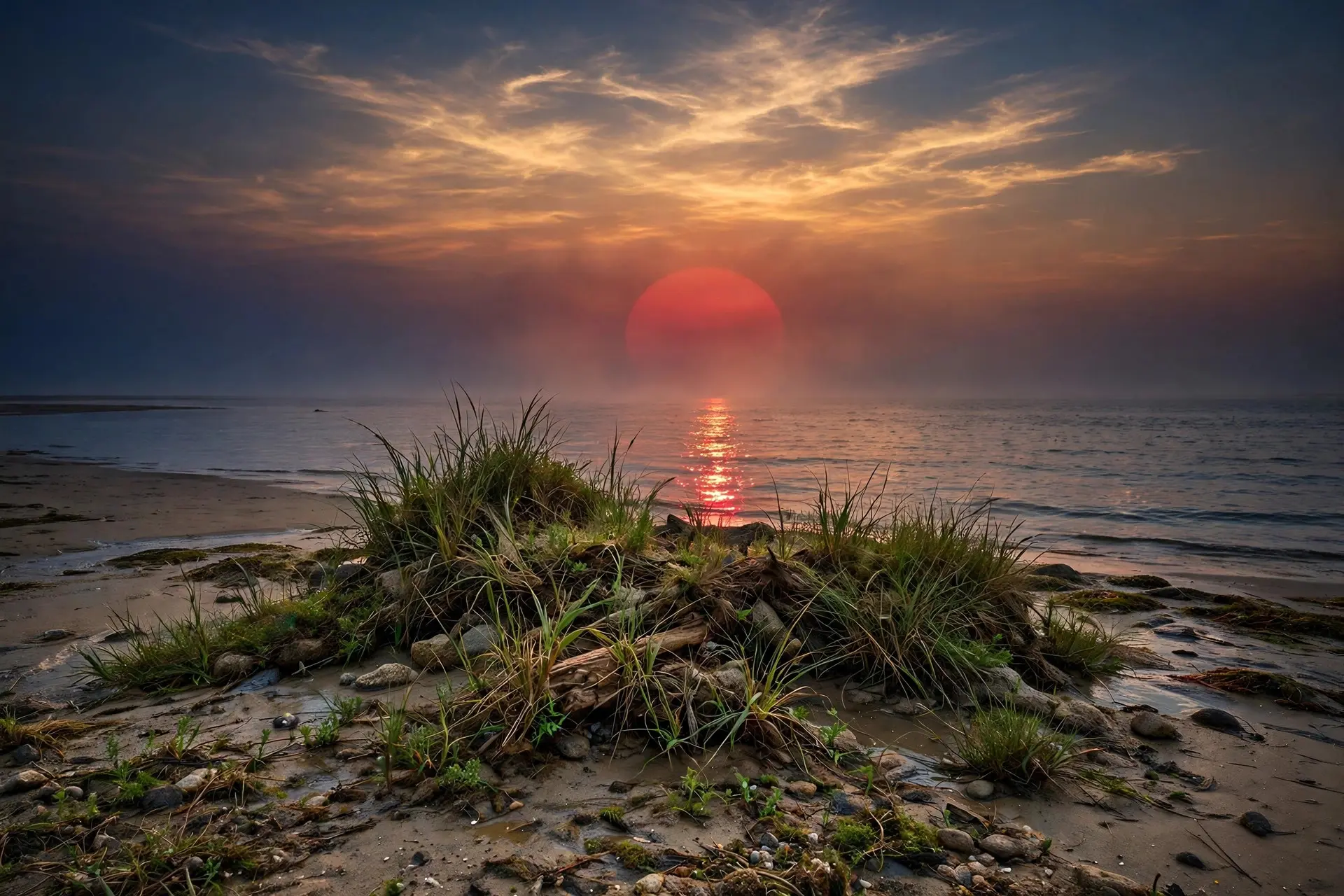
The sun is not changing color at all. At sunset its light crosses up to 40 times more air than at noon, and air molecules scatter blue light more than four times harder than red light, so only the reds survive the trip. Volcanic dust can even paint the whole world's sunsets red for years.
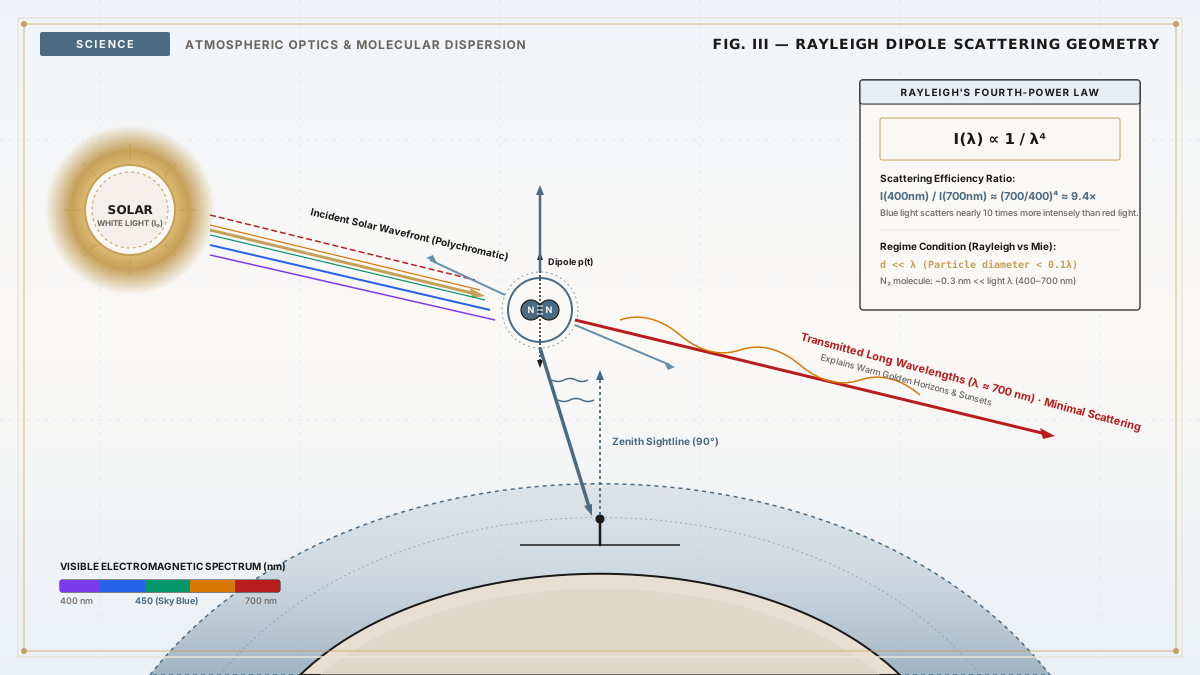
- In 1871, the British physicist John William Strutt, known as Lord Rayleigh, published the paper that solved the sky's color: scattering by tiny particles grows as the inverse fourth power of wavelength (Linda Hall Library).
- Sunset rays pass through up to 40 times as much air as rays from a high midday sun, partly because the atmosphere bends low rays into long, curved paths like a giant lens (Atmospheric Optics).
- Blue light (about 450 nanometers) is scattered more than four times as strongly as red light (about 650 nanometers) (Atmospheric Optics).
- The nitrogen and oxygen molecules doing the scattering are roughly a thousand times smaller than the wavelengths of visible light, which is exactly the size range that throws blue light aside (National Geographic).
- When Mount Pinatubo erupted during June 12 to 15, 1991, it blasted sulfur dioxide aerosols into the stratosphere, and NASA's Earth Observatory says those aerosols caused phenomena "from spectacular sunsets to global cooling" (NASA Earth Observatory).
- Ordinary pollution does not improve a sunset: NOAA meteorologist Stephen Corfidi calls that idea a myth, since large particles absorb light and scatter every wavelength equally, muddying the colors (National Geographic).
Why is the sun red at sunrise and sunset?
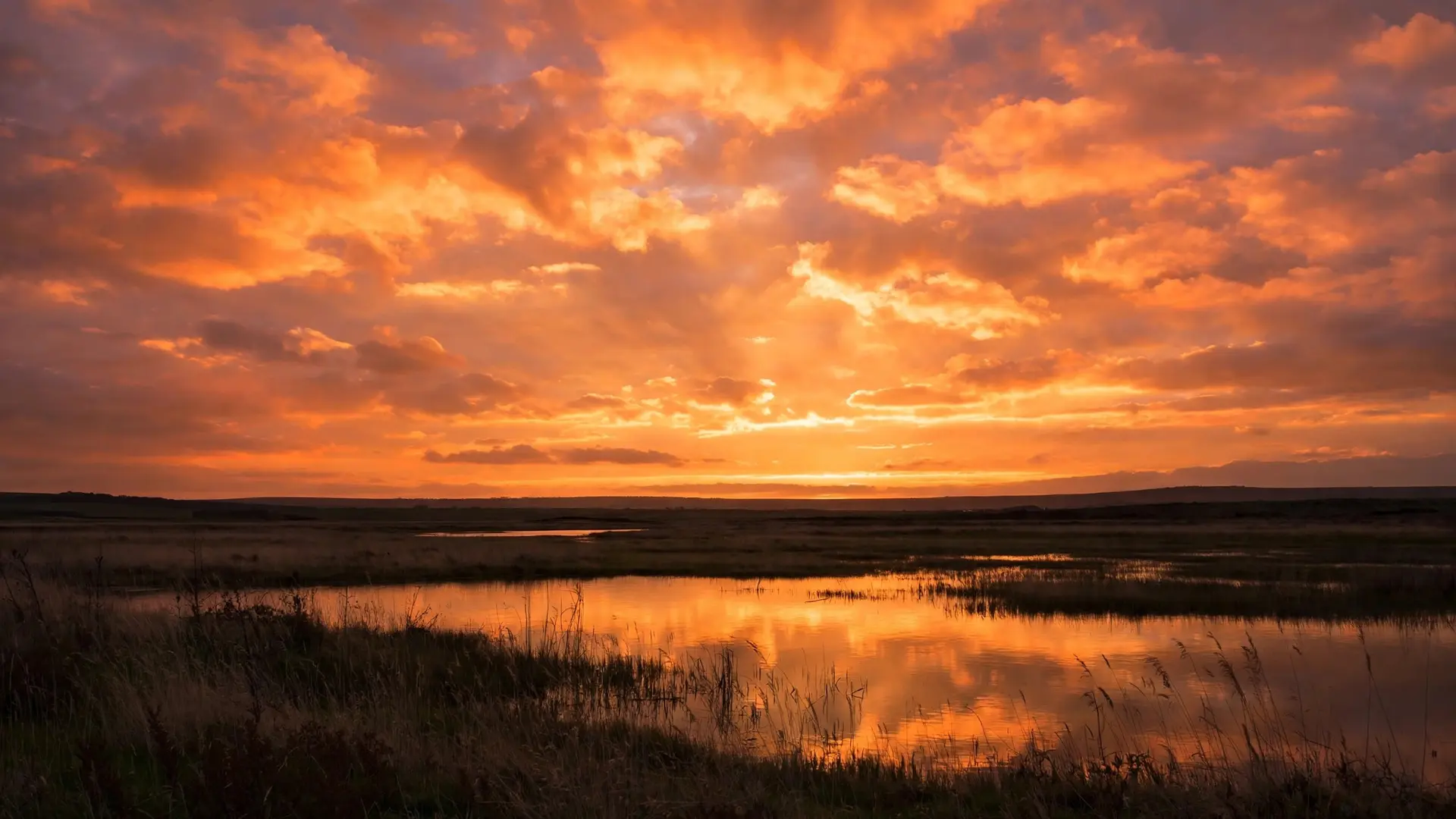
Start with the light itself. Sunlight carries every color of the visible spectrum in one beam, and it does not change on its way from the sun. What changes is the gauntlet it runs. At noon, the sun is overhead and its light takes the short route down through the least possible air. At sunrise and sunset, the sun sits near the horizon and its light arrives at a grazing angle, skimming through a far thicker slice of atmosphere. Les Cowley of Atmospheric Optics notes that refraction turns the atmosphere into a giant lens that bends low rays into long curved paths, so sunset rays can pass through up to 40 times as much air as the rays of a midday sun.
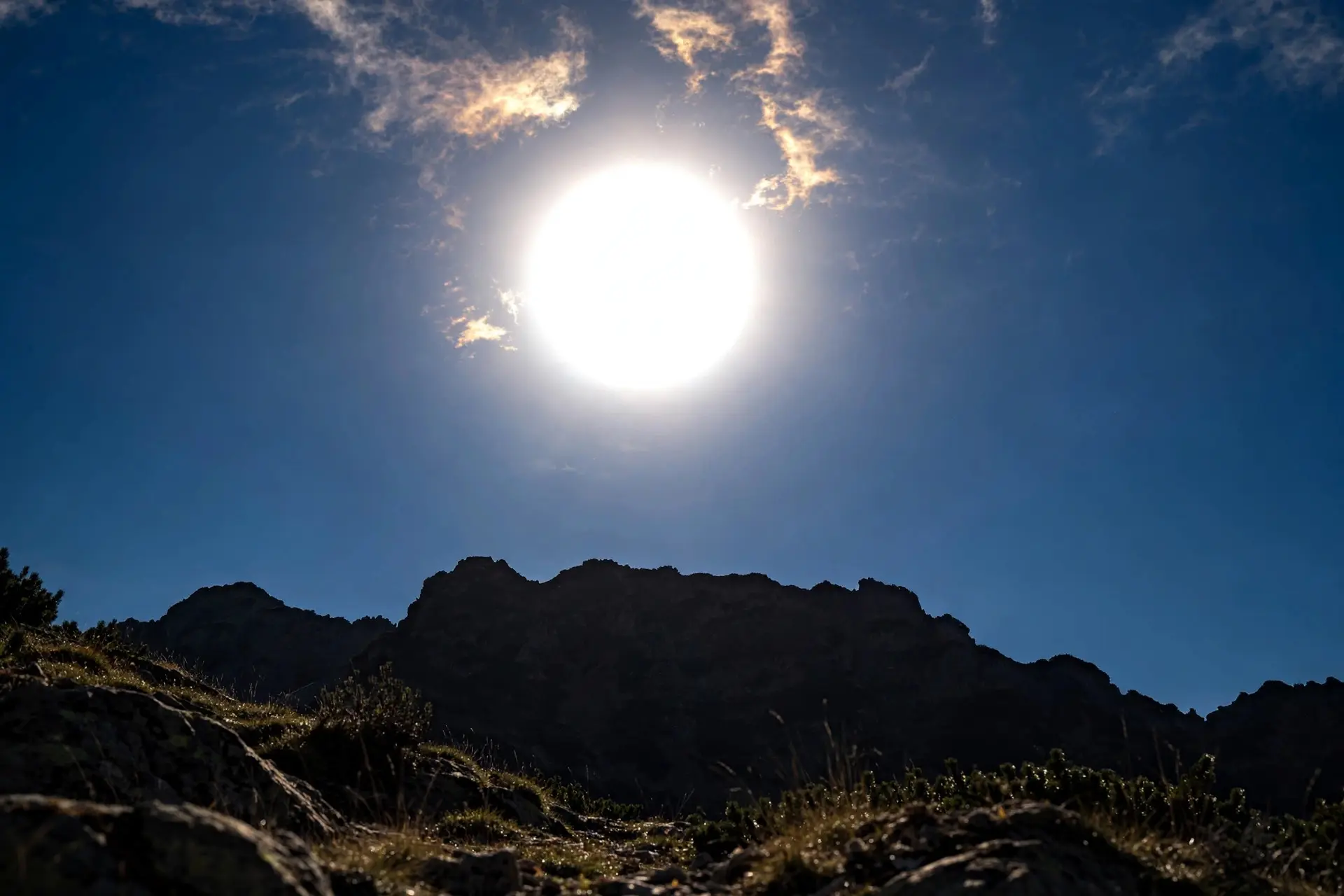
That long passage is where the color sorting happens. Air molecules, mostly nitrogen and oxygen, are far smaller than a wavelength of light. Particles that small scatter light with a strength proportional to one over the wavelength to the fourth power, which is Rayleigh's law. Blue light at around 450 nanometers is scattered more than four times as strongly as red light at around 650 nanometers. Across the short noontime path, that scattering paints the whole sky blue. Across the sunset path, the blue gets bounced out of the direct beam before the light reaches you, and the reds and oranges sail on through. Corfidi of NOAA puts it memorably: by the time a setting beam reaches the East Coast of the United States, much of its blue has already scattered out somewhere over the West Coast. What survives the journey is the part of the spectrum the air finds hardest to stop, which is why the sky can glow orange around the sun while the sun disk itself goes red.
| Midday sun | Setting sun | |
|---|---|---|
| Sun's angle | Overhead | Near the horizon |
| Air crossed | 1x (the short route down) | Up to 40x more |
| Blue light's fate | Scattered across the sky, making it blue | Nearly all bounced out of the beam |
| What reaches your eyes | Full spectrum, white-looking sun | Mostly red and orange wavelengths |
Who figured out why sunsets are red?
The answer is older than electric light in most homes. In 1871, John William Strutt, the 3rd Baron Rayleigh, published a paper titled "On the light from the sky, its polarization and colour" in the Philosophical Magazine, and it gave the first correct explanation of the blue sky, according to the Linda Hall Library's history of science collection. Rayleigh showed mathematically that particles much smaller than the wavelength of light scatter short waves far more strongly than long ones. The blue sky and the red sunset are two faces of that one equation. Rayleigh was a generalist's generalist: he later isolated the noble gas argon and won the 1904 Nobel Prize in Physics for it.
Why are some sunsets much redder than others?
The length of the path sets the baseline, but the contents of the air set the mood. Not all particles redden equally, and size decides everything. Fine particles are the real reddeners. When a volcano erupts, it can inject enormous amounts of fine dust and sulfur dioxide aerosols into the stratosphere, where they linger for years. After Mount Pinatubo's climactic eruptions of June 14 to 16, 1991, astronauts photographed distinct layers of aerosols hanging in the upper atmosphere, and NASA's Earth Observatory credits them with "spectacular sunsets to global cooling." Wildfire smoke works the same way: smoke particles are small enough to be Rayleigh scatterers, and Cowley notes that smoke looks red or brown when you see it against a bright light, but blue-white otherwise.
Large particles do the opposite. Coarse dust, haze, and the water droplets in low clouds are Mie scatterers: they dim the sun and scatter all wavelengths more or less equally, which washes the color out. That is why a hazy sunset looks pale and flat. Heavy rain can improve the next evening's show by washing the big particles out while leaving the fine ones. High, thin clouds act like a projection screen for the red light, while a thick low cloud deck blocks the whole performance.
What do people get wrong about the red sun?
The biggest misconception is that the sun itself is changing. It is not cooling down, slowing down, or dimming as it sinks. The beam that leaves the sun is the same at noon and at dusk; the atmosphere simply filters it, and your eye only ever sees what survives. The second misconception is that red sunsets mean dirty air. Corfidi is blunt about it: typical pollution in the lower atmosphere produces the opposite effect. Big pollution particles absorb light and scatter every wavelength about equally, which mutes and muddies the colors instead of intensifying them. The wall-calendar sunset needs clean air full of molecules, plus a little fine dust or smoke to deepen the red. A third surprise: the sunset you watch is a mirage. True sunset happens a minute or so before you see the sun disappear, because refraction bends the light around the curve of the Earth. You are watching light from a sun that has already set. The same bending that steals a minute from the day also stretches the light's path, which is part of why the colors get so extreme in the final moments.
Does a red sky really predict tomorrow's weather?
The old saying, "red sky at night, shepherd's delight; red sky in morning, shepherd's warning," turns out to have real physics behind it. At sunset, the most vivid reds appear when mid- and high-level clouds are lit up while the boundary layer below stays dry and clean. According to the Mount Washington Observatory, that pattern means weather and instability in the upper atmosphere are dissipating, and more stable air, with high pressure moving in, is likely on its way. A red sky at sunrise flips the forecast: the stable patch has already passed overhead, so weather is likely on the way from the east. Corfidi agrees: those spectrally pure colors tell you that a wide band of clear, dry air sits to your west, and since mid-latitude weather systems generally travel west to east, that clear air is likely to be over you tomorrow. It also explains a companion phenomenon: when the pink band of the Belt of Venus rises in the east opposite the sunset, you are seeing the Earth's shadow painted on the same fine aerosols. The short version is this: a red sun is not the sun doing anything unusual. It is the atmosphere doing its nightly sorting job, pulling the rainbow apart so the reds arrive last. Watch for the green flash as the disk goes down, or the crepuscular rays fanning out when clouds break the light. How we made this article: FactSpire researched and drafted it with AI assistance and checked every fact against the sources listed above.
Frequently asked questions
Why is the sun sometimes orange instead of deep red?
The color depends on how much of the blue gets filtered out. Less air or fewer particles means only some blue is removed, so the sun looks yellow or orange. More air and more fine particles strip nearly all of it, and the sun turns deep red. That is also why the surrounding sky can glow orange while the sun disk itself looks red.
Does a red sunset mean the air is polluted?
Usually not. Rayleigh scattering works perfectly well in clean air, and NOAA meteorologist Stephen Corfidi calls the pollution theory a myth. Large particles in the lower atmosphere absorb light and scatter every wavelength equally, which mutes colors. Fine volcanic dust and wildfire smoke are the real reddeners.
Is the sun really still above the horizon when I watch it set?
No. Corfidi explains that true sunset happens a minute or so before you see the disk disappear. The atmosphere bends the light around the curve of the Earth, so what you watch is a kind of mirage of a sun that has already set.
Can a red sky at night really predict fair weather?
Often, yes, in the mid-latitudes. Spectrally pure reds at sunset mean a wide band of clear, dry air sits to your west, and weather systems generally move west to east, so that clear air arrives the next day. A red morning sky means the clear band already passed.
Sources
- Sunsets, Atmospheric Optics
- Sunsets, Scattering, and Similes, NASA Blueshift
- Astronauts Photograph Mount Pinatubo, NASA Earth Observatory
- Lord Rayleigh, Linda Hall Library
- The Science of Sunsets, Mount Washington Observatory
- Red Sky at Night: The Science of Sunsets, National Geographic