What Is a Circumhorizontal Arc, the So-Called Fire Rainbow?
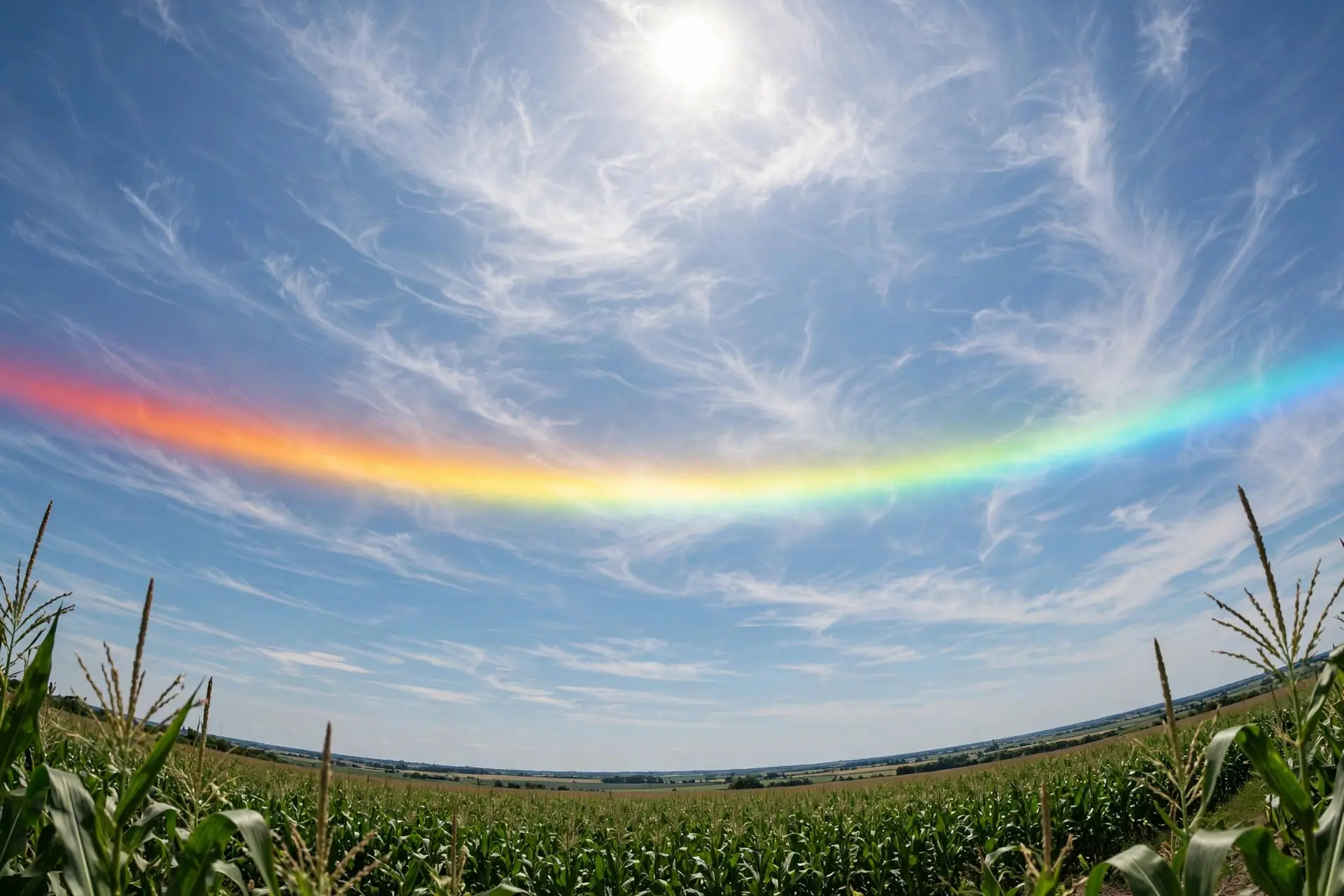
A circumhorizontal arc is a band of spectral color made by ice crystals in high cirrus, not rain — and it only appears when the sun climbs past 58 degrees.
Key takeaways
- A circumhorizontal arc is an ice-crystal halo, not a rainbow: sunlight refracts through flat hexagonal plate crystals in high cirrus.
- It only forms when the sun is at least 58 degrees above the horizon; below that, total internal reflection traps the ray inside the crystal.
- The band sits about 46 degrees below the sun, parallel to the horizon, with red on top and violet at the bottom.
- At latitudes of 55 degrees or more the sun never gets high enough, so northern Europe can never see one.
- The 'fire rainbow' nickname came from a 2006 journalist's description of clouds that looked 'afire with color.'
A circumhorizontal arc is a band of spectral color made by sunlight passing through plate-shaped ice crystals in high cirrus clouds. It is not a rainbow and has nothing to do with fire. The surprise: it can only form when the sun climbs past 58 degrees above the horizon, which is why much of Europe can never see one.
- The sun must stand at least 58 degrees above the horizon (57.8 degrees, to be exact). Below that angle, the incoming ray reflects totally inside the crystal instead of passing through, so no arc can form. (Hong Kong Observatory)
- The arc hangs about 46 degrees below the sun as a flat band parallel to the horizon, with red along the top edge and violet along the bottom. (Sky Lights)
- The colors reach peak intensity when the sun climbs to roughly 68 degrees. (Hong Kong Observatory)
- At latitudes of 55 degrees or higher, including most of northern Europe, the sun never reaches 58 degrees, so the phenomenon is geometrically impossible there. (Hong Kong Observatory)
- The nickname "fire rainbow" was coined by a Washington journalist in 2006 after clouds looked "afire with color" over Spokane; scientists dislike the name because it involves neither fire nor rainbows. (People's Daily Online, Fox Weather)
- In most of the United States, one appears about five times a year in the right season, which makes it regularly seen but rarely noticed. (Cloud Appreciation Society)
What is a circumhorizontal arc, and why is it called a fire rainbow?
A circumhorizontal arc looks like someone ironed a rainbow flat and laid it across the sky: a long band of spectral color running parallel to the horizon, floating well below the sun in a field of thin cirrus. It belongs to the halo family of ice-crystal optics, and meteorologists are blunt about the nickname. A circumhorizontal arc is not a rainbow at all. If you want the wider family portrait, see our guide to halos and sun dogs. The "fire rainbow" label is young. It was coined in 2006 by a Washington journalist who watched cirrus clouds light up like flames during a sighting in Spokane, and the name stuck in news coverage even though it misleads twice over: no fire, no rainbow. NCAR scientist Michael Kavulich has noted that researchers dislike the nickname for exactly that reason.
How do ice crystals paint a band across the sky?
The ingredients are high cirrus clouds and tiny hexagonal plate ice crystals drifting with their flat faces horizontal. Sunlight enters one of each crystal's vertical side faces, bends, and exits through the flat bottom face. The two faces sit at 90 degrees to each other, and that right-angle path splits white light into pure spectral color. Red light bends the least, so red lands on the top edge of the band, while violet bends the most and lands on the bottom. Here is the strict part. The geometry only works when the sun stands at least 58 degrees above the horizon, 57.8 degrees to be exact. At lower sun angles the incoming ray strikes the crystal's side face too obliquely and reflects totally inside the crystal instead of passing through, so no arc can form. That is why circumhorizontal arcs are strictly a midday phenomenon. Color is richest when the sun climbs to about 68 degrees.
How does it differ from a rainbow or a circumzenithal arc?
The arc most often confused with it is the circumzenithal arc, the so-called "upside-down rainbow." The two use the same crystals but mirror-image ray paths, as the comparison shows. True rainbows are a different machine entirely; our explainer on the physics of rainbows takes that one apart.
| Circumhorizontal arc | Circumzenithal arc | |
|---|---|---|
| Common nickname | "fire rainbow" | "upside-down rainbow" |
| Ray path through the crystal | enters a vertical side face, exits the flat bottom face | enters the flat top face, exits a side face |
| Where it sits | below the sun, about 46 degrees away, parallel to the horizon | above the sun, curving around the zenith |
| Color order | red on top, violet at the bottom | violet on top, red at the bottom |
| If reversed color sequences intrigue you, they happen in rainbows too: see why double rainbows reverse colors. |
When and where can you see one?
Look up near midday in summer, remembering that summer means June through August in the Northern Hemisphere and December through February south of the equator. In the US South the sun clears 58 degrees roughly from March through September; around Seattle, Detroit or Boston the window shrinks to about six weeks centered on the summer solstice, and on marginal days the arc may only flash into view right at solar noon. At latitudes of 55 degrees or higher, including most of northern Europe, the sun never gets high enough, so the display is impossible there. Where it can appear, it is not all that rare. Atmospheric-optics researcher Les Cowley estimates that most of the United States sees one about five times a year. The catch is the cloud: you need thin cirrus or cirrostratus stocked with plate crystals. Polarized sunglasses deepen the colors noticeably, and NASA's Astronomy Picture of the Day notes that a striking 2009 photograph of an arc over Ohio was taken through a polarized lens. After dark, the Moon gets its own version of the trick: the moonbow.
What do people get wrong about fire rainbows?
First, the category. It is not a rainbow but a member of the halo family, built from ice-crystal refraction with no rain required. Second, the fire. Nothing burns; the name only describes how sunlit cirrus can look flame-like. Third, the rarity. In the right latitude and season it is a routine summer sight, about five times a year across much of the United States, so the wonder is how rarely people notice it rather than how rarely it occurs. Fourth, the timing. Sunset seekers will miss it. This is a midday show, the photographic negative of rainbow weather. A circumhorizontal arc is geometry made visible: plate crystals, a high sun and a 90-degree bend of light. If you live below 55 degrees latitude, the cheapest ticket is a summer midday and a patch of thin cirrus, plus polarized sunglasses if you want the colors at full strength. How we made this article: FactSpire researched and drafted it with AI assistance and checked every fact against the sources listed above.
Frequently asked questions
Why is it called a fire rainbow if there is no fire?
The nickname dates to 2006, when a Washington journalist watched sunlit cirrus blaze like flames over Spokane and the label stuck in news coverage. Scientists dislike it because the display involves neither fire nor rainbows: it is pure ice-crystal optics. The formal name, circumhorizontal arc, simply describes a band of color running parallel to the horizon.
Can you see a circumhorizontal arc at sunrise or sunset?
No. The sun must stand at least 58 degrees above the horizon, which only happens near midday in the warmer months, the opposite schedule from true rainbows, which need a low sun behind the observer. If you want to catch one, look up around solar noon on a summer day with thin cirrus overhead.
How is a circumhorizontal arc different from a circumzenithal arc?
They use the same hexagonal plate crystals but opposite ray paths. In a circumhorizontal arc, light enters a side face and exits the bottom face, forming a band below the sun with red on top. In a circumzenithal arc, light enters the top face and exits a side face, curving around the zenith with the colors reversed.
Do I need special equipment to see one?
No equipment is needed, just timing and the right cloud: check that the sun is high on a summer midday and look for thin cirrus. Polarized sunglasses will deepen the colors noticeably. NASA's Astronomy Picture of the Day notes that a striking 2009 photograph of an arc over Ohio was taken through a polarized lens.
Sources
- Circumhorizontal Arc, Hong Kong Observatory
- APOD: 2019 May 19 - A Circumhorizontal Arc Over Ohio, NASA Science
- How ice crystals can turn ordinary clouds into a brilliant display of rainbow colors, Fox Weather
- The Summertime Halo (July 08), Cloud Appreciation Society
- Circumzenithal arc, UK Met Office
- Circumhorizontal Arcs – SKY LIGHTS, Sky Lights
- What Are Fire Rainbows? What Causes Fire Rainbows?, Science ABC
- Breathtaking photographs capture rare 'fire rainbow' phenomenon, People's Daily Online
- Circumhorizontal Arcs: A Visual Spectacle in the Sky, GreenTourism