Why Do Double Rainbows Reverse Their Colors?
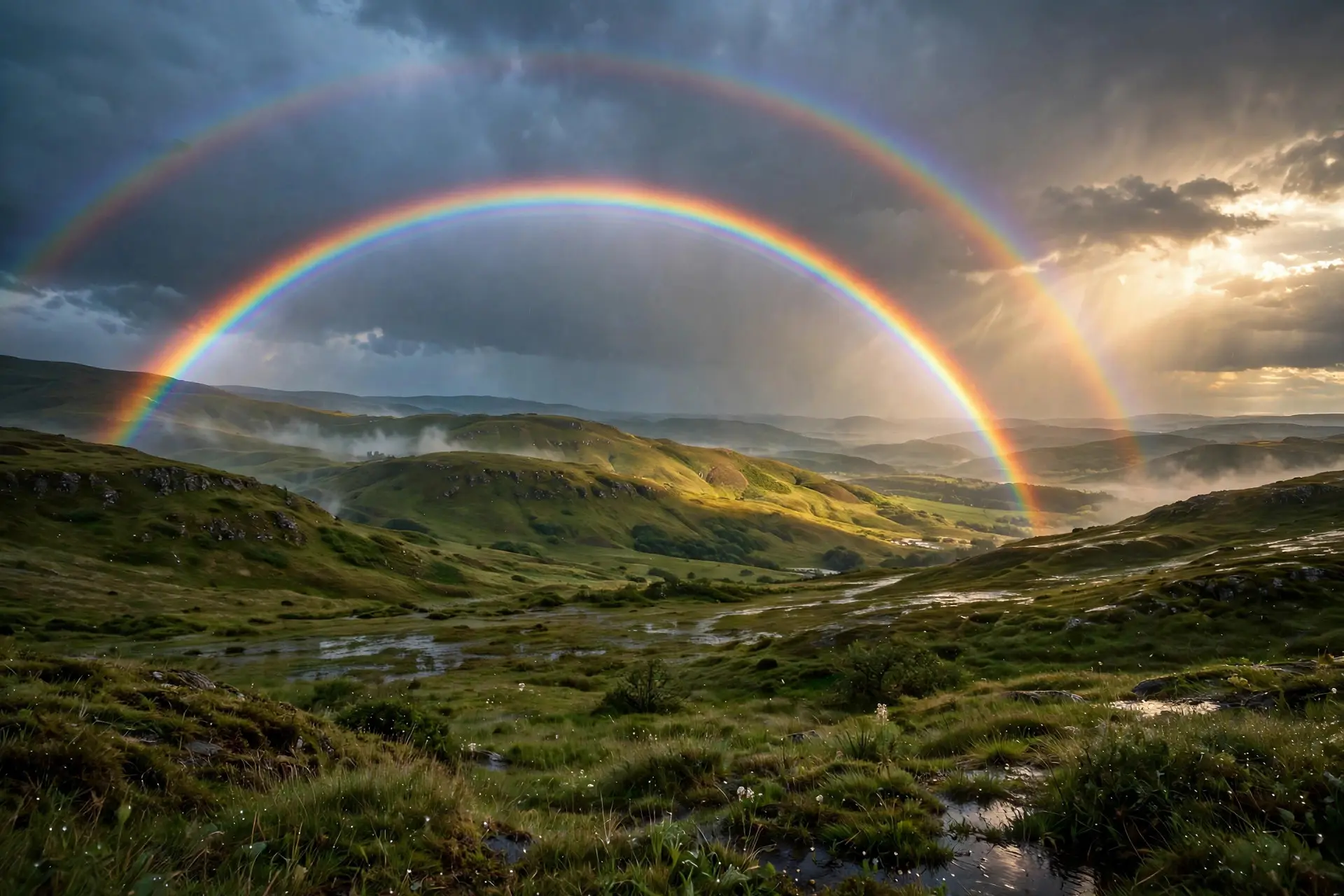
A double rainbow's outer bow runs its colors backward: violet outside, red inside. The flip comes from a second bounce of sunlight inside each raindrop.
Key takeaways
- A secondary rainbow forms when sunlight reflects twice inside a raindrop instead of once, and exits at a steeper angle of about 50 degrees.
- The secondary bow's colors run opposite to the primary's: violet on the outside, red on the inside, closest to the primary bow.
- The reversal comes from the secondary bow's different exit geometry, not from the extra bounce alone.
- The outer bow is fainter and nearly twice as wide because light escapes at each reflection and spreads over more sky.
- The dark strip between the two bows, Alexander's band, is sky that neither bow's light reaches.
Look closely at a double rainbow and something odd jumps out. The bright inner bow runs red on top and violet below, as rainbows always do — but the fainter outer bow runs the other way, violet on the outside and red on the inside. The second bow is not a copy of the first. It is light that took a longer, stranger route through the rain, and that route is what flips the colors.
What makes the second bow?
Every rainbow begins the same way: sunlight enters a raindrop, bends as it crosses into the water, and splits into its spectrum because different colors bend by different amounts. This spreading of white light into colors is called dispersion. Inside the drop, the light bounces off the back wall, then bends again as it leaves. That single-bounce path creates the primary rainbow, with its light reaching your eye at roughly 42 degrees from the direction opposite the sun. But not all the light escapes after one bounce. A portion of each ray stays inside the drop and reflects a second time before finally exiting. That twice-reflected light follows a different path out of the droplet and reaches your eye at a steeper angle, around 50 degrees. Because the angle is larger, this secondary bow appears higher and farther out in the sky, roughly 10 degrees beyond the primary bow. In principle, every rainbow has this companion: the secondary bow is always being formed, but because it is much fainter, it often fades into the background before you notice it. The conditions matter. You need the sun low behind you, rain falling ahead of you, and a bright sun against a dark, stormy backdrop so the faint outer bow has enough contrast to show. That is why double rainbows tend to appear in the early morning or late afternoon, when the sun is low and the sky behind the rain is still dark.
Why does the extra bounce flip the colors?
Here the popular explanation needs a small correction. It is tempting to say the second reflection acts like a mirror and simply turns the spectrum upside down — but the American Meteorological Society's glossary warns that this is not quite right. The extra bounce by itself is not what reverses the colors. The reversal comes from the geometry of the whole path. Think of it this way: a rainbow is not a painted object hanging in the sky. It is a pattern made by millions of drops, and you see only one color from each drop — the color whose exit angle happens to point exactly at your eye. For the primary bow, the drops sending red light to your eye sit higher in the sky than the drops sending violet light, so red ends up on top. For the secondary bow, the twice-bounced light leaves the drops at a different set of angles, and the arrangement inverts: the drops sending violet light to your eye now sit higher than the drops sending red. The result is a bow that reads backward — violet outside, red inside — with the two red edges facing each other across the gap. The numbers confirm the picture. The World Meteorological Organization's cloud atlas gives the secondary bow's red edge at a radius of 51 degrees and its violet edge at 54 degrees, while the primary bow sits near 42 degrees. In other words, the secondary bow is not just reversed but also wider, its colors spread across a broader sweep of sky. And because the spectrum is continuous rather than a set of painted stripes, the reversal is a smooth gradient, not seven neat bands flipping like tiles.
Why is the outer bow fainter and wider?
Faintness is the price of the longer journey. At every reflection inside a raindrop, some light escapes the drop instead of continuing on. The twice-reflected rays therefore arrive at your eye carrying less energy than the once-reflected rays, and the secondary bow looks washed out and pastel by comparison. The Met Office puts it plainly: more light escapes from two reflections than from one. Width adds to the dimming. The secondary bow is spread over nearly twice as much sky as the primary bow, so its already weakened light is thinned across a larger area. That is also why the outer bow can be hard to photograph: a camera set to capture the vivid primary bow often renders the secondary as little more than a pale ghost. Given a dark background and a strong sun, though, the human eye picks it out readily — which is why double rainbows feel more common to watchers than to photographers.
The same optics explain other rainbow relatives. A moonbow works by the same bending and bouncing, only with moonlight instead of sunlight, and the full story of how a single bow forms is told in the physics of rainbows. Halos, sun dogs and other sky optics, covered in our guide to halos and sun dogs, are different tricks of ice crystals rather than raindrops — a reminder of how many ways light can be rearranged overhead.
What is the dark band between the bows?
Between the two arcs lies a strip of sky that looks noticeably darker than the sky on either side. This is Alexander's band, named for Alexander of Aphrodisias, the ancient Greek commentator who first described it. It is not a shadow cast by anything. It is an absence: the geometry of refraction and reflection concentrates each bow's light into its own narrow band, and the light that would have filled the space between them simply goes elsewhere. The sky inside the primary bow is brightened by scattered light, and the sky beyond the secondary bow is lit normally, but the strip between the two receives light from neither bow — so it stands out as a dark belt. Alexander's band is a handy test when you are unsure whether you are seeing a true double rainbow. If the gap between the arcs is darker than the surrounding sky, you are looking at a genuine secondary bow, not a camera artifact or a trick of cloud. On rare occasions, patient watchers under perfect conditions can even glimpse a third bow, but by then the light has bounced so many times, and sits so close to the sun's glare, that it is almost impossible to pick out. So the reversed colors are not a mystery or a malfunction. They are a signature: proof that the light reaching your eye from the outer bow bounced twice inside the rain instead of once, arriving from different drops at a steeper angle, and painting the spectrum in reverse as a consequence. The next time you see one, find the two red edges facing each other across the dark band — that quiet symmetry is the optics of the sky, working exactly as it should.
Frequently asked questions
Are the colors of a double rainbow really reversed?
Yes. In the primary bow red sits on the outer edge and violet on the inner edge. In the secondary bow the order flips: violet is on the outside and red on the inside, so the two red edges face each other across the gap between the bows.
Why is the second rainbow always fainter?
Each time light reflects inside a raindrop, some of it escapes instead of bouncing onward, so the twice-reflected light is weaker. The secondary bow is also spread over nearly twice as much sky as the primary, which thins its light further.
What is the dark band between the two rainbows?
It is called Alexander's band, after Alexander of Aphrodisias, who described it in antiquity. Light is concentrated into the two bows themselves, leaving the strip of sky between them comparatively unlit and noticeably darker.
Can you see more than two rainbows at once?
Very rarely. Light can reflect three or more times inside a raindrop, but by then so little light remains, and the extra bows sit so close to the sun's glare, that they are extremely difficult to spot in ordinary conditions.
Sources
- How Do Rainbows Form?, National Weather Service
- MetLink - Royal Meteorological Society Rainbows, MetLink, Royal Meteorological Society
- Secondary bow, International Cloud Atlas, World Meteorological Organization
- secondary rainbow, Glossary of Meteorology, American Meteorological Society