The Danakil Depression looks like another planet because it is Earth's closest imitation of one. In this Ethiopian lowland — some of the lowest, hottest land on the planet — superheated groundwater laced with acid and dissolved minerals erupts from a magma chamber simmering just beneath the crust, painting the earth in neon yellows, greens, and oranges no familiar landscape can imitate.
The Lowest Furnace on Earth
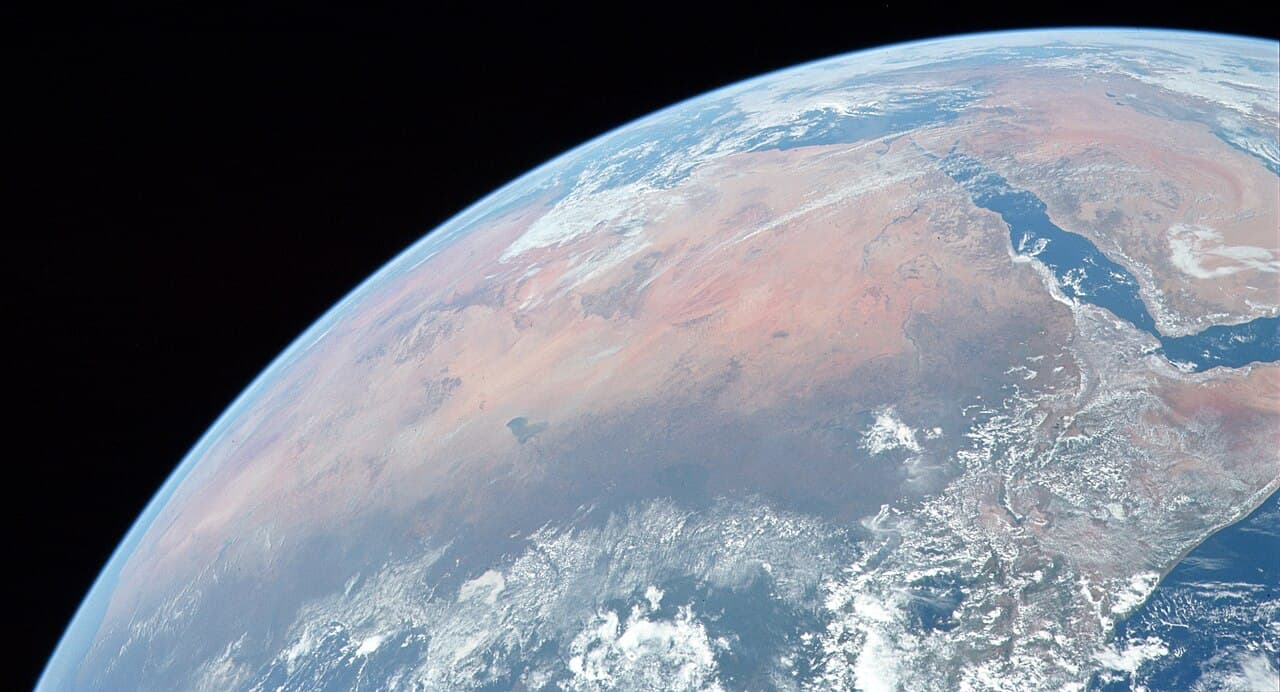
The Danakil Depression sits in the Afar Triangle of northeastern Ethiopia, near the Red Sea and the Eritrean border, and it dips more than 100 metres below sea level — deeper than Death Valley, which reaches only about 86 metres down. This makes it one of the lowest places on Earth, but elevation is only half the story. The Danakil holds the record for the highest average annual temperature of any inhabited place on the planet: roughly 35°C, measured over the years 1960 to 1966. Summer days routinely push past 50°C, annual rainfall barely reaches 100 to 200 millimetres, and whatever falls evaporates almost immediately. Unlike most deserts, the depression hardly cools at night — the heat simply stays. It is hard to believe the Red Sea once covered this entire region, yet centuries of volcanic activity and wholesale evaporation under the searing heat have left behind nothing but salt deposits and pans as far as the eye can see. Even compared with the Sahara, the Danakil feels like a different category of hot. British explorer Wilfred Thesiger called it a "land of death," and locals know it by nicknames like Devil's Kitchen and the Gateway to Hell.
Where Three Continents Are Splitting Apart
The reason the Danakil looks the way it does lies far below. The Afar Triangle is where three tectonic plates — the Arabian, Somali, and Nubian — are slowly pulling apart, tearing the crust centimetre by centimetre. This makes the depression one of only two places on Earth where you can stand on an exposed mid-ocean ridge, the other being Iceland. Tens of thousands of years ago this entire basin lay beneath the Red Sea; tectonic movement cut it off, the seawater evaporated, and what remained was one of the planet's most concentrated accumulations of salt. The process has not stopped. Geologists expect that millions of years from now, as the plates drift further apart, the Red Sea will spill into the rift and a brand-new ocean will begin dividing Africa in two — a transformation written into the rock the way the Grand Canyon writes deep time into its strata. Because the crust here is so thin and hot, the Danakil is also dotted with features you would normally only find on the seafloor: marine reefs stranded far from water, ancient shorelines etched into silt plains, and black lava flows cutting across blinding white salt.
Dallol: Painted by Acid and Salt
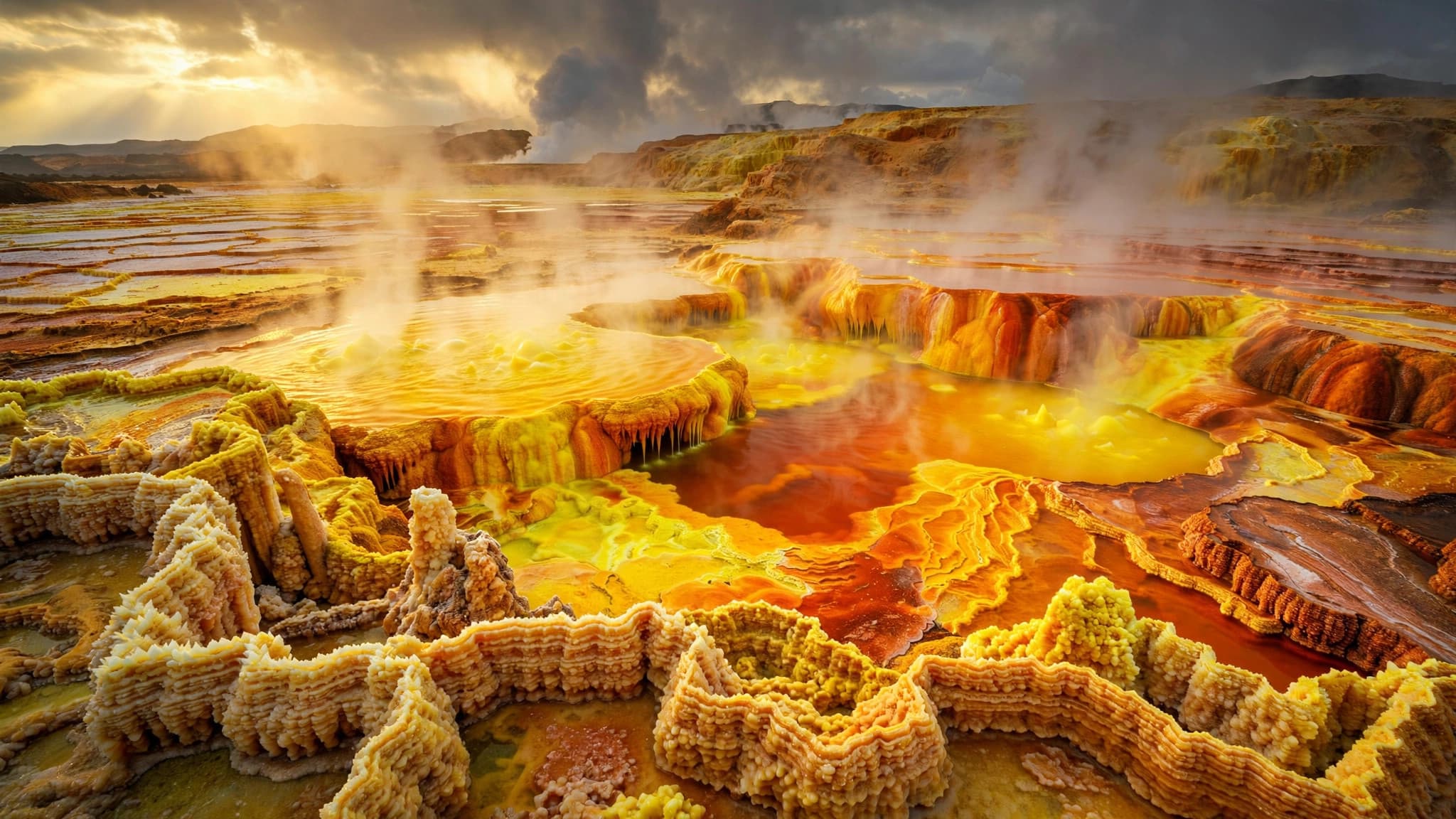
The visual signature of the Danakil is Dallol, a hydrothermal field where bubbling pools glow in neon yellow, green, orange, and red, fringed by salt pillars and chimneys in shapes variously described as mushroom-like, artichoke-like, and flower-like. The mechanism is straightforward and violent: magma heating groundwater from below, which dissolves salts and minerals on its way up, then erupts and evaporates, precipitating mineral crusts in vivid bands. The springs here discharge water with a pH below zero — measurements as low as -1.7 have been recorded, more acidic than battery acid. Remarkably, Dallol's colours are pure chemistry, not biology. Sulfate minerals produce the yellows and whites, iron oxides create the oranges and reds, and copper salts tint the water green. The air itself is part of the spectacle: toxic sulphur and chlorine vapours curl from holes in the ground, and boiling water spurts from rocks where rivers have long since died.
Life at the Edge — Or Past It
That combination — extreme heat, extreme salt, extreme acid — has turned Dallol into a natural laboratory for one of science's biggest questions: where does life stop being possible? In 2019, an international team led by astrobiologist Felipe Gómez reported ultra-small archaea, related to the order Nanohaloarchaea, embedded in salt chimneys sampled at a pH of 0.25 and temperatures near 89°C, publishing in Scientific Reports. Later that same year, a French-Spanish team led by Purificación López-García published the opposite conclusion in Nature Ecology & Evolution: after analysing many more samples with stricter controls, they found no microbial life in the hyperacid, hypersaline pools themselves — suggesting the combination of heat, magnesium-rich brines, and sub-zero pH crosses every survival threshold at once. The debate continues, but either outcome matters for space science: early Mars may have hosted similar volcanic hydrothermal systems with acidic sulfate deposits, and what Dallol teaches about habitability's limits shapes the search for ancient life on the red planet. NASA-linked astrobiologists treat Dallol as a planetary field analog — an environment on Earth resembling what Mars may have looked like billions of years ago — and NASA's Spirit rover explored Gusev Crater on Mars, a site with similar geochemical signatures. The wider Afar adds a poignant contrast — this is also the region where the 3.2-million-year-old hominin fossil "Lucy" was discovered in 1974, a cradle of humanity sitting beside a landscape that may be too extreme even for microbes.
The People Who Mine the Furnace
Yet people do live and work here. For centuries, the Afar people have mined salt by hand at Lake Karum, carving rectangular slabs — "tiles" — from the lakebed with simple tools. Each day, roughly 2,000 camels and 1,000 donkeys pass through the region, hauling the heavy tiles across the plains toward the town of Berahile, where they are sold across Ethiopia — many to farmers who supply their livestock with essential minerals. Salt here was once used as currency, and it is still called "white gold." The miners begin work before sunrise to outrun the worst of the heat, when temperatures still hover near 48°C, and make a four-day round trek for each load. It is a tradition that has continued almost unchanged into the modern era — a reminder that saline basins and the people who depend on them carry histories worth heeding, something the story of the disappearing Aral Sea tells from a very different angle.
The Danakil Depression earns its alien reputation honestly — it is the rare place where Earth's interior processes show themselves without any filter. Three splitting plates, a future ocean, chemistry that tests the very definition of habitability, and humans who built a living from it anyway. If you want to see what this planet looks like with its skin off, start here.