Hannibal's Impossible Crossing of the Alps
In 218 BC Hannibal Barca led 37 war elephants and tens of thousands of troops over the Alps into Italy, sidestepping Rome's navy in a legendary campaign.
Key takeaways
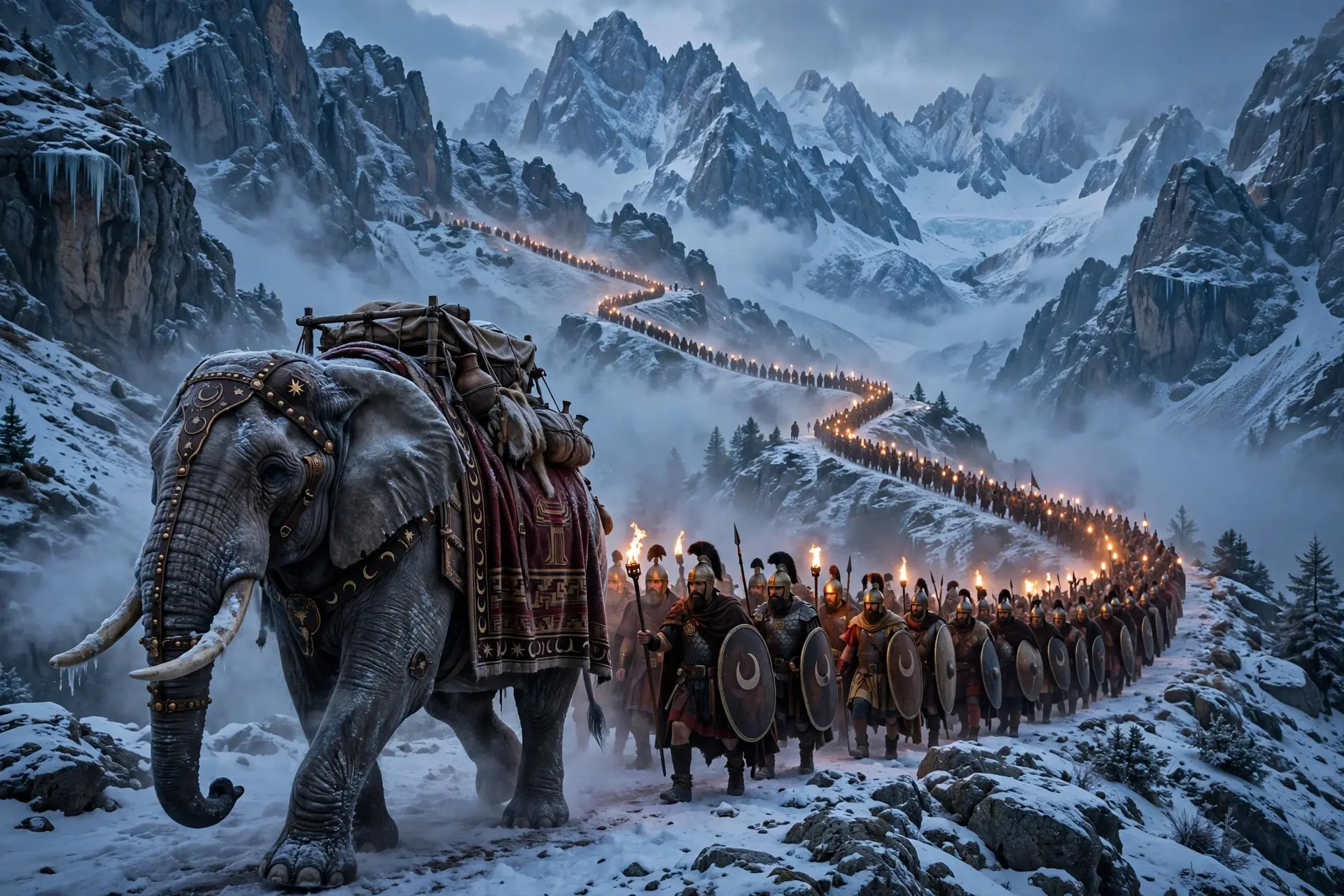
- In 218 BC, Hannibal Barca led his army over the Alps in about 15 days, bringing roughly 37 war elephants into Italy and sidestepping Rome's naval dominance.
- Polybius wrote that Hannibal crossed the Rhone with some 46,000 men, meaning the Alpine crossing crowned a forced march of nearly 1,000 kilometers from Spain.
- Most of the 37 elephants survived the mountains; they died months later in Italy's winter cold after the Battle of Trebia, leaving Hannibal with one.
- The exact pass remains debated, but modern research points to the Col de la Traversette, where animal dung dated to about 200 BC was found near the summit.
In the autumn of 218 BC, a Carthaginian general in his late twenties did something no army in recorded history had ever attempted: he marched tens of thousands of soldiers, thousands of horses and mules, and 37 war elephants over the Alps and into the heart of Roman territory. Hannibal Barca didn't cross the mountains because it was the easy route. He crossed them because it was the only route Rome wasn't watching. The popular image — elephants plunging through blizzards, an army frozen into the passes — gets the drama right but the details wrong in an important way. The astonishing thing about Hannibal's crossing isn't that the mountains nearly killed his army. It's how deliberately he had prepared for them, and what modern science is now revealing about the one thing even his own historians couldn't agree on: which way he went.
Why Did Hannibal Have to Cross the Alps at All?
Hannibal's plan grew out of a simple, brutal strategic fact: Rome owned the sea. During the Second Punic War, the Roman navy dominated the western Mediterranean, which meant Carthage couldn't land an invasion force on Italy's coast. As Cardiff University ancient historian Eve MacDonald has put it, Hannibal couldn't move his forces to Italy by sea because he lacked the allied ports to support a maritime expedition. So he went around — by land, the entire way from his base at New Carthage in Spain. That meant roughly 1,000 kilometers of forced march through hostile territory before the Alps even began: across the Pyrenees, through southern Gaul, and across the Rhone river, which he crossed under attack, ferrying his elephants on rafts. The Alpine crossing was not a desperate improvisation. It was the final, most extreme stage of a three-month logistical operation. There was a political motive too. By entering Italy from the north, Hannibal positioned himself to recruit the Gallic tribes of the Po Valley, who were already hostile to Rome. The Alps were a wall — and Hannibal decided to use them as a door.
How Big Was the Army That Went Up the Mountain?
Ancient numbers are always suspect, but Polybius — the Greek historian who wrote our most detailed surviving account — recorded that Hannibal crossed the Rhone with about 46,000 men and 37 war elephants, and a 2026 analysis published in the Proceedings of the National Academy of Sciences used those figures to model the energy costs of the various candidate routes.
Some accounts give larger figures for the start of the expedition: HISTORY's summary of the campaign cites 70,000 men and 20,000 horses setting out from Spain. What isn't disputed is the cost. The whole campaign up the passes took about two months, with the Alpine crossing itself consuming roughly 15 to 16 days — Livy gives 16, the PNAS researchers use 15. By the time the Carthaginians descended into the Po Valley, Hannibal had lost upwards of 20,000 men. The losses weren't primarily from snow. Mountain tribes — the Allobroges and others — harassed the column at narrow defiles, rolling rocks and attacking from above. On the descent, a landslide blocked the path entirely, and Hannibal's engineers had to cut a new road through the rock before the elephants could pass. Every stage of the journey demanded preparation, scouting, and improvisation.
Which Pass Did He Actually Take?
Here the story gets genuinely mysterious, because even Polybius — who claimed to have interviewed survivors and retraced parts of the route — left the geography ambiguous enough to fuel 2,200 years of argument. The candidates are all passes in the western Alps near the French-Italian border. One leading theory favors the Col du Clapier, reached via Grenoble and Susa. Another favors the Col de la Traversette, a pass at 9,669 feet southeast of Grenoble — higher, narrower, and more forbidding than the alternatives. Modern science has begun to tilt the scales toward the Traversette. In 2016, a team led by York University's Bill Mahaney reported finding a mass deposit of animal dung — likely from horses — in a mire near the pass, which carbon-isotope analysis dated to about 200 BC, almost exactly Hannibal's era. The 2026 PNAS study, which computed the cumulative energy cost of marching men, horses, and elephants along each candidate route, also favored the Traversette, offering possible insight into Hannibal's own logistical reasoning. A harder route might have been chosen deliberately, to avoid hostile tribes guarding the easier ones. That a microbiologist's horse manure analysis could resolve a two-millennium-old historical debate is exactly the kind of twist this story keeps producing. For more on how lost routes and forgotten expeditions are reconstructed, see The Silk Roads' Lost Cities.
What Really Happened to the Elephants?
The famous paintings show elephants dying in Alpine blizzards. The ancient sources tell a different story — and a more interesting one. Neither Polybius nor Livy records elephants perishing on the mountain passes. They describe the animals being successfully maneuvered across the obstacles, including that landslide-blocked descent. The elephants died after the crossing, in Italy. Following the Battle of Trebia in December 218 BC, Livy writes that the driving sleet and intolerable cold killed many men and baggage animals, and nearly all the elephants perished. Polybius says the same in compressed form: after Trebia, all the elephants except one died. By the time Hannibal crossed the Arno marshes the following spring, a single elephant remained. It's a reminder to read ancient sources on their own terms. The elephants were never meant to survive a campaign; they were psychological weapons — shock troops meant to terrify Roman infantry and impress potential Gallic recruits. They did that job perfectly at the Rhone and on the plains, even if Italy's winter did what the Alps could not.
Why Does the Crossing Still Matter?
Within months, Hannibal was winning some of Rome's worst defeats — the Trebia, Lake Trasimene, and Cannae, where he encircled and annihilated a vastly larger Roman army. Rome never recovered its confidence for a generation. The city's entire military doctrine changed: after Cannae, the Romans simply refused to give Hannibal a pitched battle, shadowing him under the Fabian strategy of delay until Scipio could take the war back to Africa. Hannibal ultimately lost the war — Carthage's defeat at Zama in 202 BC sealed it — but the crossing itself never stopped being studied. Napoleon, who crossed the Alps himself, is said to have admired it; every military academy still teaches it as the supreme example of doing what your enemy has ruled out as impossible. That may be the real legacy. The Alps were never Hannibal's obstacle. They were Rome's assumption — and Hannibal built his entire campaign on the oldest trick in warfare: attacking where the other side is certain you can't. For another story of an empire built on a single, unexpected strike, read about The Fall of Constantinople in 1453, and for the city Hannibal's army marched against, see The Colosseum. The crossing remains, as the PNAS researchers put it, one of the most extraordinary feats in military history — not because 37 elephants walked over a mountain, but because a 26-year-old planned it so carefully that nearly all of them walked out the other side.
Frequently asked questions
Why did Hannibal cross the Alps instead of sailing to Italy?
Rome controlled the Mediterranean, and Hannibal lacked the ports and ships for a sea invasion. Marching overland let him strike Italy from the north and rally Rome's hostile Gallic subjects to his side.
Did any of Hannibal's elephants survive the Alps?
Most of them did. Neither Polybius nor Livy records heavy elephant losses on the march itself; the beasts perished months later in Italy's winter cold following the Battle of Trebia, until only one remained.
Which pass did Hannibal actually use?
Scholars still argue, but recent evidence favors the Col de la Traversette, at about 9,669 feet. A research team found animal dung near the pass dated to roughly 200 BC, and modern energy-cost models of the march favor that route.