How Ancient Egyptians Moved 2.5-Ton Pyramid Stones
Wet sand halves the force to drag a sledge, a 2018 quarry ramp revealed a rope force-multiplier, and a foreman's diary detailed the Nile supply chain.
Key takeaways
- The Great Pyramid holds about 2.3 million stone blocks averaging 2.5 tons each, built around 2560 BC for Pharaoh Khufu.
- Physicists in Amsterdam showed that wetting desert sand lets a laden sledge glide with roughly half the pulling force, thanks to capillary bridges binding sand grains.
- A 2018 discovery at Hatnub revealed a steep ramp with post holes that acted as a rope force-multiplier, allowing crews to haul stones up slopes of 20 percent or more.
- A 4,500-year-old foreman's logbook documents Tura limestone being shipped to Giza by boat through Nile canals, about 200 blocks per month.
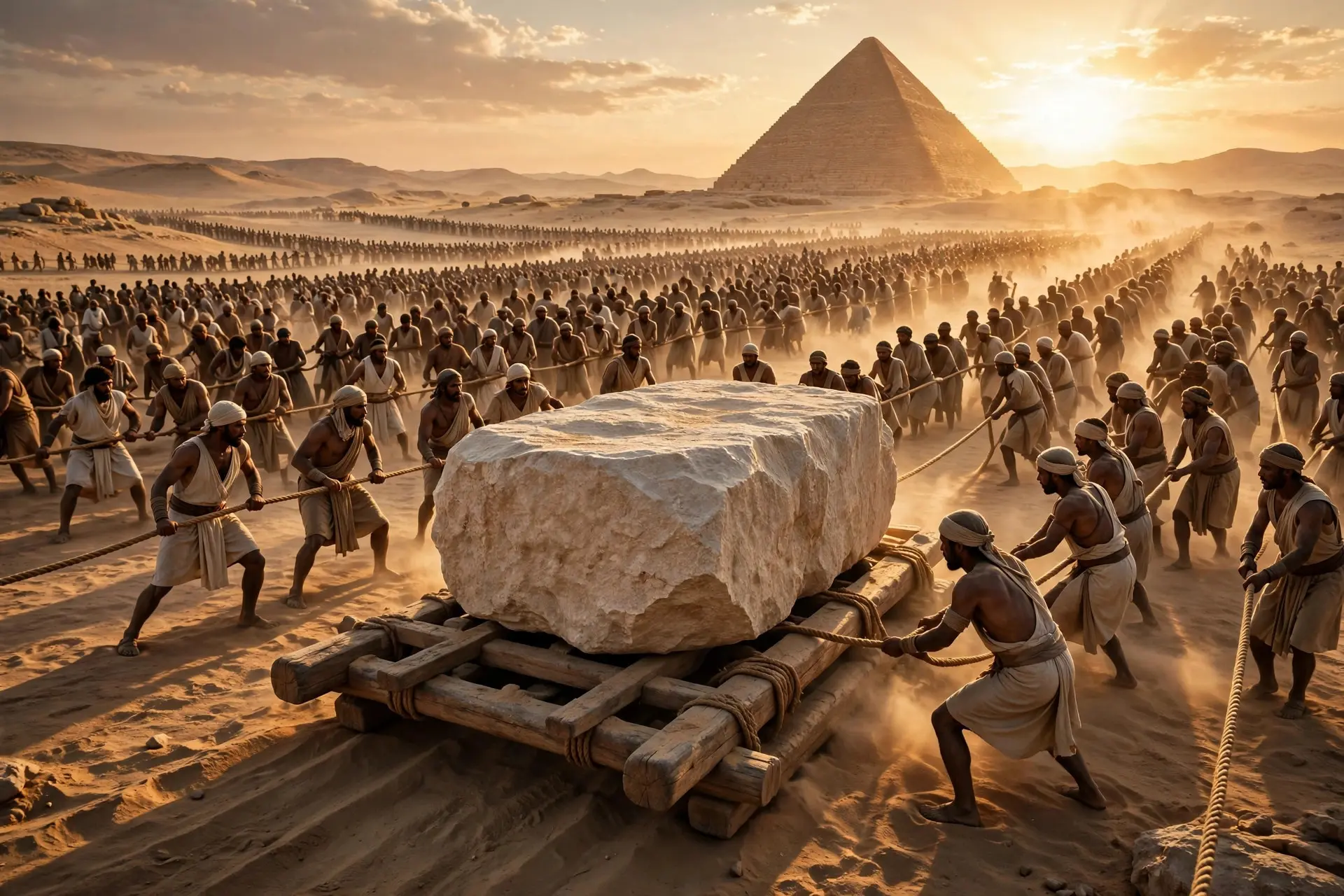
They moved them with water, rope, and an obsession with organization. The Great Pyramid of Giza contains an estimated 2.3 million stone blocks averaging 2.5 tons each, stacked some 4,500 years ago by a Bronze Age society with no engines, no pulleys, and no steel. For decades the answer was guesswork — but three modern breakthroughs, a physics experiment, a buried ramp, and a foreman's diary, have turned the mystery into a logistics story we can almost fully reconstruct.
What actually made a 2.5-ton block move?
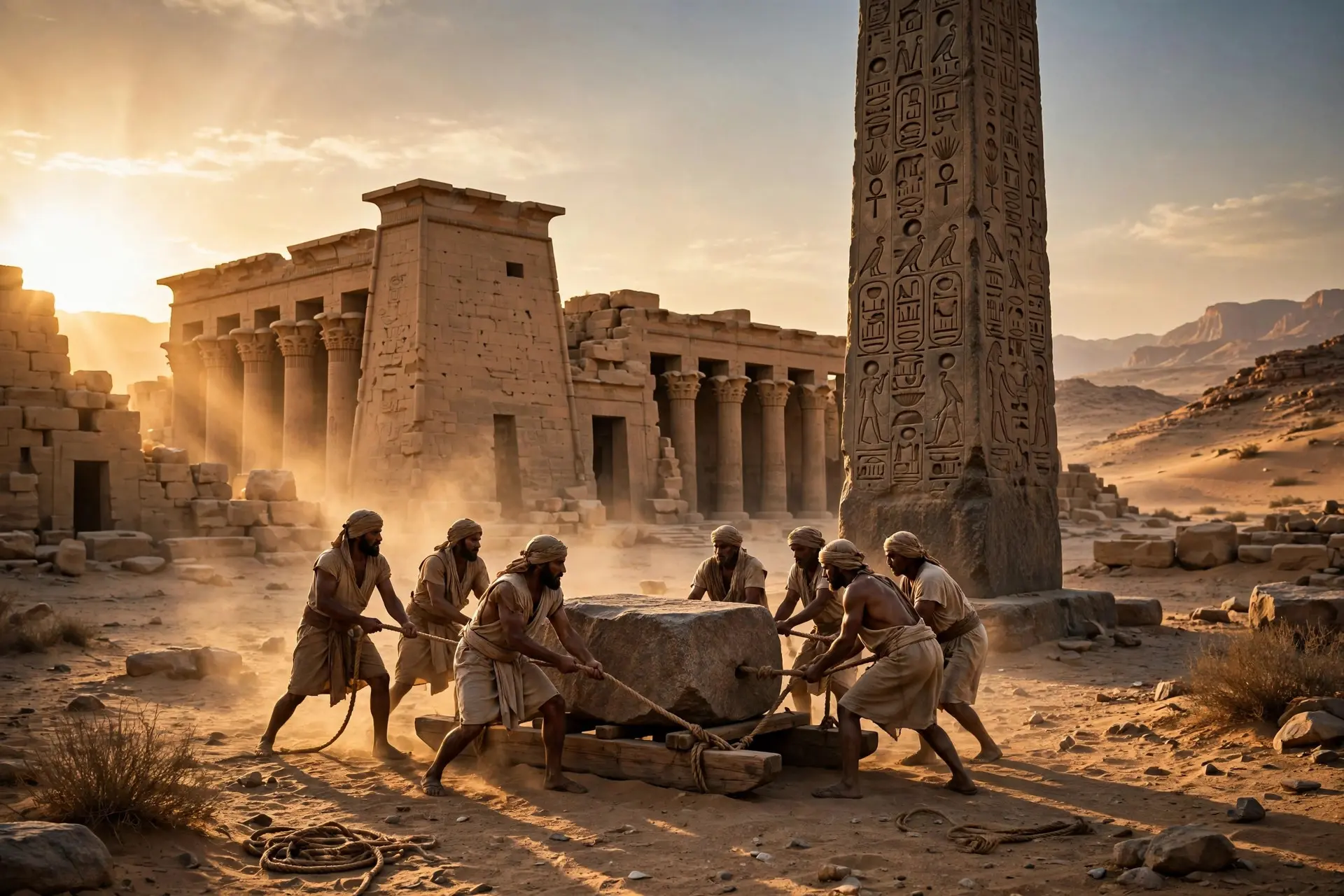
Start on flat ground. The Egyptians loaded cut stone onto wooden sledges — essentially large slabs with upturned edges — and dragged them over desert sand with ropes and manpower. On dry sand this is miserable work: the sledge digs in, and a berm of loose sand builds up in front of it, forcing the haulers to constantly clear an obstacle of their own making. The fix was almost absurdly simple, and the Egyptians appear to have known it. In 2014, physicists at the University of Amsterdam, led by Daniel Bonn, tested miniature laden sledges in trays of sand and discovered that wetting the sand in front of the sledge cut the required pulling force roughly in half. Add the right amount of water and capillary bridges — microscopic droplets binding the grains — make wet sand about twice as stiff as dry sand. Stiff sand doesn't pile up ahead of the sledge, so it glides instead of plowing. It is the same class of practical ancient engineering insight that let Romans move water across continents with nothing but gravity and stone. The kicker: the Egyptians left a hint. A wall painting in the tomb of Djehutihotep, dating to about 1900 BC, shows 172 men hauling a huge statue on a sledge — with a figure standing at the front pouring water onto the sand. For generations, Egyptologists read the water-pouring as a purely ceremonial gesture. The physics says it was an engineering technique hiding in plain sight.
How did the stones climb upward?
Flat ground is one thing; a pyramid is another. Ramps have always been the leading theory for raising blocks, but the geometry posed a problem: a ramp shallow enough to drag stones up easily would have to be enormously long, while a steep ramp seemed impossibly demanding. Then came Hatnub. In 2018, a joint mission from the French Institute for Oriental Archaeology in Cairo and the University of Liverpool uncovered a 4,500-year-old ramp system in an ancient alabaster quarry in the Eastern Desert. Its design was unlike anything seen before: a central ramp flanked by two staircases lined with numerous post holes, dating back at least to the reign of Khufu himself. The mechanics were clever. A sledge carrying a stone block was roped to the wooden posts set along the staircases, so haulers could pull from above in stages. The ropes acted as a force multiplier, making it practical to drag heavy loads up slopes of 20 percent or more — roughly double what engineers had previously thought possible. This was a working system for hauling stone out of a quarry, not the pyramid itself, but it proved that Khufu-era Egyptians had already mastered steep-slope haulage. Whatever exact ramps rose at Giza, the underlying technology — sledge, rope, mechanical advantage — was in their hands.
Where did all that stone come from, and how did it reach Giza?
The pyramid's core blocks were quarried locally on the Giza plateau, but the fine white limestone casing that once made the pyramid gleam came from Tura, across the Nile on the east bank, and the granite for the King's Chamber traveled from Aswan, more than 800 kilometers to the south. Moving stone on water is far easier than moving it on sand, and the Nile — especially during the annual flood — was ancient Egypt's great highway.
Our clearest window into this supply chain arrived in 2013, when archaeologists Pierre Tallet and Gregory Marouard excavated hundreds of papyrus fragments at the Red Sea port of Wadi al-Jarf. They are the oldest papyri ever found in Egypt — and among them was the logbook of Merer, a middle-ranking inspector who, around 2600 BC, led a team of about 40 boatmen hauling Tura limestone to Giza. Merer kept a two-column daily timetable: his crew made the Tura-to-Giza journey, through the Nile and a network of canals, in two to three days per round trip, delivering about 30 blocks of 2–3 tons each per voyage — on the order of 200 blocks a month. The granite beams, weighing up to 80 tons, were floated north on heavy wooden barges during flood season, when the river ran high and fast enough to carry them. It reads less like ancient history and more like a modern construction project: quarries, canals, a harbor, delivery schedules, and a middle manager tracking it all on paper. Few monuments of any age — the Great Wall among them — were built on supply chains this carefully managed.
Did they really drag every block up ramps, and what about the workers?
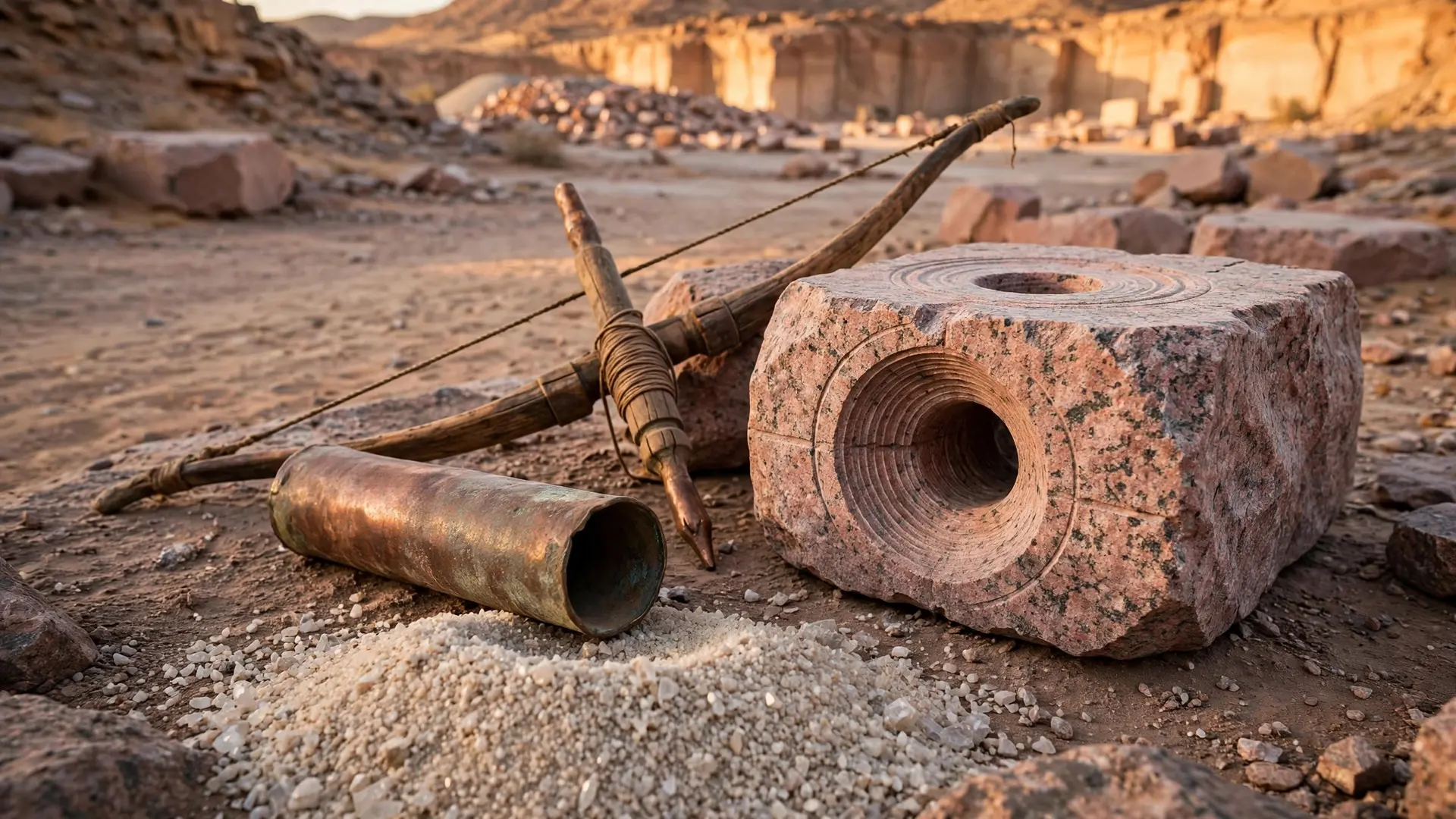
Not exactly every one, and not the way old illustrations suggest. The largest stones — the 80-ton granite beams — could never be sledged up anything, and their placement remains debated. Various ramp configurations are still argued over: straight ramps against one face, zigzagging ramps, even an internal spiral ramp that architect Jean-Pierre Houdin proposed based on structural clues and muon scanning data. What is no longer debated is the workforce. Despite Herodotus's old claim of 100,000 slaves, archaeology shows the pyramid was raised by roughly 20,000 skilled laborers and seasonal workers — bakers, copper-smiths, carpenters, surveyors — fed and housed in an organized workers' village. Copper saws and chisels cut the limestone; harder dolerite balls pounded the granite. The through-line is a civilization that compensated for limited tools with refined technique and logistics. Wet sand solved the flat-ground problem. Ropes and posts multiplied pulling force on steep slopes. The Nile carried the heaviest loads almost for free. And a bureaucracy — the unglamorous secret weapon — made sure 200 blocks arrived every month, on schedule, for roughly twenty years. The pyramid, in the end, is not a monument to brute force. It is a monument to understanding friction, leverage, and water — and to writing everything down.
Frequently asked questions
How heavy were the stones used to build the Great Pyramid?
The Great Pyramid's roughly 2.3 million core blocks average about 2.5 tons each, while the granite ceiling beams of the King's Chamber weigh up to 80 tons and came from Aswan, some 800 kilometers to the south.
Did wetting the sand really help move pyramid stones?
Yes. A 2014 University of Amsterdam study published in Physical Review Letters found that damp sand stiffens through capillary action, preventing it from piling up in front of the sledge and cutting the required pulling force roughly in half. A tomb painting from around 1880 BC even shows a worker pouring water in front of a sledge.
What did the 2018 Hatnub ramp discovery reveal?
Archaeologists found a 4,500-year-old ramp with two staircases and numerous post holes. Sledges were roped to wooden posts, letting crews pull heavy blocks up 20-percent slopes with far more force than dragging alone could produce.
How was stone transported to Giza?
White Tura limestone traveled by boat along the Nile and a system of canals, a journey taking two to three days, according to the Diary of Merer. Merer's crew of about 40 boatmen moved roughly 30 blocks of 2–3 tons each per trip.