How Jet Engines Turn Fuel Into Forward Thrust
A jet engine is a reaction engine: it hurls air backward and Newton's third law pushes it forward. Go inside the compressor, combustor, and turbine to see how.
Key takeaways
- A jet engine is a reaction engine: it accelerates air backward, and Newton's third law pushes the engine forward in return.
- NASA cites a typical air-to-fuel ratio of about 100 pounds of air per second to just 2 pounds of fuel per second.
- The turbine harvests energy from the hot gas to spin the compressor on a shared shaft, which is what makes the engine self-sustaining.
- Turbofans dominate because moving a large mass of air a little is more fuel-efficient at subsonic cruise than moving a small mass a lot.
- Only about a quarter of the air entering the core actually burns; the rest forms a cooling shroud so the flame never touches the metal.
A jet engine makes thrust the way a released balloon flies across the room: it throws something backward, and the reaction shoves it forward. In the engine's case, that something is air — swallowed at the front, squeezed to many times its original pressure, mixed with a little fuel, ignited, and blasted out the back faster than it came in. That difference in speed, exhaust racing away quicker than the intake air arrived, is the entire trick.
The reaction that moves a jetliner
Every jet engine is a reaction engine, a machine built directly on Newton's third law: every action force is answered by an equal and opposite reaction force. The engine's action is to take in a large mass of surrounding air and accelerate it rearward. The reaction pushes the engine — and the airplane bolted to it — forward. That framing clears up a common misconception. The engine is not pushing against the air piled up behind it, the way a swimmer pushes against a pool wall. Thrust comes from changing the air's momentum: air leaves the exhaust nozzle at a much higher velocity than it entered the intake, and the force required to produce that change reacts forward onto the engine. This is also why the same basic machinery works in space, where there is nothing to push against at all. The numbers make the scale vivid. According to NASA's jet engine primer, a typical engine swallows on the order of 100 pounds of air every second for every 2 pounds of fuel. The fuel is a guest; the air is the working fluid. Almost everything that roars out of the nozzle was, moments before, ordinary atmosphere.
Two men raced to the jet age
The jet engine arrived almost simultaneously in two countries that would soon be at war with each other, developed by two engineers who knew nothing of one another's work. In Britain, Royal Air Force officer Frank Whittle pursued the gas-turbine engine that would eventually power the country's first jet aircraft, the Gloster E.28/39, which took to the air on May 15, 1941. In Germany, engineer Hans von Ohain worked on his own gas-turbine designs with the backing of the aviation industrialist Ernst Heinkel. On August 27, 1939, von Ohain's HeS.3B engine carried the Heinkel He 178 — piloted by test pilot Erich Warsitz — into the sky in the world's first successful flight powered by a turbojet.
Whittle's design and von Ohain's converged on the same architecture because the physics left little room for alternatives: compress the air, add heat, extract enough energy to keep the compressor turning, and let the rest become thrust. That architecture still sits at the heart of every jet engine flying today.
Squeeze, burn, blow: the four stages
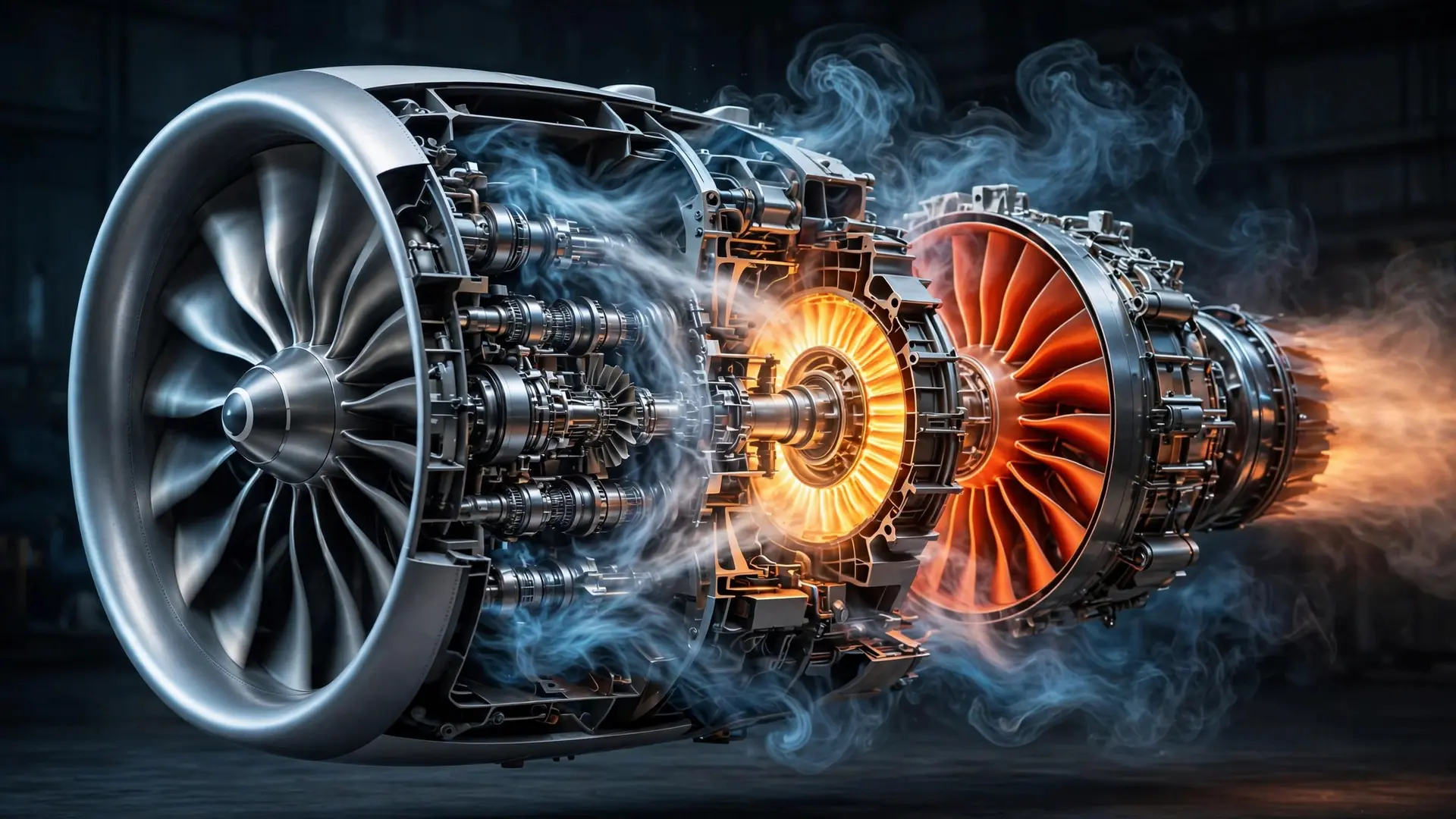
Open up any turbojet and you find four processes in sequence, each handled by its own section of the machine. First comes the intake, which delivers a steady stream of air into the compressor. The compressor is a stack of rotating and stationary airfoil rows — like a fan running in reverse. Instead of blowing air, it drinks energy to squeeze the air, and each row adds a small jump in pressure and temperature. By the back of the compressor, the air is many times denser than the free stream outside. That dense, hot air flows into the combustor, where fuel is sprayed in and ignited. Crucially, the fire is continuous, not pulsed like the explosions inside a car engine's cylinders. Once lit, it sustains itself indefinitely on the constant flow of air and fuel, like a blowtorch that never gets switched off. The hot, expanding gas then rushes through the turbine, a windmill-like set of blades at the rear. The turbine's job is not to make thrust — it harvests energy from the gas flow and uses it to turn the compressor, connected by a central shaft running through the middle of the engine. This link is what makes the machine self-sustaining: the fire drives the turbine, the turbine drives the compressor, and the compressor feeds the fire. Finally, whatever energy remains accelerates the gas through the exhaust nozzle, a converging duct at the tail. Because the exhaust leaves at a velocity well above the incoming air's, thrust is created. The whole engine is, in essence, an air-accelerating machine with a self-powered squeezing stage up front.
Why the turbofan won
If that is all there is to it, why do the engines under a modern airliner's wings look so much fatter than the slim tubes of early jets? The answer is the turbofan, the design that quietly took over aviation. A turbofan wraps the basic engine core in an extra layer of machinery: a giant fan at the front and an additional turbine stage at the back, mounted on its own shaft so the fan and the core can spin at different speeds. Part of the fan's airflow goes through the core and burns; the rest bypasses the core entirely, flowing around the outside like a propeller's slipstream at only slightly increased speed.
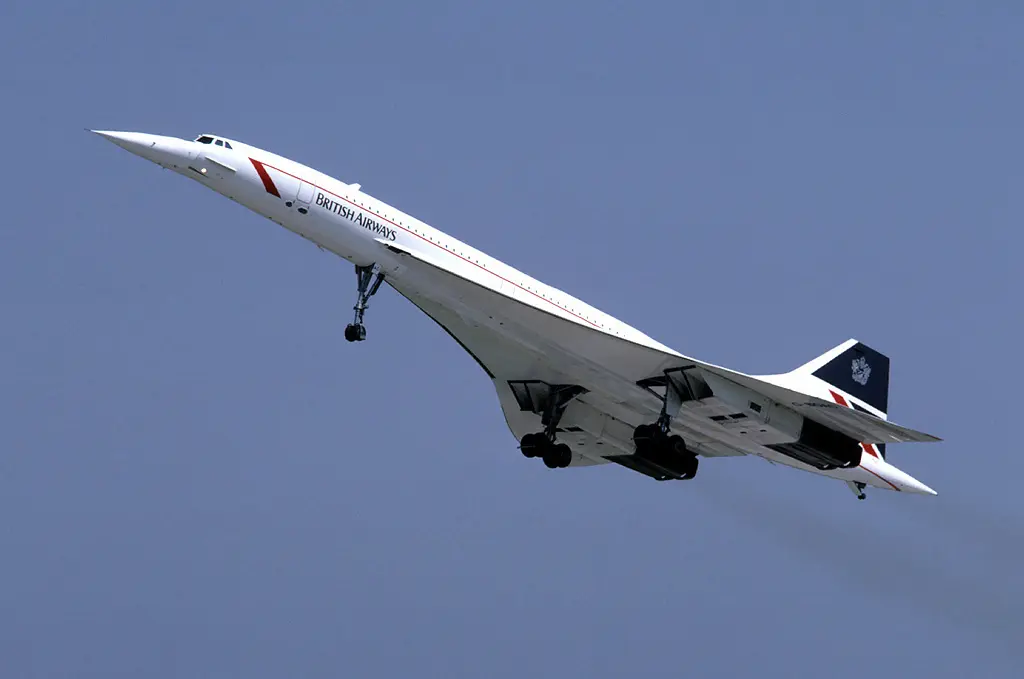
That split is the genius of the idea. Thrust is mass accelerated rearward, and there are two ways to buy it: accelerate a small mass of air a great deal, or accelerate a large mass of air a little. The turbofan chooses the second. Physics favors it at subsonic cruise speeds, because kinetic energy grows with the square of velocity — pushing a lot of air gently wastes far less energy as leftover exhaust speed than pushing a little air violently. NASA notes that the big fan adds barely any fuel burn while contributing a large share of the thrust, so a turbofan makes far more thrust from nearly the same core as a pure turbojet, approaching the fuel efficiency of a turboprop. That logic also explains where turbojets still appear. A pure turbojet is most efficient when the airplane's speed nearly matches its exhaust speed — territory that belongs to supersonic flight, like Concorde's supersonic era. For everything slower, the turbine's power is better spent turning a fan, which is why turbofans rule the airliner fleet while the open propeller, too draggy at high speed, stays on slower aircraft.
A fire that never touches metal
One detail about the combustor deserves a second look, because it sounds impossible: the flame inside a jet engine burns hotter than the metals around it can survive, yet the engine does not melt. It survives because the flame is kept away from the metal. Combustion occupies only the front portion of the burner; downstream air mixes in to cool the gases before they reach the turbine. A shroud of secondary cooling air flows inside and outside the burner liner, centering the flame in a cushion of air — if that cooling air were lost, the liner would burn straight through. In fact, only about a quarter of the air entering the core takes part in burning at all; the rest exists to cool, shape, and protect. The turbine blades live an even more extreme life. Modern engines see turbine inlet temperatures around 3,000 degrees Fahrenheit, hundreds of degrees beyond what the blade metals can withstand on their own. The blades are hollow, with air bled off the compressor forced through their interiors and out over their surfaces — a film of cooler air that lets them run some 600 to 800 degrees Fahrenheit above their own material limits. It is a fitting emblem for the whole machine. A jet engine is a controlled fire, spinning at thousands of revolutions per minute, suspended inside a cooling breeze of its own making — all to do one simple thing: throw air backward so the airplane can go forward. The same lesson in channeling violent forces runs through other hard-won aviation knowledge, like why every airliner window is rounded, where stress, not heat, was the enemy.
Frequently asked questions
Do jet engines push against the air behind them?
No. A jet engine accelerates a stream of air backward, and the reaction to that acceleration pushes the engine forward — Newton's third law. Nothing needs to be behind the engine for thrust to work, which is why rockets fly in the vacuum of space.
What is a bypass ratio?
It is the ratio of air that flows around the engine core to air that flows through it. In a high-bypass turbofan, the large front fan pushes most of its air around the core like a propeller's slipstream, which makes the engine far more fuel-efficient at airliner cruise speeds.
Why doesn't the flame inside a jet engine melt it?
Because the flame never touches the metal. Cooling air forms a protective shroud around the fire inside the combustor, and the turbine blades are hollow — cooled from within by air bled off the compressor — letting them survive temperatures roughly 3,000 degrees Fahrenheit at the turbine inlet.
Who invented the jet engine?
Two men did it independently: RAF officer Frank Whittle in Britain and engineer Hans von Ohain in Germany. Von Ohain's engine flew first, powering the Heinkel He 178 on August 27, 1939, while Whittle's design flew in the Gloster E.28/39 on May 15, 1941.