How Neurons Talk: The Chemistry of Thought
Your 86 billion neurons never touch. Every thought you have crosses the gap between them as chemistry — here's how a spark becomes a signal.
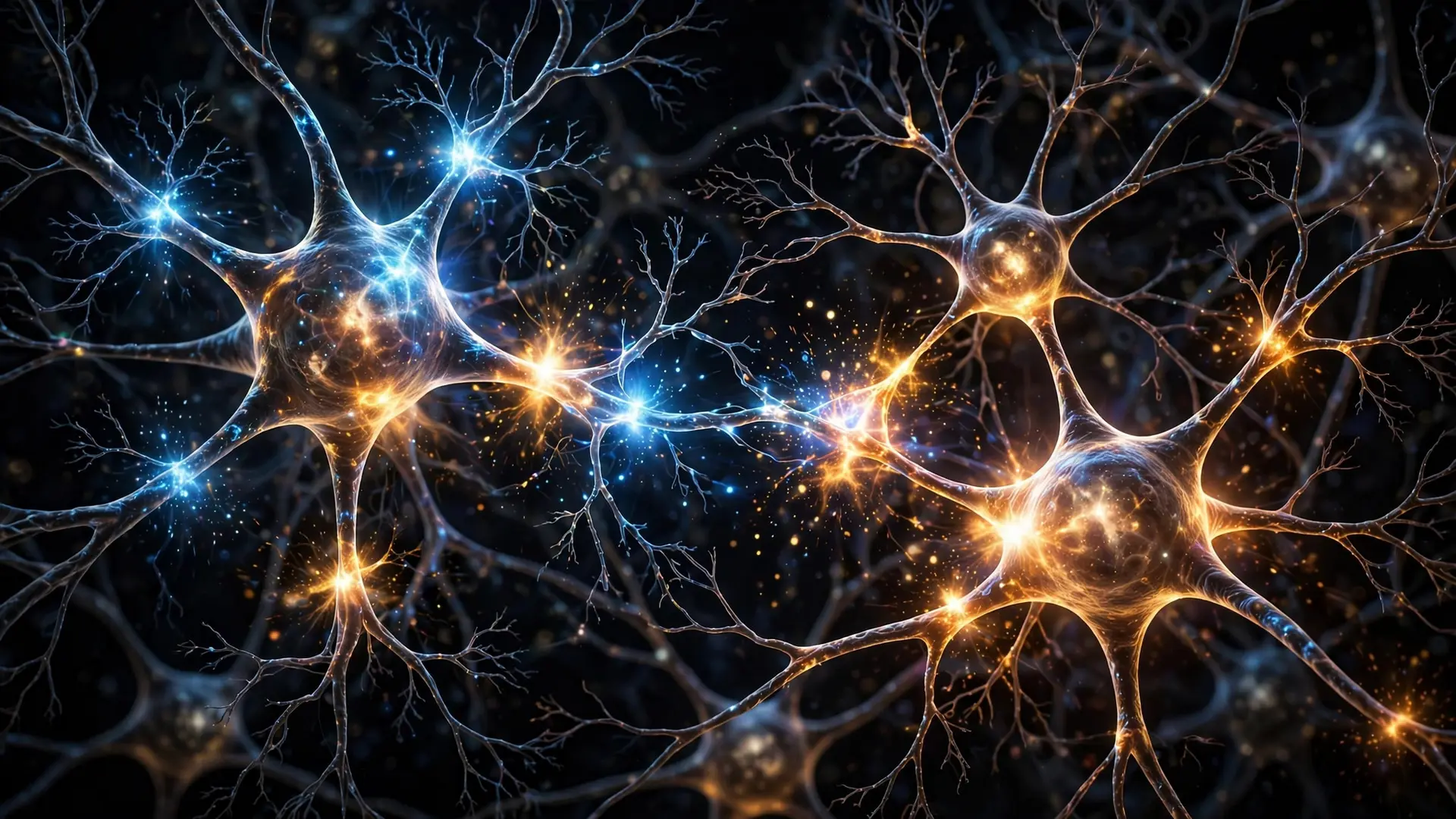
Key takeaways
- The human brain contains about 86 billion neurons that communicate mostly chemically, translating electrical signals into neurotransmitters and back again.
- An action potential is an all-or-none electrical pulse: once a neuron's membrane reaches its threshold, it fires completely or not at all.
- When the signal reaches the axon terminal, calcium channels open and synaptic vesicles release neurotransmitters into the synaptic cleft.
- Over a hundred neurotransmitters are known, including glutamate, GABA, dopamine, serotonin, and acetylcholine — the receiving neuron sums excitatory and inhibitory votes before deciding to fire.
Right now, in your brain, roughly 86 billion neurons are talking to each other — and not a single one of them is touching another. Every sensation, memory, and decision you have is the product of a conversation held across billions of microscopic gaps, in a language of electricity translated into chemistry and back again. The remarkable part isn't that neurons send signals. It's how they vote on them. No single neuron decides anything alone; each one sums thousands of competing inputs — go, stop, go, stop — before committing to a single binary decision: fire, or stay silent. Your thoughts are, quite literally, the outcome of trillions of tiny elections.
How Does a Signal Travel Inside a Neuron?
Within a neuron, communication is electrical. A resting neuron maintains a small voltage across its membrane, a standing charge like a loaded spring. When incoming stimulation pushes that voltage past a threshold — around -55 millivolts — voltage-gated sodium channels snap open, positive ions flood in, and the membrane depolarizes to about +40 millivolts in a flash. This is the action potential, and it is strictly all-or-none: once the threshold is crossed, the neuron always fires completely, exactly like a gunshot rather than a dimmer switch. After firing, the neuron must reset — potassium channels open, potassium flows out, the membrane briefly hyperpolarizes, and the sodium channels lock until they're ready again. During that refractory period, the neuron cannot fire, which sets the maximum rate of neural chatter. The signal races down the axon toward the neuron's branching terminals. In many neurons, a fatty insulating layer called myelin speeds the journey: the signal leaps between bare patches known as the nodes of Ranvier, far faster than it could travel down an uninsulated fiber. For more on the brain's electrical rhythms, see The Science of Sleep Cycles.
What Happens When the Signal Reaches the Synapse?
Here the language changes. When the action potential arrives at the axon terminal, the resulting depolarization opens voltage-gated calcium channels. Calcium floods into the terminal — and calcium is the trigger for release. It causes synaptic vesicles, tiny sacs of neurotransmitter docked at the membrane, to fuse with it and dump their chemical contents into the synaptic cleft, the narrow gap between neurons. The process is called exocytosis. The neurotransmitters diffuse across the gap and bind to receptors on the receiving neuron, like keys finding locks. Binding opens ion channels in the receiving membrane, converting the chemical message back into an electrical one — a postsynaptic potential that either nudges the neuron toward firing or holds it back. A neuron can receive inputs from thousands of other neurons at once, on its dendrites, its cell body, and even its axon. At the axon hillock — the launch point of the axon — all those excitatory and inhibitory influences are summed. If the net effect pushes the membrane to threshold, the neuron fires its own action potential, and the message continues down the chain. Thought, in other words, is a committee process: democracy, at 100 milliseconds per vote.
What Chemicals Are They Actually Speaking?
Scientists have identified over a hundred neurotransmitters, and they fall into a few broad families. Amino acids include glutamate — the brain's principal excitatory signal — and GABA, its principal brake. Monoamines, derived from amino acids, include dopamine, serotonin, norepinephrine, and epinephrine. Then there are the neuropeptides, like beta-endorphin, and acetylcholine, which stands in a class of its own. The same chemical can play different roles in different places, which is part of what makes neuroscience so intricate. Dopamine in the reward circuits drives motivation; elsewhere it fine-tunes movement — which is why its loss in Parkinson's disease disrupts motor control. Serotonin helps regulate mood and sleep, and many antidepressants work by keeping it in the synaptic cleft longer, delaying the cleanup step.
And neurons don't only talk to neurons. Chemical synapses also connect nerves to muscle and gland cells — the neuromuscular junction, where acetylcholine tells a muscle fiber to contract, is the junction that lets thought become action. For the strange sensations that can arise when signaling misfires, read Why Does Brain Freeze Happen?.
How Does the Conversation End?
Every synapse must reset, or the conversation would dissolve into noise. After signaling, neurotransmitters are cleared from the cleft in one of three ways: reabsorbed by the sending neuron through reuptake, dismantled by enzymes, or simply left to drift away. This cleanup step is some of the most consequential chemistry in medicine. Cocaine blocks dopamine reuptake, flooding synapses with the reward signal — which is precisely why it is so destructive. Many antidepressants do the gentler reverse, slowing serotonin reuptake to modestly lift signaling. Acetylcholine's enzyme, acetylcholinesterase, works so fast that nerve agents and some insecticides target it specifically, which is why they are so lethal. Small changes to the cleanup step can reshape behavior, mood, and even survival. It is no exaggeration to say that who we are is partly written in reuptake rates. The picture this leaves us with is elegant: an electrical signal, translated to chemistry, translated back to electricity, summed across thousands of inputs, decided at a threshold, then erased so the next signal can arrive. Each cycle takes milliseconds. Your brain runs trillions of them per second. It also explains why learning changes the brain itself. When two neurons fire in a coordinated rhythm, their synapses physically strengthen — more receptors are built, more vesicles docked at the membrane — so the same conversation flows more easily next time. This is the basis of long-term potentiation, the leading biological account of how short-term experiences become lasting memories. Forgetting, in turn, is partly the reverse process: unused synapses weaken and are pruned, especially during sleep, keeping the network efficient. So when you have a thought — this one, right now — you are feeling the outcome of an 86-billion-cell parliament, debating in neurotransmitters and voting in voltage. For more on the brain's stranger states, see The Science of Déjà Vu. The machinery is chemistry. The result is you.
Frequently asked questions
Do neurons physically touch each other?
No — they are separated by a tiny gap called the synaptic cleft. Signals cross it chemically: neurotransmitters released by one neuron bind to receptors on the next.
What is an action potential?
An action potential is a brief, all-or-none reversal of a neuron's membrane voltage that travels down the axon. It fires completely once a threshold is reached, like a digital bit of neural information.
How are neurotransmitters cleared from the synapse?
After signaling, neurotransmitters are reabsorbed by the sending neuron in a process called reuptake, broken down by enzymes, or simply drift away — resetting the synapse for the next signal.
What do excitatory and inhibitory neurons do?
Excitatory inputs push a neuron closer to firing; inhibitory inputs push it away. Each neuron sums thousands of these competing votes at its axon hillock before deciding whether to fire.