Living things make their own light through a chemical reaction, not electricity or heat. A molecule called luciferin reacts with oxygen, an enzyme called luciferase speeds the reaction up, and the released energy escapes almost entirely as photons of visible light. Because so little energy leaks out as heat, bioluminescence is famously described as "cold light" — a glow that can be close to 100 percent efficient, while an old incandescent bulb wastes more than 90 percent of its energy as heat.
That simple recipe has been discovered by evolution again and again — estimates suggest at least 40 separate times in animals, and possibly as many as 94 times across all life. Bacteria, fungi, jellyfish, crustaceans, squid, fish, even one family of sharks all produce light with their own chemistries. But here is the curious part: despite all that independent invention, most of it ends up looking the same. The sea glows blue. Fireflies flash yellow-green. Why?
The core chemistry: luciferin plus luciferase
Bioluminescence is a form of chemiluminescence — light from chemistry. The two starring ingredients are luciferin, a small light-emitting molecule, and luciferase, the enzyme that catalyzes its oxidation. When luciferin oxidizes, it forms an unstable product called oxyluciferin in an excited state; as it relaxes back to its ground state, the energy is released as a photon.
"Luciferin" and "luciferase" are job titles, not single substances. Different organisms use chemically distinct luciferins — fireflies have their own, many marine animals use coelenterazine, luminous bacteria use a bacterial luciferin — and their luciferase enzymes are not even related to each other by evolution. In fireflies, the reaction is well studied: it runs in two steps, needs ATP (the cell's energy currency), oxygen, and magnesium ions, and produces yellow-green light peaking around 560 nanometers. Its efficiency is remarkable — the quantum yield, the fraction of the reaction's energy that becomes light, is roughly 40 percent, one of the highest known for any bioluminescent system.
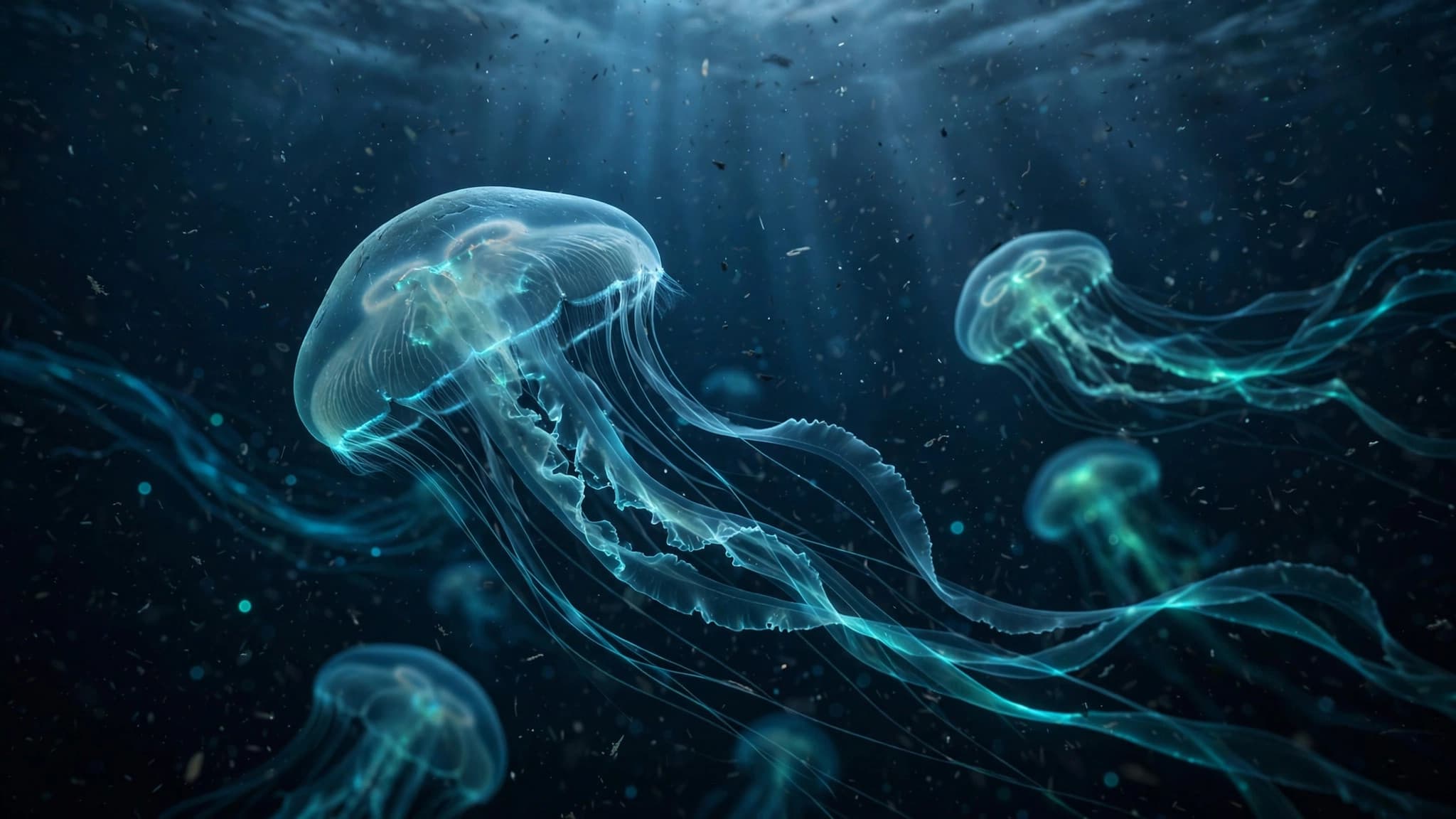
Some organisms skip the free-floating pair and bind the ingredients into a single molecule called a photoprotein, which waits silently until a signal — usually calcium ions — triggers it to flash. Jellyfish-style photoproteins work exactly this way: a touch of calcium, a pulse of blue light.
Why the ocean converged on blue
Roughly 80 percent of all bioluminescence on Earth happens beneath the ocean surface, and out in the deep it is almost always blue. That is no accident — it is physics.
Light fades in seawater wavelength by wavelength. Red is absorbed first, then orange, then yellow; deep blue penetrates farthest. Most bioluminescence sits in a narrow band of blue-green, around 470 nanometers, because that is the wavelength that travels farthest through water — and animals that evolved to use it were the ones whose signals actually reached other eyes. It is also why the ocean itself looks blue: blue light simply behaves differently in water than the rest of the spectrum. Over millions of years, thousands of species of fish, bacteria, algae, and worms independently arrived at the same answer.
And they put it to work. More than half of known bioluminescent fish make their own light through internal chemical reactions; the rest run a symbiotic deal — the fish provides food and shelter to glowing bacteria, and the bacteria provide the light. Fish are even born dull and must recruit their luminous tenants from the surrounding water as they develop.
Why fireflies went yellow-green
On land, the rules change. There is no ocean filtering the spectrum, so fireflies — more than 2,000 known species — can afford yellow, orange, and green. The common firefly's light peaks near 560 nanometers, a yellow-green that stands out beautifully against night foliage — one of nature's many ways of making color, alongside the diet-driven pink of flamingo feathers.
What makes fireflies remarkable is not the color but the control. Each species flashes in a distinct pattern — quick bursts, long glows, complex sequences — and mates use these coded signals to find the right partner: males typically flash while flying, females answer from perches below. Fireflies control the flashing by throttling oxygen flow to their light-producing cells through nerve signals, switching their lanterns on and off with precision. The system is so refined that some predatory females of other species have learned to mimic the answer-flashes of prey species, luring males in to eat them — nature hacking nature's own communication protocol.
The exceptions: red headlights and burglar alarms
The most fascinating bioluminescence breaks the rules on purpose. The dragonfish Malacosteus hunts with a red-emitting photophore — essentially headlights that are invisible to almost everything else in the sea, since most deep-sea animals only see blue. It can get away with this because, unlike its prey, it can detect longer wavelengths using chlorophyll derivatives it absorbs from the copepods it eats. No vertebrate is known to synthesize those molecules itself; the dragonfish steals them from dinner.
Other species use light as camouflage. Squid and fish with photophores on their bellies perform counterillumination: they tune their glow to match the faint blue light filtering down from the surface, erasing their silhouette from predators lurking below. Some squid can even match the light's angle and intensity, not just its color. And ostracods — tiny seed-sized crustaceans — turn light into an alarm: swallowed by a predator, they release glowing mucus that illuminates the attacker from the inside, a "burglar alarm" that either forces release or attracts a bigger predator to deal with the problem.
Even camouflage has an arms race. Some deep-sea predators carry modified yellow lenses tuned to spot the slightest mismatch between a prey's bioluminescent glow and the ambient light.
A chemistry we borrowed
Scientists have put this ancient chemistry to work. Because the firefly luciferase reaction produces light in proportion to ATP, it is used to measure cellular energy; and the luc gene, slipped into cells as a reporter, lets researchers watch genes switch on, track cancer cells, and monitor the spread of viruses — all by making darkness visible. Life spent hundreds of millions of years perfecting cold light, and now it lights up our laboratories too.
The takeaway is this: bioluminescence is one of evolution's favorite inventions, reinvented dozens of times, yet constrained by a single physical truth. Water drinks light unevenly, so the ocean glows blue; on land, chemistry answers a different question — not "what color travels farthest?" but "what signal says my name?" — and the answer is a yellow-green Morse code in the dark.