Why Do We Get Brain Freeze? The Cold Science Explained
That stabbing forehead pain after a frozen drink is a false alarm from your own blood vessels. Here is the real mechanism behind the ice cream headache.
Key takeaways
- Brain freeze is a false alarm: nothing in your skull actually freezes; it is a pain signal without any injury.
- Pain receptors in the meninges translate rapid dilation and contraction of the anterior cerebral artery into a stabbing ache.
- A 2012 Harvard study led by Jorge Serrador watched 13 volunteers on transcranial Doppler and found blood-flow changes preceded the pain.
- The sphenopalatine ganglion behind brain freeze is also implicated in migraines and cluster headaches, making it a valuable research model.
- The fastest cure is built into the mechanism: stop the cold intake and press your warm tongue against the roof of your mouth.
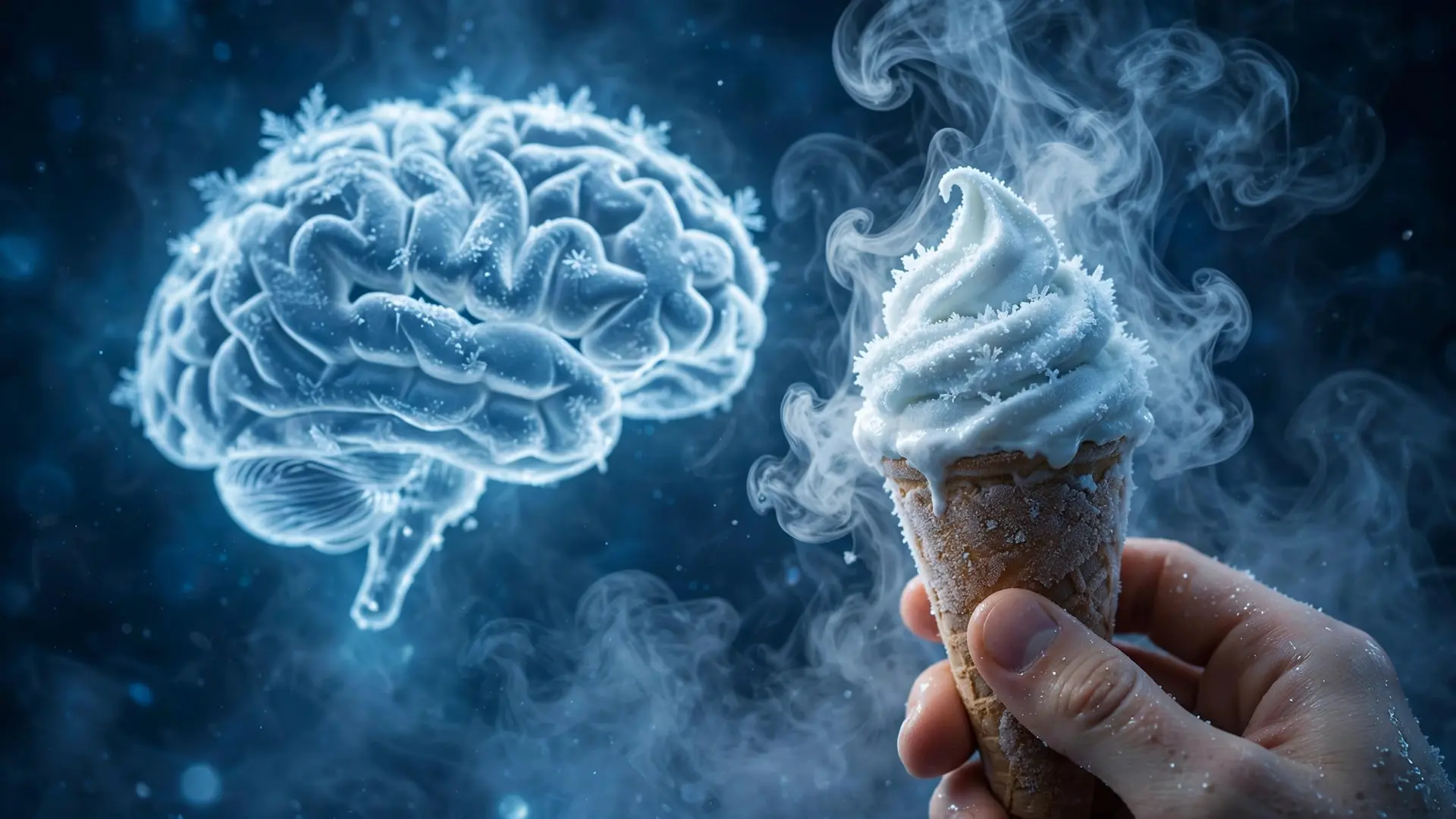
Brain freeze is not your brain freezing. It is a false alarm: when a gulp of ice cream chills the roof of your mouth too fast, nearby blood vessels constrict and then snap back open, and the pain-sensing nerves wrapped around them fire in panic. You feel the stab in your forehead because your brain misfiles where the signal came from.
The Alarm System Under Your Palate
The roof of your mouth is far more sensitive than it looks. It sits over a dense web of blood vessels and a bundle of nerves called the sphenopalatine ganglion, a knot of nerve cells tucked behind the nose that is unusually sensitive to cold. When a frozen treat touches the back of the palate, that bundle registers a sudden temperature drop and forwards the news to the brain as an urgent problem. Neuroscientist Dwayne Godwin of Wake Forest Baptist Medical Center has described what happens next. Our mouths, he notes, are highly vascularized — which is why we take our temperatures under the tongue — but gulping a cold drink does not give the mouth time to absorb the cold gradually. Instead, the cold strikes at the junction of the internal carotid artery, which feeds blood to the brain, and the anterior cerebral artery, where brain tissue begins. "One thing the brain doesn't like is for things to change," Godwin said, "and brain freeze is a mechanism to prevent you from doing that." The brain itself, remarkably, cannot feel pain despite its billions of neurons. The ache you feel is picked up by receptors in the meninges, the protective outer covering of the brain, right where those two arteries meet. When the cold hits, the arteries dilate and contract in rapid succession, and the meningeal receptors translate that vascular commotion into the stabbing forehead pain you know too well. Your brain, in other words, is interpreting plumbing turbulence as damage. It is the same class of crossed wire as the phantom tingle behind a sliced onion — sensory nerves reacting to a harmless stimulus as though it were an emergency.
Watched Second by Second on a Brain Scanner
For years the exact sequence was educated guesswork. Then, in 2012, a team led by Jorge Serrador of Harvard Medical School put brain freeze under direct observation. Thirteen healthy volunteers sipped ice water through a straw pressed against the roof of the mouth — ideal conditions for triggering the freeze — while the researchers monitored blood flow in several brain arteries with transcranial Doppler. The volunteers then repeated the exercise with room-temperature water as a control, raising one hand when the pain struck and again when it faded. The results were strikingly clean. One artery in particular, the anterior cerebral artery, dilated rapidly and flooded the brain with blood at almost exactly the moment each volunteer felt the pain begin. Soon after, the same vessel constricted — and as it narrowed, the pain ebbed away. Crucially, the blood-flow changes preceded the pain, not the other way around. The vascular event causes the ache; the ache is its echo. Serrador presented the findings at the Experimental Biology 2012 conference in San Diego with a compelling interpretation: the sudden dilation is not a malfunction but a defense. The brain is one of the body's most temperature-sensitive organs, and it must keep working around the clock. Flooding the tissue with warm blood could be the body's way of insulating the brain from extreme cold — a rapid thermal rescue. Because the skull is a rigid, closed structure, that same rush of blood may briefly raise pressure inside the skull, and that pressure is what your meninges report as pain.
Your Thermostat Acting on Instinct
Put the two accounts together and brain freeze looks less like a glitch and more like an overprotective reflex. Dr. Kristofer Rau, a physician at the Virginia Tech Carilion School of Medicine, has explained the body's logic: your brain insists on staying near 98.6 degrees Fahrenheit. When cold shrinks the vessels in the roof of your mouth, the brain answers by driving the heart to pump harder, sending a surge of warm blood up into the head to rewarm the area — which makes the vessels swell back open.
That fluctuation between constriction and expansion is the whole story. Sensory neurons are wrapped around all those blood vessels like listeners pressed against a wall, and they report the sudden stretching and shrinking as pain, sending the signal up to the brain. So the headache is collateral damage from a rescue operation: your body briefly choosing a false alarm over letting the brain's temperature slide — another reminder that much of what we feel is the brain's best guess, like the misfiring sense of familiarity behind déjà vu. In that sense, brain freeze is a compliment from your nervous system — it cares about your brain enough to overreact.
Why Migraine Researchers Pay Close Attention
Here is where a summer nuisance becomes a scientific instrument. The sphenopalatine ganglion — the same nerve bundle that converts a cold palate into a headache — is also implicated in migraines and cluster headaches, far more serious and longer-lasting conditions. Headache specialist Stephanie Vertrees of the Texas A&M College of Medicine has noted that researchers now even have devices targeting this ganglion, one that blocks it with a numbing agent and another that stimulates it electronically, with the goal of preventing migraine and cluster headaches. That makes brain freeze uniquely valuable to science. As Godwin has put it, researchers cannot easily give volunteers a migraine or a cluster headache — but they can reliably induce a brain freeze with nothing more than ice water and a straw, watch it from start to finish, and let it resolve in seconds with no drugs and no lasting effects. Previous headache research had to rely on pharmacological triggers, which introduce their own confounding effects, or on patients already mid-migraine, which misses the crucial minutes when a headache forms. Brain freeze is the one headache humans can trigger on command, making it a clean, repeatable model for studying how head pain begins — and, eventually, how to stop worse ones.
How to End It in Seconds
The good news is that the fastest cure was built into the mechanism all along. Stop the cold intake, and the trigger is gone. Press your tongue — which is warm — flat against the roof of your mouth to rewarm the palate directly. A sip of something warm or even tepid normalizes the temperature and short-circuits the whole cascade. Within seconds, the vessels settle, the alarm cancels, and the pain drains away. A few misconceptions deserve clearing up along the way. Brain freeze is not dangerous; it is a pain signal without an injury, and nothing in your skull actually freezes. It does not mean you are dehydrated or that your ice cream was too sweet. And while children seem to get it constantly, adults are just as susceptible — grown-ups are simply more likely to sip slowly enough to avoid it. The next time the stab hits, remember what it is: your own alarm system working exactly as designed, just a little too eagerly. Press your tongue to the roof of your mouth, take a breath, and go a little slower with the next spoonful.
Frequently asked questions
What actually causes brain freeze?
Cold striking the roof of the mouth triggers rapid dilation and contraction of nearby arteries, and pain receptors in the meninges translate that vascular commotion into a stabbing headache.
Why do you feel brain freeze in your forehead?
The brain misfiles where the signal came from, referring pain from the palate's nerves and arteries to the forehead.
How do you stop brain freeze fast?
Stop the cold intake and press your warm tongue flat against the roof of your mouth; a sip of something warm or tepid also short-circuits the whole cascade within seconds.
Is brain freeze dangerous?
No. It is a pain signal without an injury, and nothing in your skull actually freezes.