How QR Codes Store Data in Plain Sight
A QR code is half message, half machinery: finder patterns lock on in milliseconds, data is woven in a zigzag, and Reed-Solomon math rebuilds up to 30% of damage.
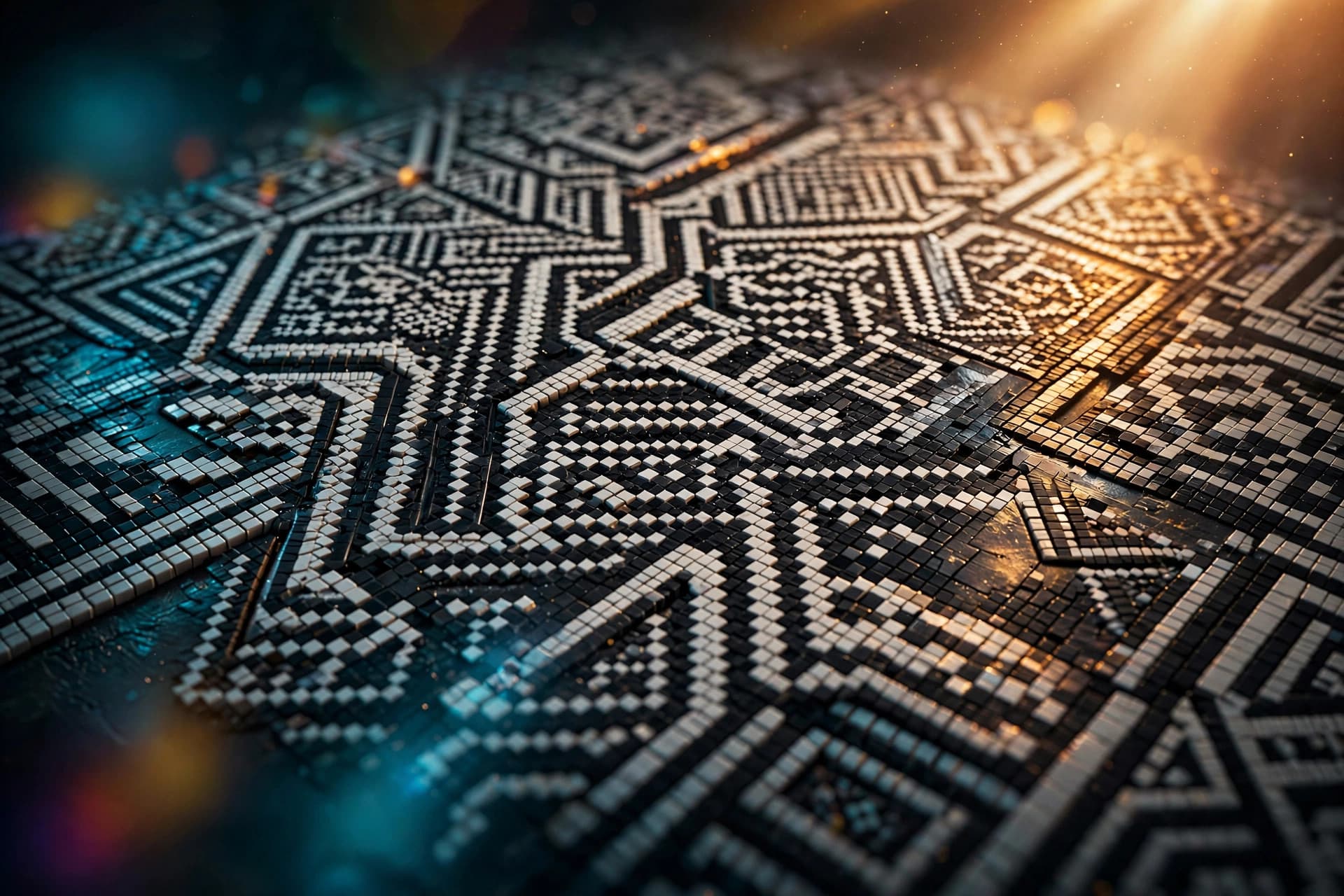
Point your phone at a QR code and a website opens in under a second. Yet nothing on that jittery black-and-white square looks like a URL — there are no letters, no numbers, just a field of scattered pixels. The answer to how it stores data is stranger than it appears: the pattern is only half message. The rest is machinery — targeting beacons, timing tracks, and a mathematical backup system that can rebuild the message even when a third of the code is destroyed.
The three squares are a homing beacon
Every QR code carries three identical square targets in its corners, and they are the reason your phone locks on almost instantly. In the early 1990s, a team led by Denso Wave engineer Masahiro Hara was trying to track auto parts on Toyota factory lines, where workers had to scan as many as ten conventional barcodes per box — each one holding only about twenty characters — and it was slowing production down. Inspired by the grid of black and white stones in the board game Go, Hara's team realized a two-dimensional pattern could hold vastly more data than a single row of bars.
The hard part was recognition: getting a scanner to find the code amid factory clutter, at any angle. The team studied newspapers, magazines, and other printed material, hunting for a black-to-white width ratio that almost never occurs by accident. They settled on 1:1:3:1:1 — the exact sequence of dark and light widths in the concentric squares of each finder pattern. Your phone's camera is effectively hunting for that ratio, and the moment it finds three of them in an L-shape, it knows the code's position, orientation, and size. A thin white separator ring isolates each finder from the surrounding data so the ratio reads cleanly, and alternating dark-light timing strips running along the edges tell the decoder how wide each module is. The invention was released in 1994, later standardized internationally as ISO/IEC 18004, and recognized as an IEEE Milestone.
Data is woven, not written
With the scaffold fixed, the message itself is encoded in the remaining space — not row by row like text, but in a peculiar two-column zigzag that snakes upward through the grid from the bottom right. Each dark module is a binary 1, each light module a 0, and eight modules are grouped into one codeword, like a byte. A large code is further split into interleaved blocks, so damage spread across the symbol hits many blocks a little instead of one block a lot.
The encoding also chooses its alphabet cleverly. QR codes support four modes, and the encoder picks the most compact for the content: numeric mode squeezes digits at about 3.3 bits each (three digits in ten bits), alphanumeric handles uppercase letters plus a small symbol set, byte mode covers URLs and mixed text, and kanji mode packs Japanese characters efficiently. A mode indicator near the code's edge tells the decoder which alphabet each segment uses, and a single symbol can switch modes mid-stream. Size scales too: there are forty versions, from a 21×21-module Version 1 up to a 177×177-module Version 40, each step adding four modules per side. The densest codes can hold 7,089 numeric characters — a short novel compressed into a postage stamp.
Before finalizing, the encoder lays one of eight mask patterns over the data region and scores the result with penalty rules, picking the mask that best evens out the dark-light balance and breaks up confusing runs. Without masking, a URL full of zeros could produce vast white fields that blind the scanner; the mask keeps the symbol looking like static so the decoder can sample it reliably. A four-module-wide "quiet zone" of empty space must surround the whole symbol — the margin that separates signal from background clutter.
Half the code is a backup copy
The most elegant engineering in the symbol is invisible: redundancy. QR codes use Reed-Solomon error correction, a scheme that computes parity codewords from the data and interleaves them throughout the symbol. If part of the code is scratched, smudged, or torn, the decoder can reconstruct the missing bits from the parity — a mathematical form of remembering by consensus.
Four levels of protection exist, and each code commits to one: Level L restores about 7% of damaged codewords, M about 15%, Q about 25%, and H about 30%. Higher levels eat into payload capacity, since redundancy steals modules from data — a real engineering trade-off, not free insurance. That 30% ceiling at Level H is also why you can stamp a logo in the middle of a QR code and still have it scan: the designer is deliberately "damaging" the code within its recovery budget. It is the same mathematical family that protects deep-space transmissions and the data on your hard drive — overkill for a restaurant menu, perhaps, but the lineage is what makes the trick so reliable. The story of how error correction became a pillar of computing goes back to machines like the ENIAC, built when every bit was precious.
Not every dot is data
It is worth naming what the scanner ignores. The function patterns — the three finders, the timing strips, the alignment squares that appear in larger versions to correct for perspective distortion, the format information stored in duplicate near the finders — carry zero user data. In a Version 40 symbol they consume a meaningful fraction of its 31,329 modules. Denso Wave also kept the "QR Code" trademark and still holds patents, but released the technology as an open standard; anyone implementing ISO/IEC 18004 can use it without a license fee. That single business decision, more than any technical detail, explains why the code ended up on everything from boarding passes to tombstones.
The quiet heroism of the design is its thrift. Error-correction math first honed for quantum computing's fragile qubits and for deep-space probes works just as well on a printed napkin. The finder ratio found by scanning old newspapers still catches your phone's eye in a crowded poster. Nothing about the symbol changed; the world simply built billions of decoders that understand it.
The next time a QR code resolves before your eyes can focus, look at it differently: it is not a picture of data, but a small machine for delivering data — part map, part message, part spare parts kit, all visible in plain sight.