The Undersea Cables Carrying 99% of Intercontinental Internet
Over 99% of intercontinental internet traffic travels not by satellite but through glass fibers on the ocean floor — laid by ships across 1.4 million kilometers.
Your video call from Sydney to London feels wireless, but almost none of it is. Over 99% of intercontinental internet traffic — every email, trade, stream, and AI prompt crossing an ocean — travels not through satellites but through hair-thin glass fibers resting on the seabed, some nearly four kilometers down. The digital world is, quite literally, held together by cables lying in the dark.
The highway you never see
The scale is staggering. TeleGeography tracks more than 600 active and planned submarine cable systems spanning roughly 1.4 million kilometers of ocean floor, with nearly 1,900 landing points where they surface at coastal stations. Satellites carry under 1% of intercontinental throughput; the cables form the economic backbone of global banking, with trillions of dollars in transactions and settlements flowing through them daily. It is an odd reversal of intuition: we picture the internet as satellites and clouds, but the International Telecommunication Union puts the number plainly — over 99% of international data traffic rides submarine cables.
The lineage goes back much further than the internet. The first successful transatlantic telegraph cable was completed in 1866, and the telephone era's TAT-1 arrived in 1956 carrying just 36 simultaneous calls. The real hinge moment came in December 1988 with TAT-8: the first transatlantic fiber-optic system, built by AT&T with British Telecom and France Telecom, running 280 Mbit/s through six strands of glass across nearly 6,000 kilometers of seabed — a forty-thousand-call capacity that was ten times the last copper cable's. Engineers at the time joked it might be the last transatlantic cable the world would ever need. It filled in eighteen months.
How you lay a cable across an ocean
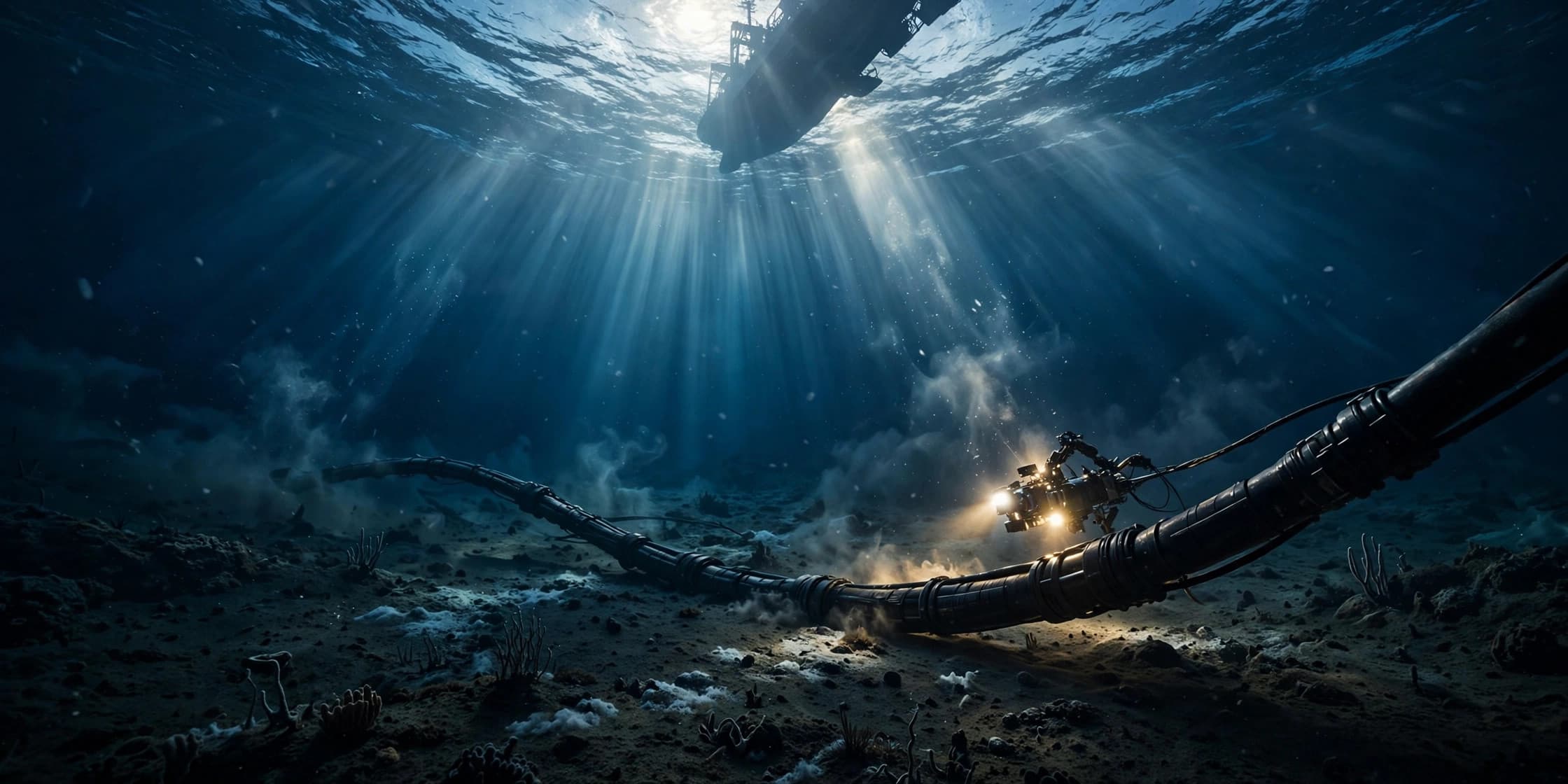
Laying a cable is closer to a military operation than to wiring a house. Dedicated cable ships, some over 140 meters long, carry thousands of kilometers of cable wound in enormous tanks and pay it out at a controlled speed while navigating a surveyed route. The cable itself is a marvel of layered engineering: at its heart, pairs of single-mode optical fibers; around them, a copper sheath that carries electrical power; then steel armor and polyethylene insulation. In shallow water the cable is thicker and often buried three feet under the seabed by a jetting plow, because that is where the danger lives.
In the deep ocean, the cable is thinner — sometimes barely an inch across — and simply rests on the seabed, because at crushing depth nothing much disturbs it. Along the way sit repeaters: sealed pressure-rated steel housings, spaced every few dozen kilometers, that amplify and regenerate the optical signal so light pulses survive the crossing. TAT-8's repeaters were tested for depths approaching 8,000 meters. Modern systems push further: multiple fiber pairs per cable, dense wavelength-division multiplexing squeezing dozens of light channels onto each fiber, and lit capacities on international routes now measured in petabits per second.
Broken by anchors, not hackers
Here is the absurd contrast at the heart of the network. This is the infrastructure that carries quantum-era AI models and trillion-parameter training runs — and a large share of its failures come from ship anchors and fishing trawlers. The ITU attributed roughly 86% of cable damage to ordinary human activity: fishing gear and anchors dragging across seabed routes, not cyberattacks or sabotage. A damaged cable is not a rare event; dozens of faults occur each year, and dedicated repair ships are permanently stationed at strategic ports, ready to haul a broken cable up from kilometers down, splice in a repair, and lay it back.
Repair is the slow, physical counterpoint to the instant internet: finding the break with pulses of light, grappling the cable off the floor, and fusing glass fibers thinner than a human hair on a rolling deck. Yet most users never notice a fault, because traffic reroutes. The network's resilience comes from redundancy — multiple systems on diverse routes — rather than from any single cable's invulnerability. The chokepoints that worry planners are geographic: the approaches to the Red Sea and Suez, the Taiwan and Luzon Straits, the shallow Baltic shelf. Vast and brittle is the paradox of the whole system.
Who pays for the ocean floor now
The newest twist is who builds it. Content and cloud networks now account for roughly three-quarters of used international bandwidth, and the hyperscalers — Google, Meta, Microsoft, Amazon — own, co-own, or buy capacity on a growing share of new systems. Cables that were once the exclusive domain of national telecom monopolies are increasingly financed by the cloud companies whose data centers they connect. Bandwidth planners simply assume demand will double again within a few years, so the cable ships keep sailing. TeleGeography reported 119 new undersea cables planned in 2026, up from 66 in 2020, with demand growing roughly 30% per year as AI workloads stretch across continents. The traffic matrix of the AI era no longer connects phone exchanges; it connects data centers, and the subsea network is being engineered around those dense flows.
Modern defenses are getting creative too: distributed acoustic sensing turns an ordinary fiber into a thousands-of-kilometers-long microphone, so operators can detect approaching ships by the vibration of their hulls through the cable itself. The same glass that carries your data can listen to the ocean.
Every message you send across an ocean makes the same journey: out through a landing station, down a buried cable past the danger of anchors, along thin fibers laid in abyssal darkness, up repeaters engineered for the crushing deep — and into another continent. Satellites get the poetry; the cables do the work. Where atomic-clock satellites in orbit keep time for navigation, the seafloor carries the substance of the network — and as smart cities and edge computing multiply the data hungry endpoints at the shore, the quiet highway under the sea keeps getting wider.
The internet is not in the cloud. It is on the bottom of the ocean, wrapped in steel, listening.