Edison, Swan, and the Invention of the Light Bulb
Edison didn't invent the light bulb — Davy, Swan and dozens of others got there first. What Edison actually invented was the system that made light practical.
Key takeaways
- Edison's carbonized cotton filament burned for 13.5 hours on October 22, 1879 — the first incandescent lamp long-lived and cheap enough to sell.
- Dozens of inventors made glowing wires before Edison, from Humphry Davy in 1802 to Joseph Swan's public demonstrations in 1878-79.
- Edison's real breakthrough was the system: a high-resistance lamp at 110 volts on parallel circuits, plus generators, wiring, and meters.
- Swan's strong British patents forced a merger: the two rivals formed the Edison and Swan United Electric Company in 1883.
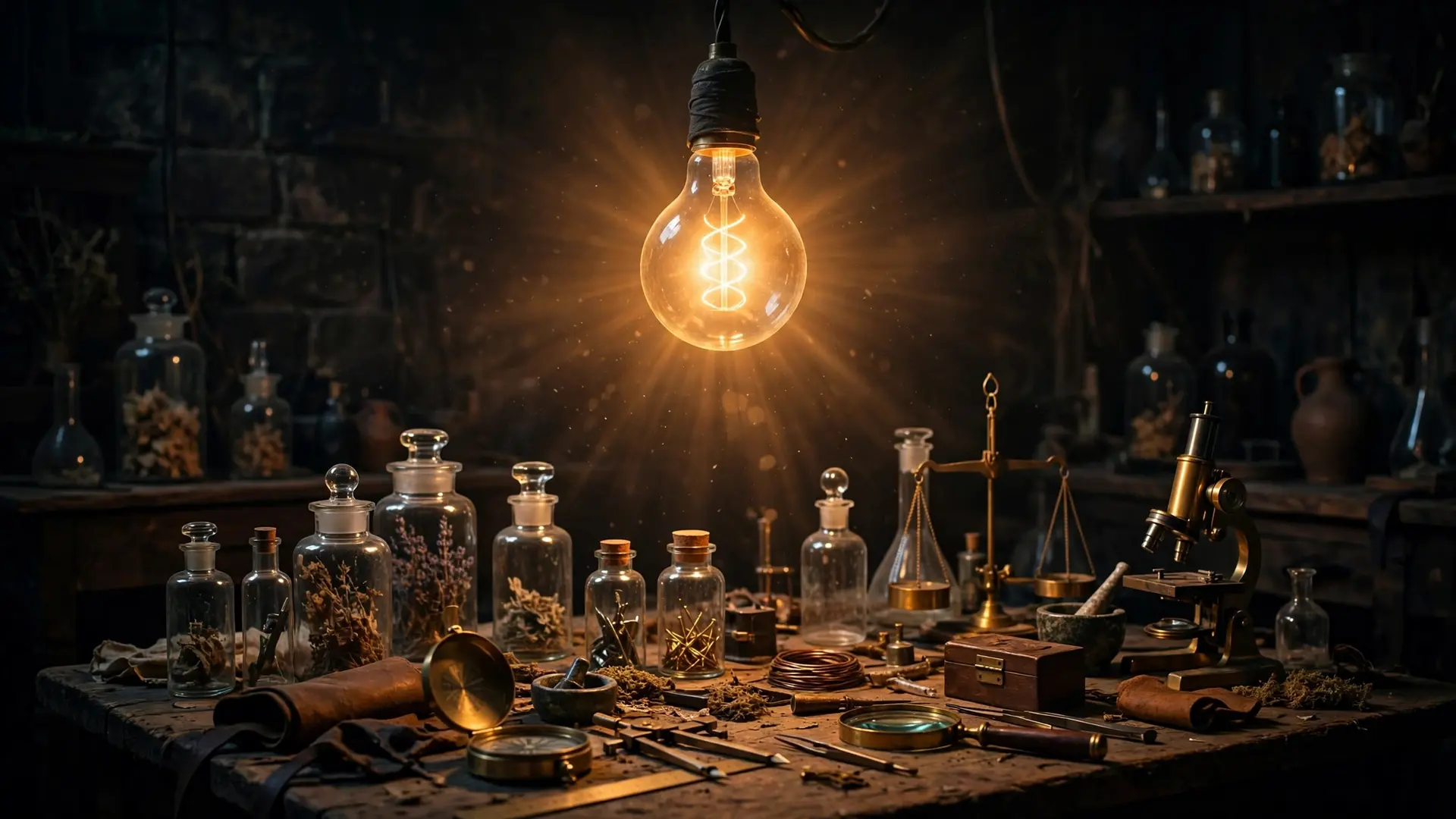
Ask most people who invented the light bulb and they will answer instantly: Thomas Edison. The real answer is messier and more interesting. By the time Edison's famous test glowed in October 1879, experimenters had been making electric light for nearly eighty years. Edison did not invent the light bulb. He invented the light bulb that worked — and the world it worked in. That distinction matters, because it changes what "invention" means. Edison's genius was not the glass globe or the glowing wire. It was turning a laboratory curiosity into something ordinary: a lamp cheap enough to sell, durable enough to use, and wired into a system that could light a city.
Who was making electric light before Edison?
The principle is older than anyone expects. In 1802, the English scientist Humphry Davy passed a powerful electric current through a thin strip of platinum and produced incandescent light — a wire made to glow white-hot. Around the same time he demonstrated the electric arc, an even brighter light made by current jumping between two pieces of charcoal. Arc lamps went on to light lighthouses and factories, but they devoured their electrodes in minutes and blazed far too brightly for a parlor. Shrinking that glare into a household lamp took most of the nineteenth century. Inventor after inventor tried. Warren De la Rue sealed a platinum filament inside an evacuated glass bulb in 1840 — elegant, but platinum was far too costly for a commercial lamp. Frederick de Moleyns won the first patent for an incandescent lamp in 1841. In 1874, the Canadians Henry Woodward and Mathew Evans patented a lamp of carbon rods in a nitrogen-filled cylinder; they never managed to sell it and eventually sold their patent rights to Edison. The closest rival to Edison was Joseph Swan, a British chemist from the northeast of England. Swan had been experimenting with carbonized paper filaments since 1850, and once better vacuum pumps arrived in the 1870s, he moved fast. On December 18, 1878, he demonstrated a carbon-rod lamp to the Newcastle Chemical Society; he repeated the demo that January, and on February 3, 1879, showed it to 700 people at the Literary and Philosophical Society of Newcastle — the first public building ever lit by electricity. Swan went on to light his own house at Gateshead, Mosley Street in Newcastle became the first street lit by incandescent lamps in 1880, and in 1881 the Savoy Theatre in London became the first theatre lit entirely by electricity. His bulbs worked. What they could not do was work cheaply: with low electrical resistance, they demanded enormous currents and thick, expensive wiring.
What did Edison actually do differently?
Edison began serious work on electric light in 1878, and he attacked the problem as a businessman as much as an inventor. He understood that a lamp alone was worthless. For electric light to compete with gas, the whole system had to make economic sense — and that dictated the design of the bulb itself. Thick copper wiring for a whole city would be ruinously expensive, so the lamp had to draw only a little current. A lamp that draws little current needs high electrical resistance and low voltage. Edison settled on roughly 110 volts and set his laboratory to find a filament to match. The famous test came on October 22, 1879, at his Menlo Park laboratory in New Jersey. A carbonized cotton thread, sealed in an evacuated glass bulb, glowed steadily for 13.5 hours. It was not the first incandescent lamp ever made — but it was the first one that was long-lived enough, cheap enough, and reproducible enough to be a product. Edison filed his patent on November 4, 1879, and it was granted on January 27, 1880, as U.S. Patent 223,898. Then came the refinement. Edison and his team tested materials relentlessly — platinum, papers, woods, fibers — and eventually found that carbonized bamboo, of all things, could burn for about 1,200 hours when paired with an improved vacuum pump. On New Year's Eve 1879, Edison staged a public demonstration at Menlo Park: about 70 lamps with Bristol-board filaments, each lasting roughly 125 hours, lighting the buildings and grounds for invited crowds. By early 1880 he was selling improved bamboo-filament lamps rated around 600 hours. At that demonstration he made his famous promise: "We will make electricity so cheap that only the rich will burn candles." But the lamp was only half the achievement. Edison patented the surrounding system too: current divided into parallel branches so one burned-out lamp would not darken the street, the wiring, the meters that billed customers by usage. He had formed the Edison Electric Light Company back in 1878 with financiers including J.P. Morgan and the Vanderbilts, so the money was ready the moment the lamp was. He was not selling glass bulbs. He was selling light by the hour.
What happened with Joseph Swan?
If Edison's story ended there, it would be a clean tale of the better system winning. But Swan had been there first in public, and his British patents were formidable. The two men were on a collision course, and the result was the most sensible outcome in the history of invention rivalries: they merged. In 1883, the Edison and Swan United Electric Company — Ediswan — was formed to sell lamps in Britain using both men's work.
The patent wars did not stop at the merger. In October 1883, the U.S. Patent Office ruled that Edison's lamp patents were based on the prior art of another inventor, William Sawyer, and declared them invalid. Nearly six years of litigation followed, until a judge ruled in October 1889 that Edison's claim for "a filament of carbon of high resistance" was valid after all. Invention, it turns out, is decided as much in courtrooms as in laboratories. The historian Thomas Hughes later put Edison's achievement in its proper frame: the lamp itself was a small component in a far larger system of electric lighting, no more critical than the generators, the mains and feeders, and the parallel-distribution network. Other inventors built lamps just as clever, Hughes argued, and have been forgotten precisely because they never built the system that carried their lamps into the world. As historians Robert Friedel and Paul Israel concluded, what made Edison's version the first practical implementation was the combination: an effective filament material, a better vacuum, a high resistance that made centralized power distribution economical, and every associated component a lighting system required.
Why does Edison get all the credit?
Because we remember products, not systems — and Edison built both. Swan lit the first house, the first street, and the first theatre with electric light, all real achievements. But Edison lit them as part of a business: a financed company, a patented network, a metered utility, a promise of cheap light that pulled investment and demand behind it. The Smithsonian notes that the publicity from his New Year's Eve demonstration helped accelerate the electrification of the world — the so-called Second Industrial Revolution. There is a lesson in the light bulb's true history that applies far beyond lighting. Invention is rarely a single flash in a single mind. It is a relay: Davy proved the principle, De la Rue and Woodward and Evans and Swan carried it forward, and Edison — arriving nearly eighty years after Davy's glowing platinum strip — ran the final leg, the one that crossed the finish line into people's homes. The bulb on your ceiling is Edison's. The idea behind it belongs to a crowd. For more on invention's happy accidents, read about the accidental invention of the microwave oven. To see what Edison's system grew into, explore how solar panels turn sunlight into electricity, and revisit the steam engine that powered the first industrial revolution.
Frequently asked questions
Did Thomas Edison really invent the light bulb?
Not from scratch. Electric light had been demonstrated for decades, and Joseph Swan showed working incandescent bulbs before Edison's. Edison's contribution was the first commercially practical lamp and the complete lighting system around it.
How long did Edison's first successful light bulb last?
His carbonized cotton filament test of October 22, 1879 burned for 13.5 hours. Later carbonized bamboo filaments reached about 1,200 hours, which made the bulbs commercially viable.
Who was Joseph Swan and what happened between him and Edison?
Swan was a British chemist who demonstrated incandescent lamps publicly in 1878-79 and lit homes and streets in Newcastle. His British patents were strong enough that Edison merged with him, forming the Ediswan company in 1883.