How Did Ancient Egyptians Light Deep Tomb Corridors?
Ancient Egyptians lit tomb corridors with oil lamps, wicks and torches. Archaeology shows no trace of mirrors or electric-style bulbs, only soot and flame.
Key takeaways
- Ancient Egyptian tomb workers used small oil lamps with linen wicks burning olive or castor oil as their main light source.
- Written records confirm the system: lists of linen wick deliveries for tomb work survive from the Valley of the Kings.
- Clean-burning oil leaves little soot, which is why some unopened tombs show no ceiling stains; most soot came from later visitors.
- The 'Dendera lightbulb' reliefs actually show a serpent god emerging from a lotus flower, not an incandescent bulb.
- Mirrors, batteries, and electric lighting have zero archaeological evidence behind them in ancient Egypt.
Ancient Egyptian builders lit tomb corridors with small oil lamps, linen wicks soaked in olive or castor oil, plus some torches. Clean-burning oil leaves little soot, which explains the surprisingly clean ceilings, and most of the soot we do see came from later visitors. Claims of electric lights or giant mirrors have no supporting evidence.
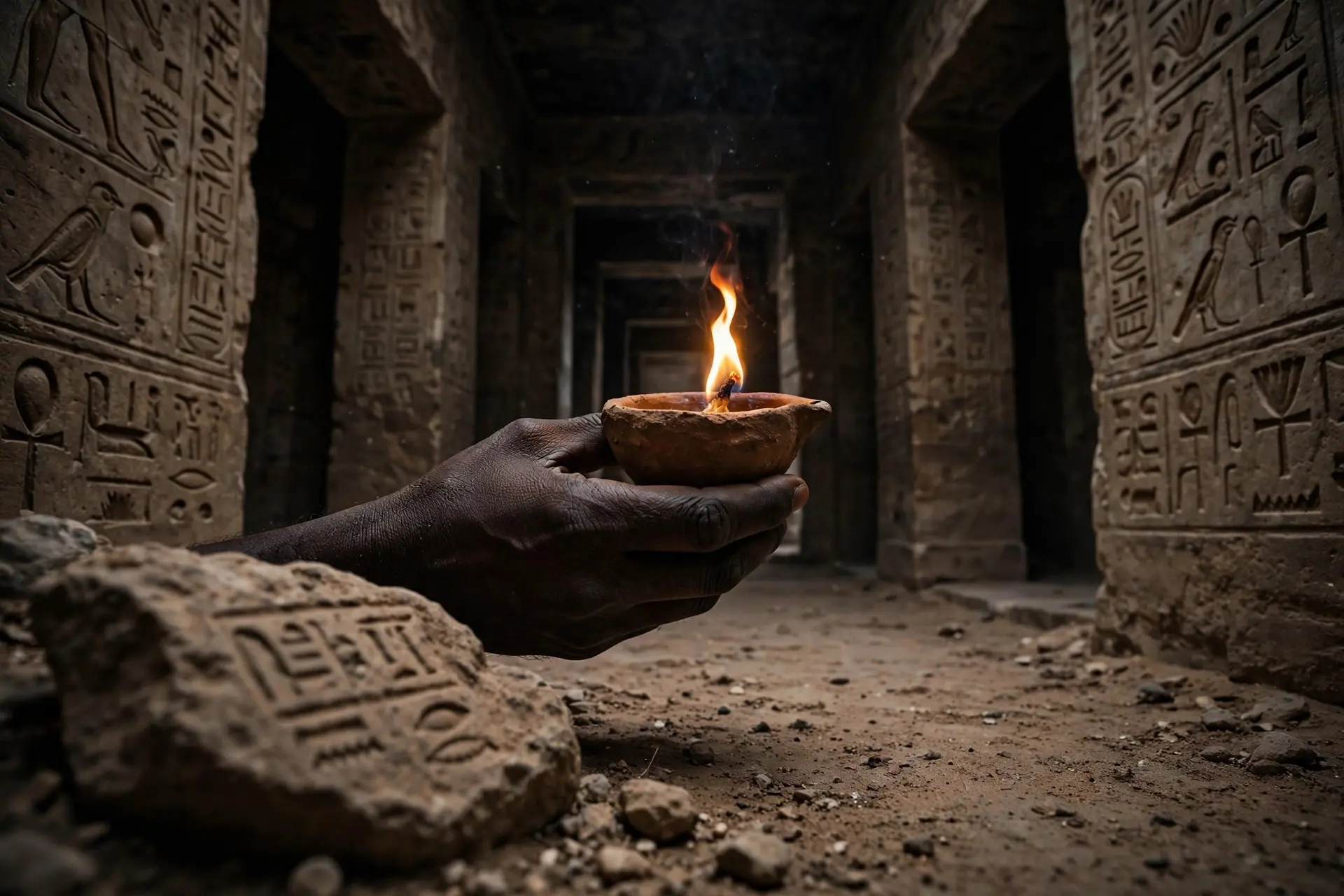
- Oil lamps were the main source of light for tomb work, sometimes shown on tomb reliefs as open receptacles with a base made to be grasped in the hand. (Catchpenny Mysteries)
- Administration kept up with illumination: Dieter Arnold notes distribution lists of linen wicks for work in the Valley of the Kings, and Kent Weeks found ostraca receipts for wicks among the rubble of KV5. (Catchpenny Mysteries)
- Some lamps were little more than open dishes with a floating wick and a pinched pouring rim; each gave meager light, so many must have burned at once to work by. (Catchpenny Mysteries)
- Olive oil burns fairly clean, and adding salt may have kept soot down further; the lamps may also have been covered in some way to cut smoke. (Catchpenny Mysteries)
- Torches existed too: 10- to 15-inch wooden torches with resin-soaked linen tops were found at Deir el-Medina, though they may have served ritual processions rather than daily work. (Catchpenny Mysteries)
- The soot caked on the ceiling of the Temple of Hathor at Dendera comes mostly from later periods, including 18th- and 19th-century visitors exploring with lit torches. (Tales of Times Forgotten)
What did a tomb lamp actually look like?
Forget the romantic brass lamp of the storybooks. An Egyptian work lamp was a small pottery or stone dish, sometimes alabaster for the wealthy, with oil inside and a linen wick floating on top. One edge of the rim was often pinched into a spout for pouring. A workman could grip the base, set the dish on a ledge, or carry it along the corridor.
The fuel mattered more than the vessel. Vegetable oils such as olive, sesame, and castor oil were the standard fuels, and castor oil lamps in particular burn clean enough to leave almost no soot. That detail is the quiet answer to a loud internet debate: tomb ceilings that have been sealed since antiquity look clean because the original lamps barely stained them, not because the builders had some secret light source. And they did not keep lamps burning all the time. Tombs were dark between ceremonies; workers lit lamps for specific tasks and extinguished them after, which limited the total soot any campaign of work could produce.
How do we know lamps, not mirrors?
The evidence is administrative as well as physical. Ancient Egypt ran on paperwork, and its scribes recorded deliveries of linen wicks for work in the Valley of the Kings. Archaeologists have dug up lamp fragments, and tomb paintings show figures carrying torches. Oil lamps of ancient types have been excavated across Egypt in large quantities. Mirrors, the popular alternative theory, have no such support. The idea is that sunlight was bounced down the corridors off polished copper. But no ancient source describes it, and it fails a practical test: the beams would have to be retracked constantly as the sun moved, and the beam's path would always be blocked by the workman himself. Compare that with oil lamps, which the Egyptians demonstrably owned in bulk, and the mystery dissolves. This pattern, of favoring elaborate theories over documented tools, also runs through how Egyptian obelisks were raised: the surviving evidence points to rope, sand, and levers, not lost technology.
What about the famous "Dendera lightbulb"?
The single most cited piece of "evidence" for ancient Egyptian electricity is a set of three reliefs in the southern crypt of the Temple of Hathor at Dendera. Believers read them as incandescent bulbs: the stem of a lotus as a wire, a bubble around a serpent as the glass, the serpent as the filament. Look closely and the reading collapses. The reliefs show the god Harsomtus arising as a serpent from a giant lotus flower, surrounded by a bubble of magical energy, a well-attested scene from Egyptian mythology about creation. The "filament" is a snake with visible eyes and a mouth. A real filament is a horizontal wire connected on both sides; the Dendera serpent is attached to the lotus only at its tail, with its head free. Nothing about the image functions as a bulb, and the temple itself was built in the well-documented Hellenistic and Roman periods, when we would expect records of electric lighting if it existed. There are none.
The soot argument fails just as cleanly. Supporters claim tombs lack soot, therefore flames were never used. In reality, many ceilings are absolutely caked in soot, like Dendera's hypostyle hall. But that soot is mostly later: from the Byzantine period onward, squatters lived in the tombs, and 18th- and 19th-century explorers routinely explored with torches. Meanwhile the tombs with the cleanest ceilings have usually been cleaned by modern restoration experts. One famous graffito in the Tomb of Ramesses IV, left by a frustrated Byzantine visitor, complains in Greek: "I cannot read the writing on the wall."
Myth versus fact: tomb lighting
| The claim | What the evidence says |
|---|---|
| No soot on ceilings proves no flames were used | Sealed tombs show little soot because castor oil lamps burn clean; soot-heavy ceilings mostly got their soot from later visitors |
| The Dendera reliefs show lightbulbs | They show the serpent god Harsomtus emerging from a lotus flower; the "filament" has eyes, a mouth, and only one attachment point |
| Mirrors bounced sunlight down corridors | No ancient source or artifact supports this; workers would constantly block the beam |
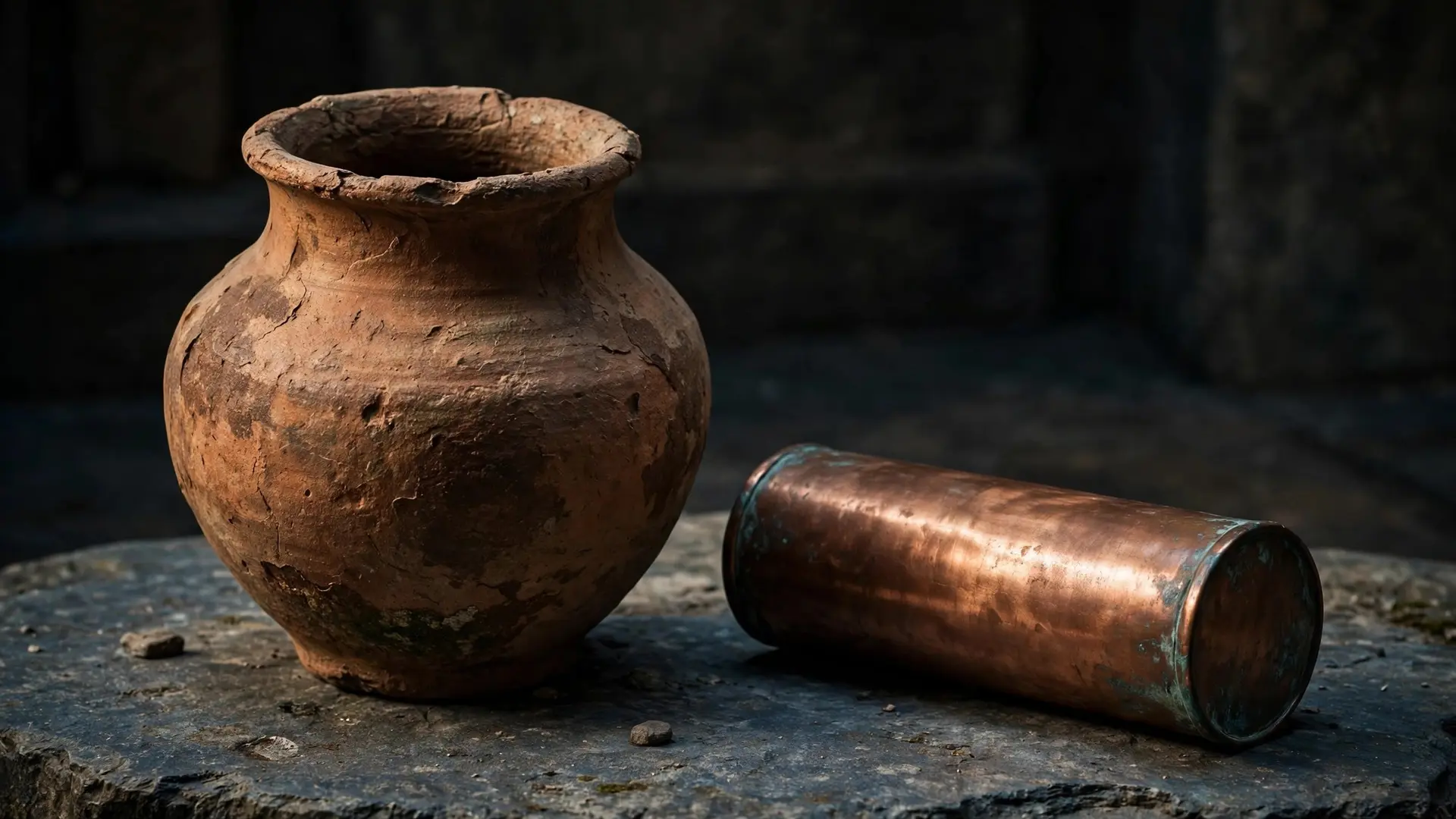
| The Baghdad Battery proves electric lighting | It is a 2,000-year-old Parthian clay jar from near Baghdad with a copper cylinder inside; no electrical apparatus or purpose has been proven |
Why the ordinary answer wins
The principle at work is the unglamorous one: the Egyptians solved a daily problem with tools they already owned. They made pottery dishes, pressed oil from olives and castor beans, wove linen wicks, and kept bureaucratic lists of the supplies. We can hold these lamps in museums. We can read the wick receipts. We cannot hold an ancient lightbulb, because none exists. That is also why the tomb corridors could stay dark for centuries at a time. The Egyptians did not need permanent lighting underground; they needed portable light for the weeks or months of decoration, the way a modern restorer needs a work lamp. Moving those enormous loads of stone for the pyramids was a daylight job anyway; most pyramid chambers were built in open ditches and roofed over afterward, so the so-called mystery of the missing soot never applied to them at all. The ancient Egyptians did not light their tombs with electricity. They lit them with oil, wicks, and careful bookkeeping, and the traces are still on the ceilings for anyone willing to look past the legend. How we made this article: FactSpire researched and drafted it with AI assistance and checked every fact against the sources listed above.
Frequently asked questions
Why don't Egyptian tomb ceilings have more soot?
The decorators likely used castor oil lamps, which burn clean and leave almost no soot, so clean ceilings are exactly what you would expect. Ceilings that do show soot are often caked in it, but that soot mostly came from later centuries: Byzantine squatters, 18th- and 19th-century explorers with torches, and tomb robbers. Many clean ceilings were also scrubbed by modern restoration teams.
Did the Egyptians really use mirrors to light tombs?
Probably not. Mirrors are sometimes suggested, but no evidence shows they were used this way. A mirror relay would be impractical: each beam would have to track the moving sun constantly, and the workers themselves would keep blocking the path of the light. Oil lamps, which we know the Egyptians had in large quantities, solve the problem simply.
What is the Dendera lightbulb?
It is a modern misreading of three relief carvings in the southern crypt of the Temple of Hathor at Dendera. They show the god Harsomtus arising as a serpent from a giant lotus flower inside a bubble of magical energy. The 'filament' is a snake with eyes and a mouth, attached to the flower only at its tail: nothing like a lightbulb's wired filament.
Did ancient Egyptians have electric lighting?
No. Electric lighting is never mentioned in any ancient Egyptian source, and archaeology has found no lightbulbs, filaments, power plants, or wiring. What archaeologists have found in large quantities is ancient oil lamps. The Baghdad Battery, sometimes cited, is a 2,000-year-old Parthian jar from near Baghdad with no proven electrical purpose.
Sources
- Tomb Lighting, Catchpenny Mysteries
- Did the Ancient Egyptians Have Electric Lighting?, Tales of Times Forgotten
- Lamp - New Kingdom - The Metropolitan Museum of Art, The Metropolitan Museum of Art