How Did the Nabataeans Carve Petra's Stone Treasury?
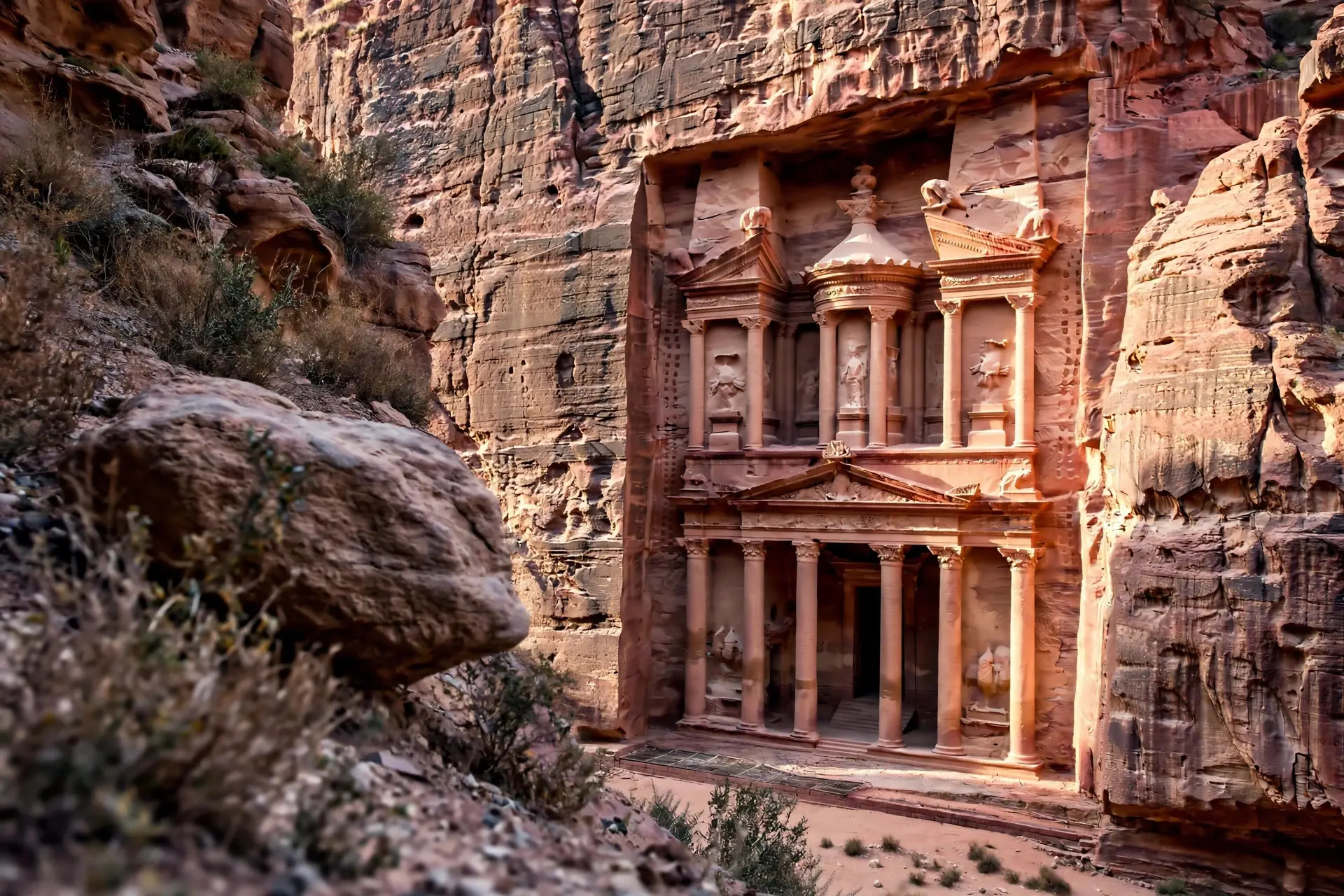
Petra's Treasury is a 39 m (128 ft) facade carved top-down from a single cliff. No scaffolding, no mortar. How did the Nabataeans carve Petra's Treasury?
Key takeaways
- Al Khazneh's facade is about 39 m (128 ft) high and was carved top-down from a single sandstone cliff.
- Masons used iron chisels and hammering tools, starting from a rock-cut platform at the top.
- The famous stone urn is solid rock; bullet marks came from treasure hunters chasing a myth.
- Built in the 1st century BC, it was likely a royal tomb, possibly for King Aretas IV.
Nobody built the Treasury at Petra. There was no first stone, no scaffolding and no crane: Nabataean masons started at the top of a cliff and cut their way down, standing on the rock they had not cut yet. The 39 m (128 ft) facade that emerged, complete with Corinthian columns and a stone urn, came from removing rock, not adding it.
- The facade measures about 39 m (128 ft) high and 25 m (82 ft) wide, carved straight into the sandstone cliff at the end of the Siq canyon.
- The work followed a descending method: carving began at the uppermost part and moved downward, so debris never damaged finished sections.
- Small hand-size holes climb both sides of the building, like scaffolding; experts believe a master builder led masons who started from a rock-cut platform at the mountain's top.
- Iron chisels and hammering tools detached the sandstone in layers, and reference lines were likely marked on the rock before cutting began.
- The whole monument is one single rock mass: no structural joints, no assembled blocks, no second chances if a cut went too deep.
- The urn on the crown is solid sandstone; its bullet marks come from later attempts to break it open in search of a supposed treasure.
How was the Petra Treasury carved?
Rough shaping came first: masons blocked out the facade's two great tiers, the lower portico and the upper level with its central round structure, the tholos. Then sculptors refined the details, six Corinthian columns with acanthus-leaf capitals below, and the slender tholos columns with the domed roof and urn above. The sandstone itself shaped the design: harder layers took the finest detail, while softer layers were left slightly thicker to keep the facade stable. The design blends Greek Corinthian architecture with Egyptian and local traditions, a fitting style for a city that grew rich on trade between Arabia, Egypt and the Mediterranean. The Nabataeans were Arab traders who rose to power around the 4th century BC, and their wealth paid for more than 600 monumental tombs across Petra. The Treasury dates to the 1st century BC, likely the reign of King Aretas IV (9 BC to AD 40).
Why did the Nabataeans carve from the top down?
Gravity and caution. Starting at the crown meant the masons always stood on solid, uncut rock while shaping the most delicate architectural elements. Every chip they cut fell away from the finished work instead of onto it. And because a single overcut could never be undone, the top-down order let them judge each cut against the whole composition as it grew. The same logic explains the plain interior. Behind the grand facade, the chambers are shallow, undecorated rooms with ceilings that follow the sandstone's natural layers. The architectural effort went almost entirely into the exterior, which faced the canyon exit, visible only after the final bend of the 1.2 km (0.75 mile) Siq. This was a monument designed for arrival: the full facade appears at once, framed by the gorge.
Myth vs fact: what the Treasury really is
| Myth | Fact |
|---|---|
| It was built, stone by stone | It was carved top-down from a living cliff; nothing was ever added |
| The urn hides a pharaoh's gold | The urn is solid sandstone, carved from the same rock as the facade |
| It was a bank or treasury | It was likely a royal tomb, possibly for King Aretas IV; its purpose is still debated |
| The Nabataeans invented the style alone | The facade blends Greek Corinthian, Egyptian and local traditions |
| The carving is a thin skin on the rock | The interior chambers are real rooms, excavated deep into the cliff |
The name "Treasury" comes from the Bedouin belief that the urn held a hidden hoard. Google Arts & Culture confirms the bullet holes at the base of the central tower were shot by local Bedouins hunting that treasure. The Nabataean gods Dushara and Al-'Uzza watched over the real structure instead.
What most people get wrong about the Treasury
"Petra was lost until 1812." The Swiss explorer Johann Burckhardt was the first Westerner to reach it in modern times, but the local Bedouin knew it all along. "Rediscovery" is a European story, not a universal one. "The Treasury is Petra's most important building." It is the most photographed, not necessarily the most important. The city also held a theatre carved for thousands, a colonnaded street, and a water system of dams, channels and cisterns that let 20,000 people live in a desert that gets only a few inches of rain a year. Read about Petra's hidden water engineering to see the other half of the achievement. "Sandstone carving is easy." Fresh Petra sandstone cuts more readily than many rocks, but the Treasury's details have weathered for 2,000 years under wind, moisture and temperature swings. An earthquake on May 19, AD 363, cracked the walls and destroyed half the city, yet the facade still stands, because it is the mountain itself. "The Nabataeans disappeared." Roman annexation in AD 106 and shifting trade routes shrank the city, but the Nabataeans' rock-cut craft echoes in later stonework traditions, from Inca walls fitted without mortar to the techniques used to move Egypt's pyramid stones.
Why the Treasury still stops people in their tracks
Jordan's Ministry of Tourism calls Petra one of the new Seven Wonders of the World, and the Treasury is its front door. But the real wonder is the method: a building made by subtraction, finished at the crown while the base was still raw cliff. Somewhere in Petra there are unfinished tombs that show exactly that moment, crown complete, rock below untouched. The Treasury is simply the one they finished, and it proves that the Nabataeans' greatest tool was not the chisel but patience. How we made this article: FactSpire researched and drafted it with AI assistance and checked every fact against the sources listed above.
Frequently asked questions
How was the Petra Treasury carved?
Nabataean masons started from a rock-cut platform at the top of the cliff and chiseled downward with iron chisels and hammers, standing on rock they had not yet cut. The whole facade, about 39 m (128 ft) high, was cut from a single sandstone mass, with no joints or added blocks.
Is there really treasure hidden in Petra's Treasury?
No. The stone urn on the crown is solid sandstone, carved from the same rock as the facade. Bullet marks on it come from later attempts by local inhabitants to break it open in search of a treasure that never existed.
What was the Treasury actually used for?
Its exact purpose is still debated, but scholars believe Al Khazneh was a royal tomb, possibly for the Nabataean king Aretas IV, who reigned from 9 BC to AD 40. The plain interior chambers are far smaller than the grand facade suggests.
When was the Treasury carved?
It dates to the 1st century BC, during the peak of Nabataean power. Petra itself was founded around the 4th century BC by Arab traders, and the city held more than 20,000 people by AD 50.
Sources
- Petra • Treasury (Al Khazneh) - A Masterpiece of Nabatean Artistry, Travel Video
- Petra — Google Arts & Culture, Google Arts & Culture
- Petra - ministry of tourism and antiquities, Jordan Ministry of Tourism and Antiquities
- The Nabataeans: How the Masters of the Desert Built the Rose-Red City of Petra, The Archaeologist