Noctilucent Clouds: Why the Sky Glows After Sunset
These eerie blue clouds hover 82 km above Earth, glowing long after sunset. Discover how meteor dust, ice crystals, and ozone paint the summer twilight sky.
Key takeaways
- Noctilucent clouds are Earth's highest clouds, made of ice crystals roughly 80 km up in the mesosphere — far above ordinary weather clouds.
- They glow after sunset because sunlight still reaches them from below the horizon while the ground below lies in twilight shadow.
- Their electric blue color comes from ozone soaking up red and orange light before it reaches the clouds.
- Ice forms on 'meteor smoke' — dust left by burning meteoroids — during summer, when the mesosphere is paradoxically at its coldest.
- First noticed in 1885, these clouds are growing brighter and spreading toward the equator, possibly linked to greenhouse gases.
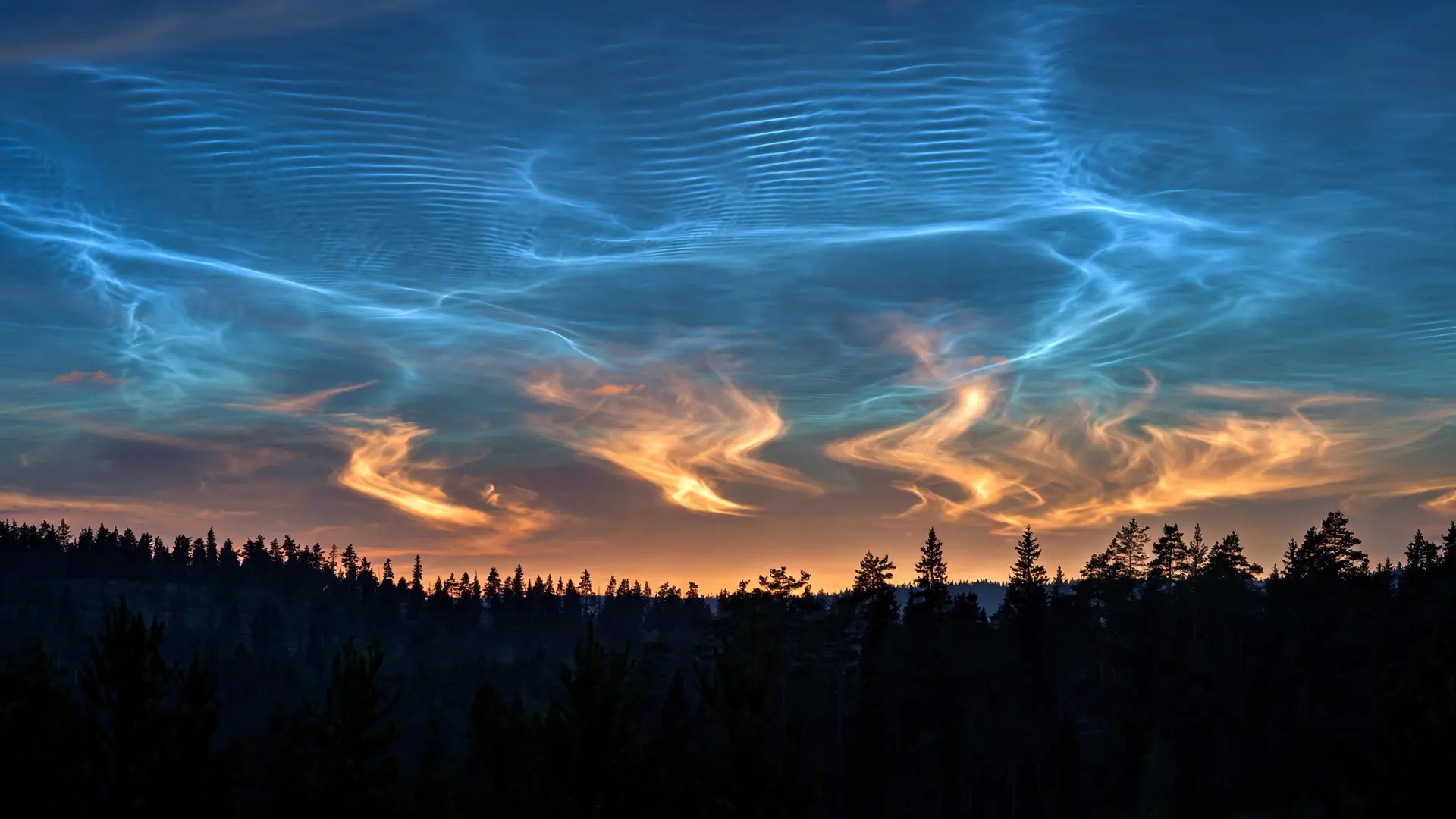
Noctilucent clouds glow after sunset for a beautifully simple reason: they float roughly 80 kilometers above the ground, so sunlight still reaches them long after the Sun has dipped below your horizon. These wispy electric-blue veils are the highest clouds on Earth — sheets of ice crystals in the frigid mesosphere, shining in direct sunlight while the world beneath them lies in twilight shadow.
What exactly are noctilucent clouds?
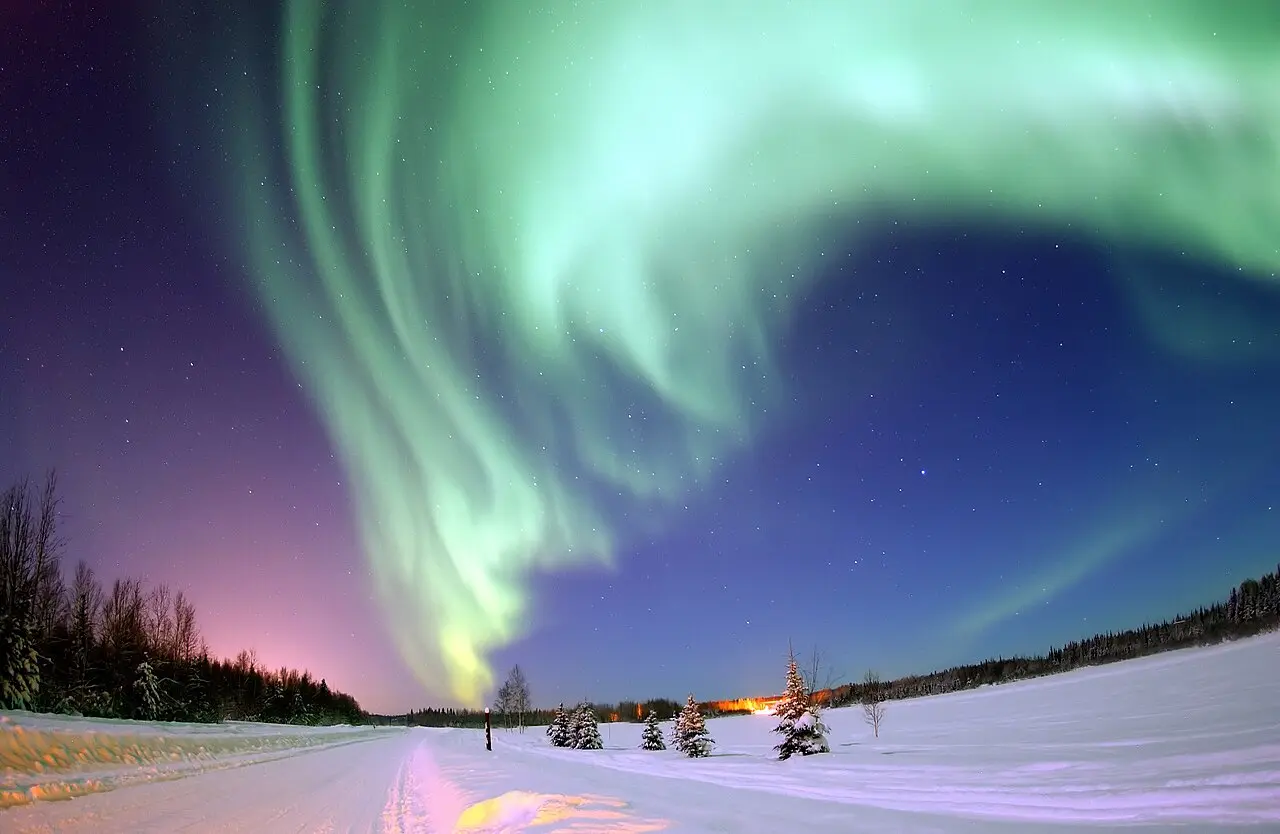
Ordinary weather clouds drift in the troposphere, the lowest layer of the atmosphere, which tops out around 11 miles above the ground. Noctilucent clouds live far beyond that realm — about 50 miles (roughly 82 kilometers) up, in a layer called the mesosphere. Nothing else in Earth's atmosphere forms clouds that high. Scientists actually use two names for the same phenomenon, depending on the viewpoint. Seen from space by satellites, they are called polar mesospheric clouds. Seen from the ground, typically from locations near the poles, they are noctilucent clouds — from Latin roots meaning "night-shining." They consist of tiny ice crystals, and on a summer night they unfurl across the sky in rippled bands, streaks, and fibrous tendrils of unmistakable blue. That color is worth pausing on. Unlike the aurora borealis, which is the upper atmosphere glowing under a rain of charged particles from the Sun, noctilucent clouds shine only with borrowed light. The blue is painted by our own atmosphere: the ozone layer absorbs red and orange wavelengths from the sunlight striking the clouds, tinting what reaches your eye an otherworldly electric blue. It is a trick of optics, not of emission — closer in spirit to why the sky is blue than to any aurora.
Why do they stay lit after the Sun sets?
The glow is pure geometry. Once the Sun sinks below your horizon, darkness climbs upward through the atmosphere layer by layer. Low clouds go dark first; higher ones keep catching the last light a little longer. At 80 kilometers up, the clouds' horizon sits far beyond yours, so they remain in direct sunlight for one to two hours after sunset — and they brighten again before dawn for the same reason.
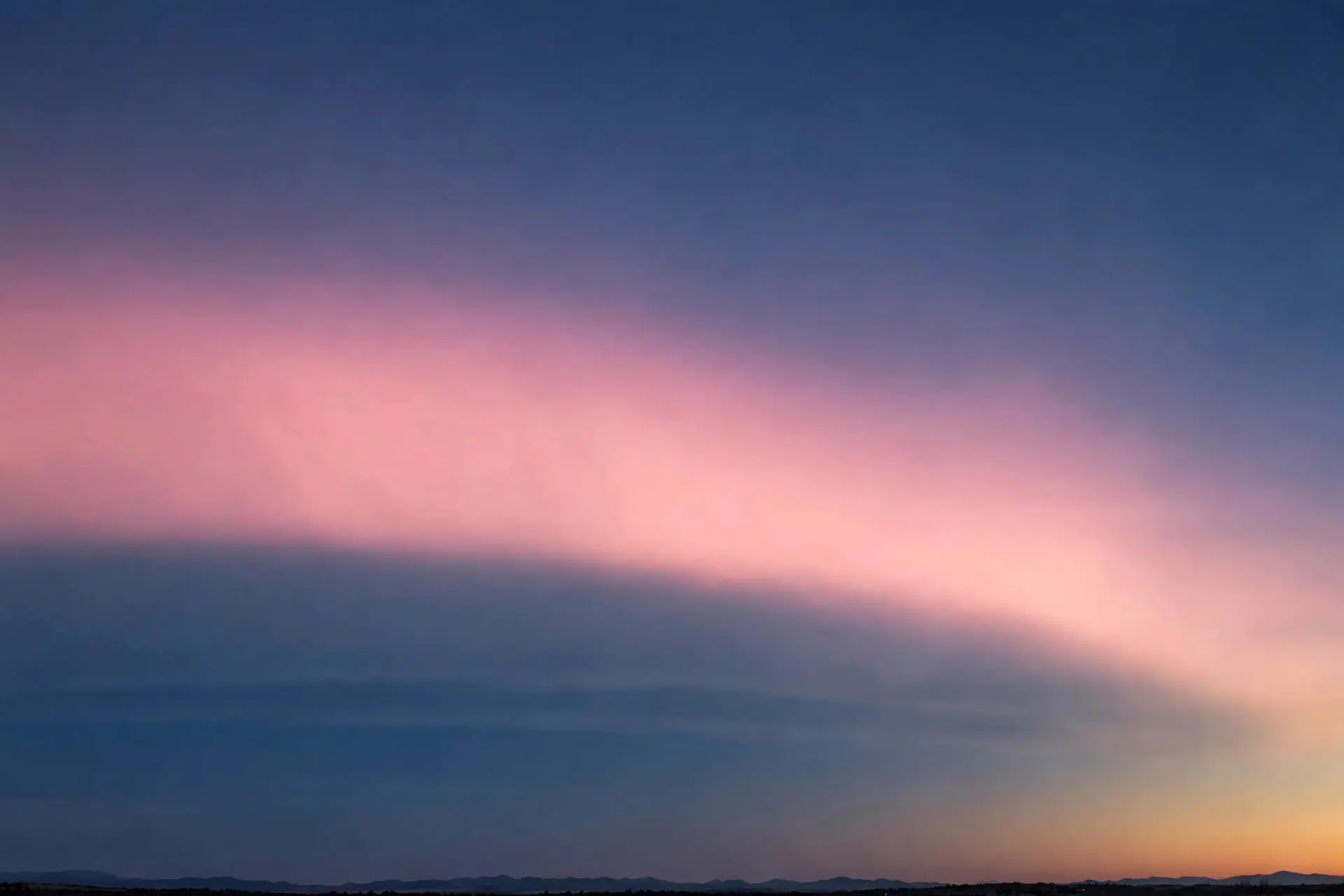
That is why the classic viewing window is so specific: roughly half an hour to two hours after sunset, or the mirror image before sunrise. During full daylight the clouds are still there, but the bright sky washes them out completely. They are creatures of twilight, visible only when the observer and the lower atmosphere are in Earth's shadow while the clouds themselves remain sunlit. There is a practical pitfall here. High cirrus clouds can mimic noctilucent clouds, glowing faintly pink in the same twilight. The tell is altitude and behavior: cirrus sit far lower and fall into Earth's shadow earlier, turning dark while the noctilucent bands behind them keep shining blue. Experienced watchers also note that genuine displays hug the northern horizon from mid-latitudes, while cirrus can appear anywhere overhead.
How do ice clouds form at the edge of space — in summer?
The strangest fact about noctilucent clouds is their season. In the Northern Hemisphere they appear from late May to mid-August, peaking near the summer solstice; in the Southern Hemisphere the season runs from November to February. Ice clouds at the edge of space, forming in the warmest months of the year — it sounds backwards. It works because the mesosphere runs on inverted logic. Summer heat at the surface drives air upward; as that air rises it expands and cools, and the cooling reaches all the way up. The result is that the summer mesosphere is the coldest place in Earth's atmosphere, plunging to around minus 210 degrees Fahrenheit — cold enough for the trace of water vapor that reaches that altitude to freeze. But cold vapor alone is not enough; ice needs something to form on. The seeds are "meteor smoke" — the fine sooty debris left behind as meteoroids burn up in the upper atmosphere. Water vapor drifting up from below condenses onto these microscopic grains, growing the nanometer-scale ice crystals that scatter sunlight into those ghostly blue bands. Sulfur-rich volcanic gases can serve as secondary nuclei, and rocket exhaust, which is mostly water vapor and small ice particles, can contribute its own share once it climbs high enough. All of this favors the polar regions, because the mesosphere is coldest there. In the Northern Hemisphere, prime viewing latitudes run roughly 50 to 70 degrees north — across northern Europe, Canada, and the northern United States — where observers watch the bottom 20 or 25 degrees of the northern sky as the stars begin to appear.
Why are they spreading — and what does that mean?
Noctilucent clouds were first noticed in 1885, and for a long time they were a high-latitude specialty. That is changing. Ground stations and satellites have recorded displays growing brighter and more frequent, with sightings nudging equatorward — as far south as Kansas, Colorado, and even Los Angeles in recent years. NASA took the trend seriously enough that in May 2025 it asked citizen scientists to submit observations and photographs, past and present, to a crowdsourced project called Space Cloud Watch, to help work out why the clouds keep appearing at mid and low latitudes. One leading suspect is us. Greenhouse gases reshape the upper atmosphere in the opposite way from the lower one: methane drifting upward combines with hydroxyl radicals to create extra water vapor, and carbon dioxide — notorious for warming the surface — cools the mesosphere by radiating heat away as infrared. More moisture plus deeper cold means more ice, more often, farther from the poles. "The NLCs are very sensitive to both temperature and water vapor and they like cold and wet conditions," research scientist Lynn Harvey of the University of Colorado's Laboratory for Atmospheric and Space Physics told Sky & Telescope. "Every degree makes a big difference in the amount of clouds observed at a given location." Other forces play a role too. Ultraviolet light from the Sun varies with the solar cycle, heating and puffing up the outer atmosphere at solar maximum and letting it cool at minimum. And in 2022, the underwater eruption near Tonga hurled an enormous plume of water vapor skyward — moisture that takes roughly two years to circulate up to the mesosphere, where it may have turbocharged recent displays.
A twilight phenomenon worth a vigil
Twilight is full of strange optics — the green flash at the Sun's dying second, the pink belt of Earth's shadow rising in the east — but noctilucent clouds may be the most ethereal of them all: ice at the edge of space, seeded by stardust, lit by a Sun you can no longer see. They are not a warning sign on their own, just a sensitive instrument panel for the upper atmosphere, and one of the few places where climate change may be painting the sky a deeper blue. If you want to catch them, the recipe is simple. Pick a clear summer night, find a dark spot with an open northern horizon, and start watching about an hour after sunset. Bring a camera — the clouds' fine structure photographs beautifully — and if you spot those unmistakable blue ripples, consider sending the picture to science. The clouds are still full of unanswered questions, and the next data point could be yours.
Frequently asked questions
Why do noctilucent clouds glow after sunset?
They form about 80 kilometers overhead, so the Sun still strikes them from below the horizon for one to two hours after it has set for observers on the ground. The lower atmosphere sits in Earth's shadow while the clouds keep catching sunlight.
What makes noctilucent clouds blue?
The blue tint is imparted by the ozone layer, which absorbs the red and orange wavelengths from the sunlight reflected off the clouds, leaving them tinted electric blue.
When and where can you see noctilucent clouds?
Look one to two hours after sunset or before sunrise during summer — late May to mid-August in the Northern Hemisphere — toward the northern horizon, ideally from latitudes between about 50 and 70 degrees.
Are noctilucent clouds caused by climate change?
Possibly. Researchers suspect rising methane adds water vapor to the upper atmosphere while extra carbon dioxide cools the mesosphere — both conditions favor brighter, more widespread displays. The connection is still being studied.