The Opium Wars: Trade, Addiction, and Empire
Britain fixed its China trade deficit with opium — and when China fought back, gunboats kept the trade open. The story of addiction as an instrument of empire.
Key takeaways
- Britain fixed its China trade deficit by growing opium in India and smuggling it into China - by the early 1800s over a thousand tonnes a year.
- In 1839, Commissioner Lin Zexu confiscated some 20,000 chests of opium and destroyed them publicly at Humen.
- The Treaty of Nanking (August 29, 1842) ceded Hong Kong, opened five ports, and imposed a 21-million-tael indemnity - but never addressed opium.
- Opium was formally legalized only after the Second Opium War, in the 1858 Treaty of Tianjin, enforced by the 1860 Convention of Peking.
- In 1860, Anglo-French troops looted and burned Beijing's Old Summer Palace on October 18-19 in retaliation during the war's final phase.
In the early 1800s, Britain had a trade problem: China sold it everything and bought almost nothing. London's answer was to addict China — growing opium in British India, smuggling it into Chinese ports, and then waging two wars to keep the pipeline open. The Opium Wars were not wars about opium the way most wars are about territory. They were wars to protect a business model.
The Silver Drain
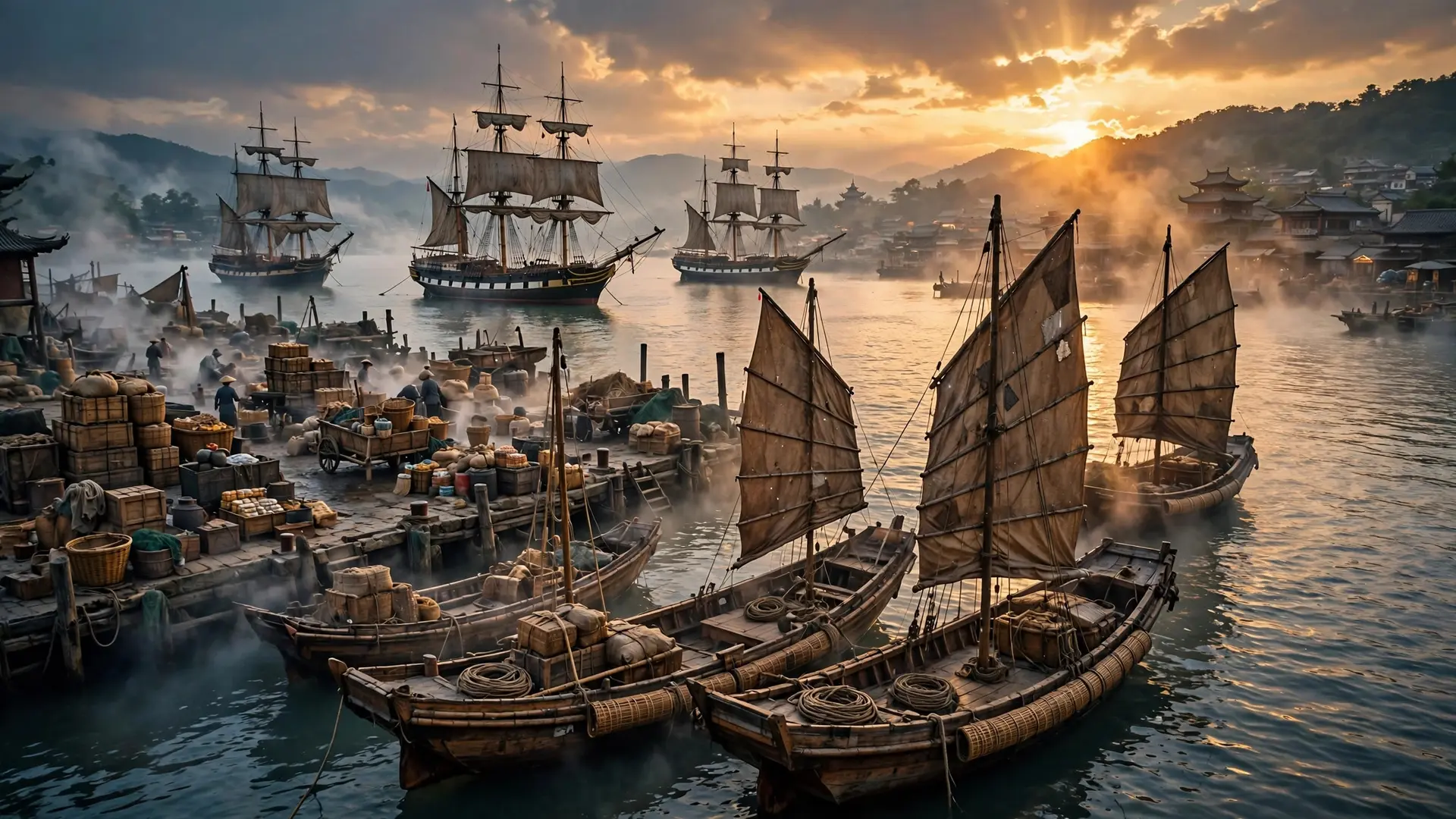
Britain's eighteenth-century appetite for Chinese goods was insatiable. Tea, silk, and porcelain poured into British ports — and China, which saw little it wanted from Britain's workshops, insisted on payment in silver. Silver was flowing out of Britain toward Asia at a rate that alarmed London's merchants and ministers. The fix arrived in the form of a flower. The British East India Company grew opium on its Indian plantations and sold it — officially at arm's length, through private traders — into China. The mechanism was brutally elegant: Chinese silver that flowed out to pay for tea was now flowing back to pay for opium. Addiction was not a side effect of this system; it was the system's growth engine. Demand did not fall when prices rose, which made opium the perfect counterweight to a trade deficit. China saw exactly what was happening. The imperial government banned opium outright in 1796. The ban was enforced unevenly — smugglers risked the death penalty by 1838 — and British merchants simply kept smuggling, by the early 1800s moving well over a thousand tonnes a year. By the 1830s, millions of Chinese were addicted and the empire's silver was hemorrhaging. For centuries, East–West trade had enriched intermediaries; now it was draining the Qing treasury to feed a drug habit it had outlawed.
Lin Zexu's Crackdown
In 1839, the Daoguang Emperor sent Commissioner Lin Zexu to the port of Canton with orders to end the trade. Lin was methodical and uncompromising: he confiscated some 20,000 chests of opium from British merchants, destroyed it publicly at the seaside town of Humen, and demanded that all foreign traders sign bonds pledging — on pain of death — to handle no more of the drug.
The British Superintendent of Trade, Charles Elliot, ordered merchants not to sign. London's response was not to accept the loss. The government seized on the confiscation as grounds for compensation claims — and when Parliament voted for war, the expedition was framed as a defense of free trade and British subjects. The reality on the ground was starker: in an early clash, two British warships scattered a Chinese fleet of nearly thirty junks, and from there the campaign was a rolling demonstration of industrial-era gunboats against an empire still fighting with matchlock muskets. By mid-1842, British forces had seized Hong Kong, occupied Shanghai and other key cities, and were threatening Nanjing.
The Treaty That Made Losing Profitable
The war ended with the Treaty of Nanking, signed on August 29, 1842 — the first of what China would call the "unequal treaties." Its terms redrew the rules of China–foreign trade: Hong Kong was ceded to Britain; five ports (Guangzhou, Xiamen, Fuzhou, Ningbo, and Shanghai) were opened to British residence and commerce; tariffs were fixed by mutual agreement rather than set by China; British subjects were exempted from Chinese law; and China was to pay an indemnity of 21 million silver taels — covering the destroyed opium, war debts, and the cost of the war itself. But the treaty did not do the one thing its name implied. It never addressed the opium trade. Opium was not legalized, not banned, not even mentioned in a way that slowed it. Freed from the old Canton restrictions, addiction in China doubled, and opium would not be formally legalized until the Treaty of Tianjin in 1858. The wars' second-order consequences were as grave as the first: with Qing customs collection in disarray, Westerners began staffing and managing China's maritime customs service, embedding foreign power directly inside the imperial bureaucracy.
The Second War and the Burning Palace
The settlement did not hold. In 1856, Chinese authorities seized the Arrow, a ship registered in Hong Kong, and in the same period a French missionary was executed — giving Britain and France, which wanted the opium trade legalized and all of China opened to merchants, their pretext for a second war. The 1858 Treaty of Tianjin promised all of that: ten more ports, rights for foreigners to travel and preach inside China, and the legalization of opium. When the Xianfeng Emperor refused to ratify it, war resumed.
In 1860 an Anglo-French force advanced on Beijing. Qing general Sengge Rinchen's troops were shattered at the Battle of Palikao, British diplomat Harry Parkes and others were taken hostage and some tortured, and the emperor fled the capital. In retaliation, Lord Elgin ordered his soldiers to loot and then burn the Old Summer Palace — the Yuanmingyuan, a vast imperial garden complex of pavilions and lakes. The palaces burned through October 18 and 19, 1860, a deliberate punishment that, Elgin wrote, would fall on the emperor himself rather than on the Chinese people. Beijing's fall forced the Convention of Peking on October 24, 1860: the Kowloon Peninsula was ceded to Britain, China paid 8 million taels of silver each to Britain and France, and the Tianjin terms — including opium legalization — took full effect. In the shadows of the same settlement, Russia extracted its own concessions: China ceded more than 1.5 million square kilometres of territory in the northeast, sealing off its access to the Sea of Japan. It was the beginning of what Chinese history would remember as the Century of Humiliation.
When Trade Needs Gunboats
Strip away the diplomatic language and the Opium Wars reveal a chilling economic logic. A trade deficit was fixed not by selling better goods, but by manufacturing an addiction — and when the addicted country tried to quit, the suppliers returned with warships to defend their market share. The treaties that followed did not merely end wars; they installed an enforcement system — fixed tariffs, extraterritoriality, foreign-run customs — that made resistance structurally impossible. Two common misconceptions deserve retiring. The first is that the wars were about "free trade" in any principled sense: Britain wanted the trade it wanted, in the goods it chose, on terms it dictated. The second is that opium was legalized as some pragmatic compromise: it was legalized at gunpoint, after a war fought to keep it flowing. Like the commodity manias that warped Europe's markets, the opium trade shows how commerce can detach from anything resembling mutual benefit — and how trade routes have always carried more than cargo. The scars are still visible. Hong Kong's century and a half under British rule, modern Chinese nationalism, and Beijing's long memory of foreign gunboats all trace back to these two conflicts. The Opium Wars ask an uncomfortable question that has not expired: when an empire calls something free trade, who is free — and who is paying?
Frequently asked questions
Why did Britain sell opium to China?
China bought almost nothing from Britain but sold tea, silk, and porcelain for silver, creating a trade deficit. Opium reversed the silver flow - and addiction guaranteed demand.
What ended the First Opium War?
The Treaty of Nanking, signed August 29, 1842: Hong Kong was ceded to Britain, five ports opened, tariffs fixed by agreement, and China paid 21 million silver taels.
When was opium legalized in China?
After the Second Opium War - the 1858 Treaty of Tianjin legalized it, with terms enforced by the Convention of Peking in 1860.
What happened to the Old Summer Palace?
In October 1860, British soldiers under Lord Elgin looted and burned the Yuanmingyuan, Beijing's vast imperial garden complex, as retaliation during the Second Opium War.