How Cai Lun Invented Paper in Ancient China
Paper was not born in 105 CE — but Cai Lun turned waste bark, hemp and old rags into the cheap, reproducible paper that conquered the ancient world.
Key takeaways
- Paper existed in China centuries before Cai Lun, but his 105 CE process made it cheap and reproducible from waste fibers.
- He mixed macerated tree bark, hemp waste, old rags, and fishnets — abundant garbage that became the empire's writing surface.
- The emperor commended his paper and it spread across the empire as 'the paper of Lord Cai.'
- Papermaking reached the Arab world via Samarkand after the 751 CE Battle of Talas, then slowly spread to Europe.
Everyone learns that a Chinese official named Cai Lun invented paper in 105 CE. The real story is more interesting: paper already existed, and had existed for centuries. Cai Lun's genius was something else entirely. He took the empire's garbage — bark, hemp trash, worn-out rags, old fishing nets — and turned it into a cheap, reproducible writing surface that dethroned bamboo and silk. Before Cai Lun, writing in China was a burden. Bamboo slips were heavy and clumsy; silk was light and lovely but far too expensive for ordinary use. What China needed was not a new material but a better process. Cai Lun delivered it.
What did Cai Lun actually do in 105 CE?
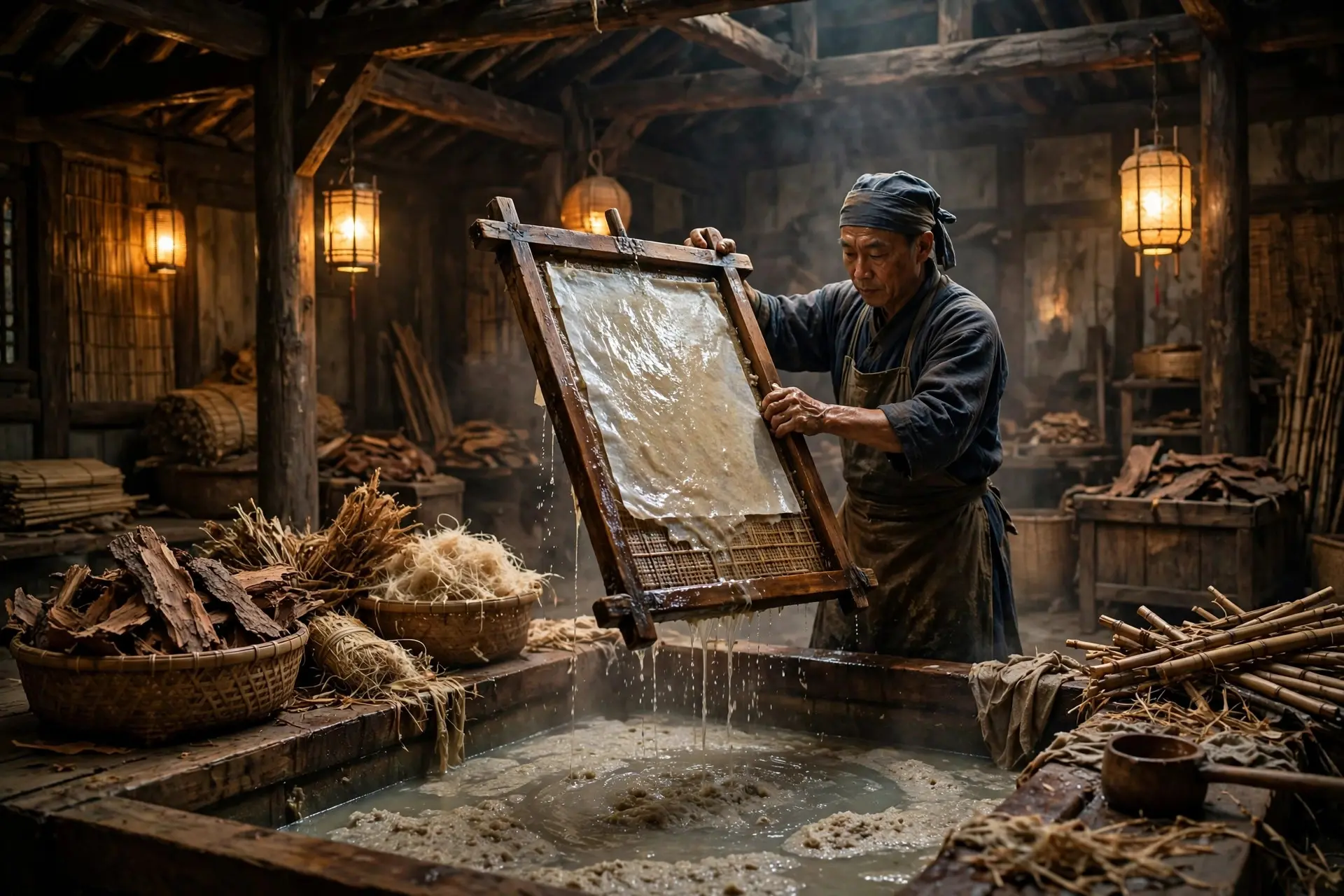
Cai Lun was a eunuch who entered imperial palace service in 75 CE, rose to become chief eunuch under Emperor Hedi in 89, and served as prefect of the palace workshop — the office in charge of making instruments and tools. Around 105 CE, he developed a way to form sheets of paper from macerated tree bark, hemp waste, old rags, and fishnets, beaten and boiled into pulp, then lifted on a screen and dried. The result was, by the account of historians, superior in writing quality to silk — the main writing surface of the time — and far cheaper, made from raw materials that were abundant and essentially free. He reported his discovery to the emperor, who commended him. Paper spread across the empire under the nickname "the paper of Lord Cai," and his apprentice Zuo Bo went on to make important improvements to the process.
The process itself was elegantly simple: waste fibers were soaked, beaten, and boiled into pulp, then formed into thin sheets and dried. Nothing in it was expensive or exotic. That was the point. Where silk demanded silkworms and weaving, paper demanded only water, waste, and patience — which is why a whole empire could adopt it within a generation. The nickname "paper of Lord Cai" shows how personally the achievement was tied to its inventor, even though the real story belongs to the centuries of anonymous craftsmen before him. For this, Cai Lun was named a marquess in 114 CE. His end was bleak: implicated in the death of Consort Song, he was ordered to answer for it — and chose to kill himself by drinking poison.
Who was Cai Lun, really?
Cai Lun was not a scholar or a craftsman by birth — he was a palace official. A eunuch who entered imperial palace service in 75 CE, he rose through the ranks to become chief eunuch under Emperor Hedi in 89 CE and was later made prefect of the palace workshop, the office responsible for manufacturing instruments and tools. He was, in other words, a man whose job was making things work at scale — the ideal profile for an industrial process improvement. He did not work alone. His apprentice Zuo Bo made important improvements to the papermaking process, a reminder that even "lone inventor" stories are usually team efforts. Cai Lun was rewarded for his paper with the title of marquess in 114 CE — and his life ended brutally soon after. Implicated in the death of Consort Song, he was ordered to answer for the charge and chose instead to drink poison.
If paper existed before him, what is he credited for?
Archaeology has pushed paper's origins back well before Cai Lun. Primitive hemp-based paper in China dates to the 2nd century BCE — one hypothesis holds that hemp clothes left soaking in wash water left a residue that could be pressed into sheets. Research from the University of Hamburg's Centre for the Study of Manuscript Cultures dates the invention to the 2nd–1st centuries BCE, with the oldest surviving book written on paper dated to 250 BCE.
So Cai Lun did not invent paper. He standardized it. Earlier papers were fragile, uneven, and not suited to writing. His process — boiling waste fibers into a consistent pulp and forming uniform sheets — made paper reliable enough, and cheap enough, to replace bamboo and silk at scale. The distinction matters: discovery versus industrialization, and Cai Lun's place in history is as the man who made paper practical.
How did paper spread across the world?
Papermaking traveled in both directions from China. To the east, it moved along the Silk Road into Korea and Japan over the following centuries. Chinese craftsmen guarded the technique much as they guarded silk — but secrets leak, and within a few centuries the east knew how to make paper. To the west, the spread has a precise turning point. After the Battle of Talas in 751 CE, where Arab forces defeated a Chinese army, papermakers were taken prisoner — and papermaking reached the Arab world via Samarkand. Baghdad became a major paper producer, and from the Islamic world the technique slowly spread to Europe, where paper would eventually fuel the age of print. The printing press later broke the knowledge monopolies paper had helped build, but paper made that revolution possible. The recipe kept evolving with demand. Early hemp paper gave way to rattan — until overharvesting nearly wiped it out in some regions — then to bamboo from the 8th century, and boiled mulberry bark under the Song dynasty. The first paper money appeared in Tang times, with real banknotes following around 1120 CE.
Why does Cai Lun's paper still matter?
Paper did for ideas what the Library of Alexandria tried to do for books: it made knowledge portable, copyable, and cheap. Every manuscript, newspaper, novel, and banknote of the next two millennia descends from a process invented to recycle waste fibers into writing sheets. Cai Lun's story also carries a warning about invention myths. History loves a single inventor and a single date. But paper, like most great technologies, was really the product of centuries of anonymous craftsmen — and one palace official who saw that the empire's garbage could become its memory.
Frequently asked questions
Who invented paper?
Paper existed in China from at least the 2nd century BCE, but Cai Lun — a Chinese palace official — is credited with standardizing it around 105 CE into a cheap, reliable process using bark, hemp waste, rags, and fishnets.
What did people write on before paper?
In China, the main writing surfaces were bamboo slips and silk. Cai Lun's paper was superior in writing quality to silk and far cheaper, which is why it spread so quickly.
How did paper reach the rest of the world?
Papermaking traveled east along the Silk Road to Korea and Japan, and westward it reached the Arab world via Samarkand after the Battle of Talas in 751 CE, then slowly spread to Europe.
How did Cai Lun die?
He was named a marquess in 114 CE, but after being ordered to answer for the death of Consort Song, he killed himself by drinking poison.