
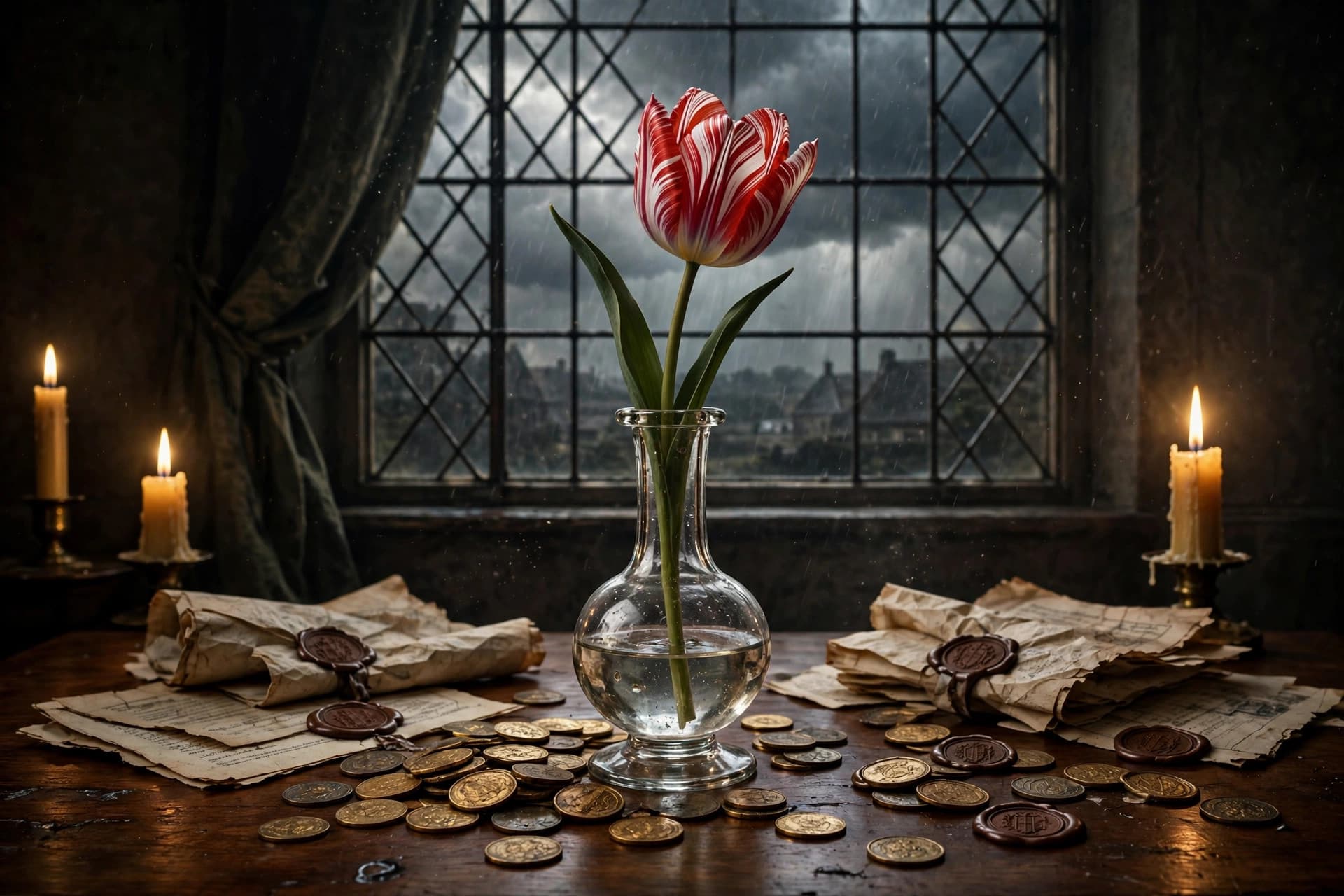
Yes — the Dutch really did bid the price of a house on a flower bulb. In the winter of 1636–37, single rare tulip bulbs in the Netherlands sold for sums that would make a modern day-trader blink. But almost everything else you have heard about "tulip mania" — a nation bankrupted, the economy in ruins, the first great lesson in crowd madness — was largely invented decades later by moralists. The real story, pulled from 17th-century Dutch archives, is weirder and more instructive: a short, strange futures market for a plant virus, and a crash that destroyed promises rather than fortunes.
A House for a Flower
To understand the prices, you have to understand the Dutch Golden Age. Freshly independent from Spain, Dutch merchants were getting rich on global trade, and the new wealthy class collected art and exotica to prove it. Tulips, imported from the Ottoman Empire through Constantinople, arrived in this gilded moment and quickly became a status marker: by 1634 it was a sign of being somebody to own rare ones.
The most coveted tulips were "broken" ones — bulbs that bloomed with striped, speckled, feathered petals. Today we know those famous stripes were caused by the tulip breaking virus (a tulip-specific mosaic virus): the most prized flowers were, botanically speaking, sick plants. The legendary Semper Augustus — white petals flamed with carmine on a blue base — belonged to a director of the Dutch East India Company who refused to sell, and scarcity plus obsession did the rest.
At the peak, prices reached levels that sound made up: roughly 5,000 guilders for a single rare bulb, about the price of a nice house in 1637. One variety, the Viseroij, went for 3,000 to 4,200 guilders at an Alkmaar auction on February 5, 1637 — and 3,000 guilders was about twenty times a skilled craftsman's annual salary. The common Switsers variety leapt from 125 guilders per pound on December 31, 1636 to 1,500 guilders per pound by February 1, 1637 — a twelve-fold jump in a single month. The prosperity that funded this frenzy was built on the same relentless ingenuity that let the Dutch reclaim their land from the sea — a small nation, rich fast, and increasingly sure the good times would never end.
Taverns, Contracts, and Bulbs Still in the Ground
Here is the part the legend usually skips: almost none of this trading involved actual bulbs. Tulips bloom in spring and are planted in autumn; in winter, the bulbs were in the ground. So the trade became a market in paper — futures contracts promising delivery of bulbs that were still buried, traded in taverns rather than on an exchange.
Buyers did not need cash and sellers did not need bulbs. A contract was a bet that the next person would pay more. Six companies were set up specifically to sell tulips, and ordinary people — weavers, merchants, a landscape painter named Jan van Goyen who agreed to pay nearly 1,800 guilders plus two paintings for forty bulbs just days before the crash — piled in. It was leverage without a lender, speculation without settlement, built entirely on trust: buyers pledged "all my goods, movable and immovable" to guarantee payment.
This is why the crash, when it came, behaved the way it did. There was almost no money to lose — just promises.
The Crash of February 1637
The market broke in early February 1637 with stunning speed. On February 3, a routine bulb auction in Haarlem failed to attract any buyers at all — the bidders simply did not show. Word of the empty room traveled from town to town within days. Sellers materialized everywhere; buyers vanished.
Two days after the Haarlem failure, traders met anxiously to decide what to do about contracts they had signed for bulbs now worth a fraction of the agreed price. The answer, in most cases, was to default. Courts declined to enforce the contracts, treating them as gambling debts. Provincial authorities eventually intervened with an emergency circuit-breaker: buyers could void their futures contracts by paying a small cancellation fee — around 10 percent — rather than the face value. It was, in effect, a 17th-century bailout for a 17th-century options market.
The damage was real but of a particular kind: not a wave of bankruptcies, but a wave of broken promises — a crisis of trust in a merchant society where honoring your word was the foundation of commerce. Like any market blindsided by a shock — think of the global chaos after the summer that never came — the panic spread faster than the cause.
What the Archives Actually Show
The popular version of tulip mania comes mostly from one man: the Scottish journalist Charles Mackay, whose 1841 book Extraordinary Popular Delusions and the Madness of Crowds painted a picture of a nation consumed by folly. Mackay's account is vivid, moralizing — and largely unreliable.
Historian Anne Goldgar spent years digging through the actual archives of Amsterdam, Alkmaar, Enkhuizen and Haarlem: public notaries' records, small-claims courts, wills. What she found was not a nationwide fever but a relatively small, short-lived market for an exotic luxury. She located only about 37 people who paid more than 300 guilders for a bulb (a craftsman's yearly wage). She found few if any actual bankruptcies attributable to tulip mania alone — Jan van Goyen did die impoverished, but he was also deep in land speculation. The national economy? It kept growing through the mid-17th century. The tulip market itself faded for the rarest bulbs over decades, settling at 1–2 percent of peak value.
In other words: the bubble was real, prices were genuinely absurd, and real people lost real money. But the catastrophe was invented afterward, polished into a sermon about greed. The irony is that the myth of tulip mania has done more damage than the event — every financial crash since has been lazily filed under "just like the tulips," while the actual mechanics (a paper futures market, unenforceable contracts, a trust crisis) get ignored.
The deeper lesson of 1637 is not that crowds are stupid. It is that markets can run on nothing but promises for a surprisingly long time — and that the stories told about a crash afterward tell you more about the storytellers than about the crash itself.