The Netherlands should not exist, at least not where it is. Roughly a quarter of the country lies below mean sea level, and without its dikes, dunes, and pumps, something like 65 percent of it would be underwater at high tide. Yet the Dutch did not merely survive this geography — they enlarged it. Through a thousand years of diking and draining, they pulled new provinces out of the sea and lakes, until roughly a sixth of the country's land was ground they had manufactured themselves. But the strangest part of the story is this: reclamation never ends. The land they won keeps sinking, the sea keeps rising, and the pumps must run forever.
The Country That Shouldn't Exist
Begin with the numbers, because they are genuinely hard to believe. About 26 percent of the Netherlands by area sits below mean sea level — Schiphol, one of Europe's busiest airports, included — and some 21 percent of the population lives there. More than half the population lives in low-lying areas where some 70 percent of the country's economic output is generated. The country maintains over 17,000 kilometres of dikes and water barriers, and more than 3,000 polders: tracts of reclaimed land, ringed by dikes, that only stay dry because water is continuously pumped out of them.
The work began more than a millennium ago. The first written references to dike building date to the early 11th century, when the goal was modest: turn soggy peat bogs into farmland. Frisian settlers had already been building terpen — artificial dwelling mounds — as far back as 500 BCE, raising entire villages above the flood line one shovelful at a time. Systematic embankment took off in the 12th and 13th centuries, often organised by monasteries that owned the land and could marshal the labour, and some of the water boards set up to manage the works — the Dutch waterschappen — trace their charters to the 13th century, making them among the oldest democratic institutions anywhere.
How You Build Land From Water
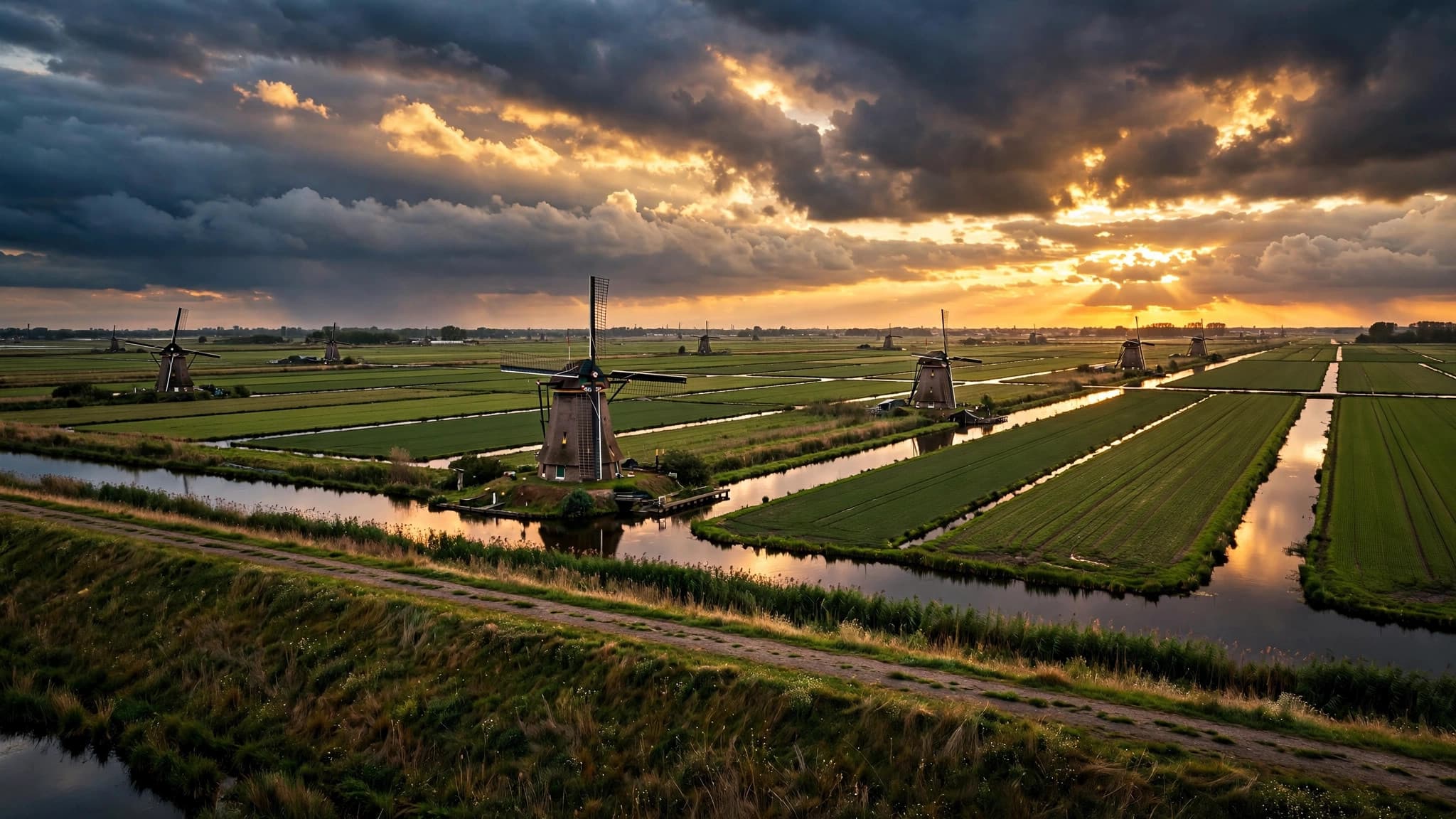
A polder is, conceptually, simple. Ring a low-lying area with dikes, drain the water out, and farm the dry floor. Doing it for centuries required ever better pumps. The arrival of windmill-driven pumping in the 15th century let the Dutch drain significant lakes and sea inlets, and the silhouette of the country — those iconic windmills — is really the silhouette of a machine fleet. The first steam-powered pumping station followed in 1787; today, windmills have mostly been replaced by electric and diesel pumps, some of which can move staggering volumes of water per minute.
The 17th century gave the technique its signature triumphs: the draining of lakes like the Beemster in 1612, now a UNESCO World Heritage site, and later the Haarlemmermeer in the 1850s — the reclaimed lake bed that now holds Amsterdam's Schiphol Airport and its surrounding suburbs. Much of what the Dutch "reclaimed from the sea" was in fact reclaimed from lakes and shallow bays, and the grid of dead-straight ditches and parcel lines still visible from the air is part of why some Dutch country borders are such straight lines: reclaimed land is surveyed, not born.
The Century of Megaprojects
The modern era of reclamation started with a disaster. In 1916, a storm surge battered the dikes along the Zuiderzee — a shallow bay the St. Lucia's Flood of 1287 had torn out of farmland centuries earlier, killing tens of thousands — and Parliament passed the Zuiderzee Act of 1918. The plan came from engineer Cornelis Lely: close the bay off from the North Sea with a 32-kilometre enclosure dam, the Afsluitdijk, then drain the new freshwater lake in stages.
The Afsluitdijk was closed in 1932, creating what is now the IJsselmeer, and the draining proceeded polder by polder: the Wieringermeer in 1930, the Noordoostpolder in 1942 — where resistance fighters hid out during the Second World War — Eastern Flevoland in 1957, and Southern Flevoland in 1968. Together with associated works, the 20th century added roughly 1,650 square kilometres of new land, and Flevoland became the Netherlands' twelfth province — a province younger than many of its residents.
Then the sea reminded everyone why the work existed. In the night of early February 1953, the North Sea Flood overwhelmed the defences of Zeeland and South Holland, killing more than 1,800 people. The response was the Delta Works, a decades-long programme of dams and storm-surge barriers sealing the estuaries of the Rhine, Meuse, and Scheldt, substantially completed in 1997. It is counted among the Seven Wonders of the Modern World by the American Society of Civil Engineers — a fitting title for a country whose landscape is, in large part, a machine.
The Treadmill Beneath Their Feet
Here is the catch the Dutch learned early: reclaimed land does not stay won. Drain a peat bog and the peat oxidises and compacts — the land sinks, sometimes metres below the water it was drained from. Many polders now lie several metres below sea level not because the sea rose to meet them, but because the ground fell away beneath them. So the pumps run day and night, and they always will; a polder is not a finished product but a process, a place that must be continuously un-drowned.
Add climate change and the equation tightens further. The North Sea is rising, storms are intensifying, and the country that spent a thousand years pushing water out now has to plan for pushing ever more of it away forever. The disappearing Aral Sea stands as a grim mirror image of this story — what happens when water management fails — but the Dutch lesson is subtler: even when water management succeeds brilliantly, it commits you to managing it in perpetuity. There is no final victory over the sea, only a maintenance contract.
That may be the deepest fact about the Netherlands. The country is not so much a place as a decision, renewed daily by thousands of pumps. Its landscape — flat, geometric, impossibly green — looks like the natural order of things. It isn't. It is the most successful piece of civil engineering in human history, and it is still running.