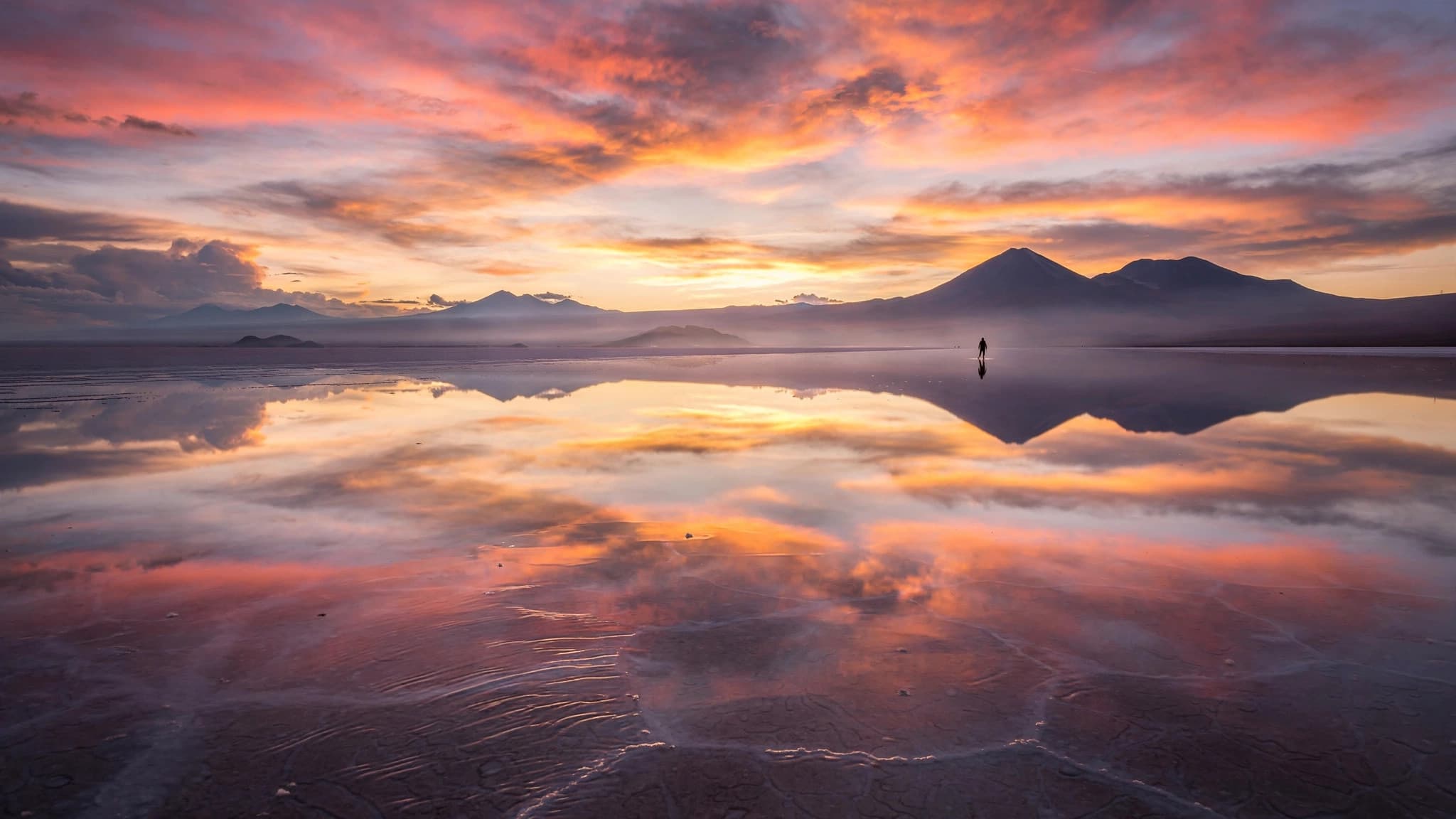
Stand in the middle of Salar de Uyuni during the rainy season and the horizon disappears. Beneath your feet, stretching 129 kilometres in every direction, lies not ground but sky — clouds drifting where earth should be, volcanoes floating upside down, your own reflection walking on air. It is the largest natural mirror on the planet, and it exists because of an accident of geology: a lake that died 40,000 years ago, leaving a salt crust so flat that even the European Space Agency uses it to calibrate its satellites.
The Mirror You Walk On
Salar de Uyuni is the world's largest salt flat, covering about 10,582 square kilometres of southwestern Bolivia — an area larger than many countries — at an elevation of 3,656 metres in the Andes. It sits on the Altiplano, a high plateau with no drainage outlet to the sea. Between roughly December and April, the rainy season lays a film of water across the salt crust, in places only centimetres deep, and because the surface beneath is astonishingly level — elevation varies by less than a metre across the entire expanse — the water sits perfectly still and dead calm. The result is a reflection so complete that pilots have reportedly struggled to tell ground from sky, and filmmakers chose it as another planet: the salt flat stood in for the planet Crait in Star Wars: The Last Jedi.
That impossible flatness has a measurement behind it. Repeated floods dissolve salt from the slightly higher patches, carry it in solution to the slightly lower ones, and deposit it again as the water evaporates. The salar resurfaces itself every rainy season, like a skating rink getting a fresh pass from the Zamboni. It is the reason the surface stays flatter, year after year, than almost any other large feature on Earth — and the reason the mirror returns each summer as reliably as the rain.
A Lake That Died and a Desert That Remembers It
Uyuni was not always salt. Around 42,000 to 30,000 years ago, a series of enormous prehistoric lakes filled this basin — the best known is called Lake Minchin — and then the climate dried and the lakes vanished, leaving a crust of halite, ordinary table salt, several metres thick, sealing a pool of lithium-rich brine beneath. Ten billion tonnes of salt is the figure often cited, but the more consequential number is the lithium: the salar is frequently described as holding between 50 and 70 percent of the world's known lithium reserves, the metal at the heart of the batteries powering electric vehicles and the energy transition.
That buried wealth is why the flat is far more than a photographic backdrop. Small rectangular lithium operations are already visible on satellite imagery along the salar's southern edge, and Bolivia has spent years negotiating how — and how fast — to develop the resource. The tension is real and unresolved: the same crust that draws hundreds of thousands of visitors and calibrates orbital instruments also sits atop the largest known pool of the material the 21st century runs on. Meanwhile, the salt itself remains a livelihood: in Colchani, a village on the salar's edge, families harvest salt the traditional way, piling it into glistening mounds and carving blocks for tables and bricks — even entire hotels have been built from salt. Like the Dead Sea, Uyuni is a closed basin where water arrives and only evaporation leaves — but where the Dead Sea concentrated its minerals into water, Uyuni's evaporation wrote them into stone.
The practical consequence is that timing is everything. The mirror reliably appears only during and just after the rainy season — visitors planning the famous walking-on-the-sky photographs generally aim for the southern-hemisphere summer, while the dry months deliver a different spectacle: an endless white crust cracked into interlocking hexagons, blinding under the thin air of 3,656 metres. Either way, the thin atmosphere and relentless sun demand respect; warmth and sunscreen are not optional.
The Flattest Instrument on Earth
When scientists needed a reference surface to test how their satellites measure Earth's topography, they did not build one. They pointed at Uyuni. The European Space Agency notes that the salar's extraordinary flatness makes it ideal for calibrating laser and radar altimeters, and NASA's Earth Observatory has tracked its seasonal flooding from orbit for years. Clear skies, enormous area, and a surface that varies less than a metre in height: nature's laboratory bench.
The salt flat moonlights as more than a measuring tool. It is a major breeding ground for several species of flamingos, a climatological boundary where towering tropical cloud formations from the east cannot cross into the drier west, and home to islands like Incahuasi, where giant cacti grow in the middle of ten thousand square kilometres of salt. It has even been used as an analogue for Martian terrain in reflectance studies — the crust's uniformity reads a little like another world.
The Mirror Has a Catch
For all its perfection, the mirror is fickle. It appears only when rainfall is right: too little rain and the flat stays a dry, cracked expanse of white hexagons; too much and the salar floods deeply enough that local authorities sometimes restrict travel across it during peak tourist season. The reflection you see in famous photographs is a window that opens for weeks or months, not a permanent feature.
And the flatness itself carries a warning that applies to closed basins everywhere. The disappearing Aral Sea shows what happens when the water balance of a terminal basin is pushed past its limit — evaporation wins, and what remains is poison and dust. Uyuni's balance has held for millennia, but it depends on rainfall patterns that are already shifting, and on the assumption that lithium extraction on an industrial scale will not disturb the hydrology of the crust it floats on.
Visit in the wet months and you can walk on the sky. Just remember what you are walking on: a sheet of ancient salt, renewed by each rain, that doubles as a scientific instrument, a flamingo nursery, and possibly the largest battery mine in history. Very few places on Earth manage to be all four at once.