In the summer of 1816, it snowed in July across New England, frosts killed crops in August, and famine stalked three continents. Nobody alive at the time knew why. The cause was a volcano on the far side of the planet that had exploded fourteen months earlier — and its blast was still echoing through the sky.
The year 1816 is remembered as the Year Without a Summer, the coldest summer in parts of Europe in the 250 years for which records survive. It froze harvests, emptied grain stores, and forced thousands of families to abandon their farms. And it left fingerprints on things nobody would ever connect to a volcano: a horror novel, the first bicycle, and the map of the American Midwest.
The eruption that dimmed the sun
On April 10, 1815, Mount Tambora on the Indonesian island of Sumbawa erupted in the largest volcanic blast in at least 1,300 years — an explosion roughly ten times more powerful than Krakatoa's. The mountain, once more than 13,000 feet tall, lost about a third of its height. People heard it over a thousand kilometers away. Tens of thousands died in the immediate disaster, most in the months that followed from starvation and disease.
The ash fell back to Earth within days. The real weapon was invisible: sulfur dioxide gas, blasted more than 25 kilometers into the stratosphere, far above the clouds where rain could wash it out. Up there, the gas transformed into tiny sulfate droplets that drifted on high-altitude winds until they formed a thin veil around the entire planet. Sunlight hit the veil and bounced back into space. Sunsets turned blood-red. And the planet cooled — by only about 0.4 to 0.7 degrees Celsius on average, but relentlessly, for more than a year.
Places like the Danakil Depression show what volcanic terrain looks like from the ground. Tambora's eruption showed what volcanism looks like from orbit: a single mountain rewriting the weather of the entire Northern Hemisphere.
A summer that never arrived
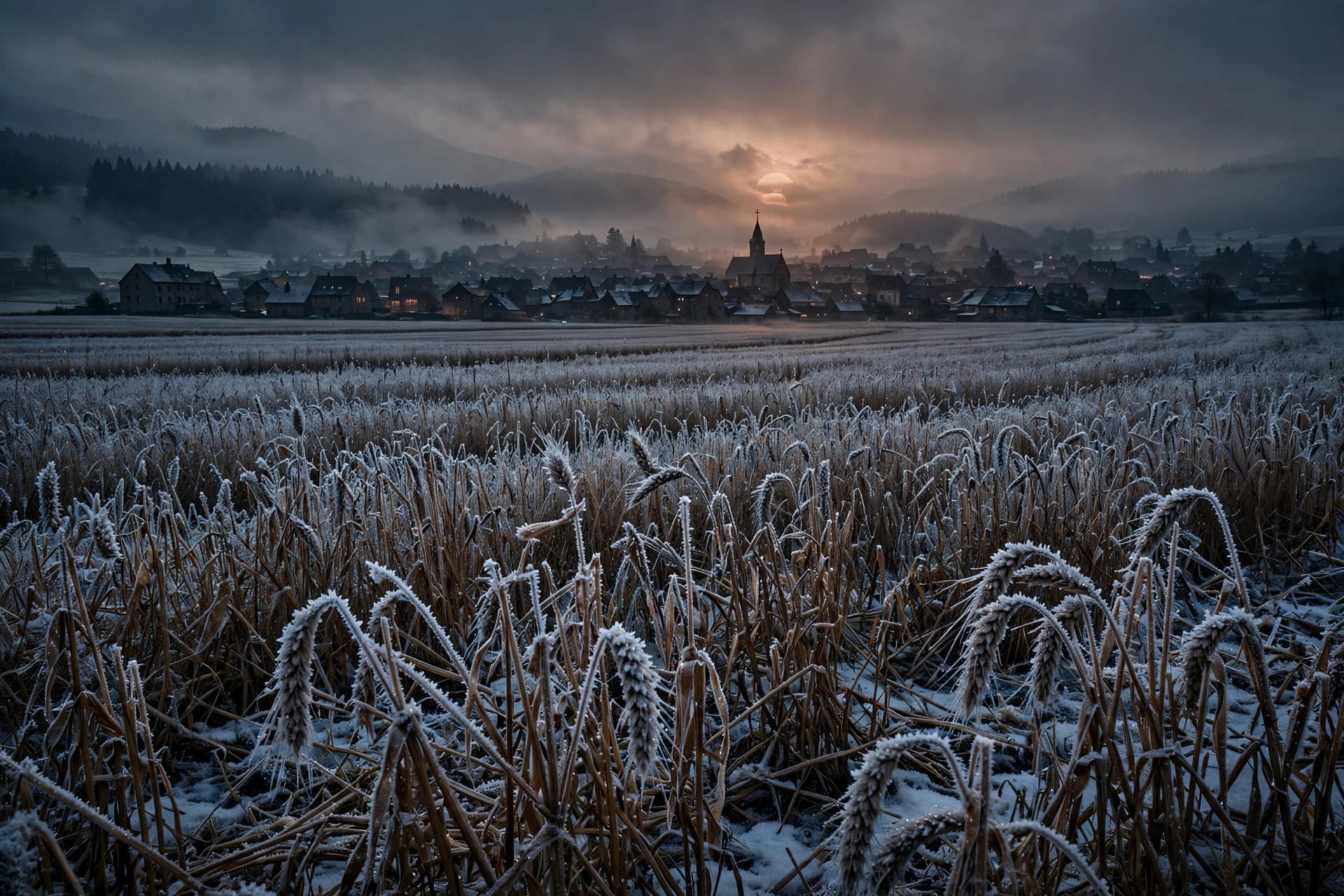
Spring 1816 arrived on schedule, and farmers planted as usual. Then the seasons seemed to run backward. In the eastern United States, frosts returned in June, July, and August. Snow fell in Albany and Quebec on June 6. Two days later it snowed across Vermont. A persistent haze dimmed the sunlight all summer — observers described the sun as "in a cloud of smoke." Crops failed as fast as they were planted. People later called it "eighteen hundred and froze to death."
Across the Atlantic, the summer was cold and ruinously wet. Parts of Europe were drenched by as many as 130 days of rain between April and September. Cereal harvests collapsed, hay could not be cut, and bread prices soared. Europe was still digging out from the Napoleonic Wars, and the continent tipped into crisis: food riots in Britain and France, a national emergency in Switzerland, and famine in Ireland, where the wheat, oat, and potato crops failed and a typhus outbreak compounded the misery.
The catastrophe reached far beyond the Atlantic. In China, unusually cold summer temperatures devastated rice production in Yunnan, and summer snow was reported as far south as Jiangxi and even Taiwan. In India, the climate disruption helped unleash a virulent new strain of cholera. Thomas Jefferson, retired to Monticello, watched his harvests fail and his debts deepen. Hunger, it turned out, was global long before the word "globalization" existed.
Frankenstein, the bicycle, and the road west
The strangest legacy of 1816 is cultural. That summer, a group of young English writers was trapped by relentless rain at Lake Geneva — and they held a ghost-story contest to pass the time. An eighteen-year-old Mary Shelley began Frankenstein. John Polidori started The Vampyre. Lord Byron wrote the poem "Darkness," which opens with the haunting line: "I had a dream, which was not all a dream. The bright sun was extinguish'd." Two pillars of horror literature were born from one cold, sunless summer.
Then there is the bicycle. The oat harvest failure of 1816 starved horses across Europe and sent the price of oats soaring, forcing farmers to slaughter livestock they could not feed. German inventor Karl von Drais, watching horseless roads fill with hungry people, began working on a machine that needed no horse at all. In 1817 he unveiled the laufmaschine — the "running machine" — a wooden two-wheeler you pushed with your feet, the direct ancestor of every bicycle on the road today.
And the harvest crisis moved people. Thousands of New England families abandoned their ruined farms and headed west toward the fertile Midwest, accelerating American expansion; historians note that the disaster also helped spur projects like the Erie Canal, as the crisis exposed how badly inland regions depended on better transportation.
Why half a degree was enough
Here is the part that still unsettles climate scientists: the global average dropped by less than one degree Celsius. How does that cancel a summer? Because crops do not care about global averages. They care about the frost-free window — the stretch of warm days between the last spring frost and the first autumn one. Shrink that window by a few weeks, or scatter a few unseasonable frosts into July and August, and the corn dies no matter what the annual mean looks like.
Tambora was not alone, either. Researchers believe an unidentified tropical eruption around 1809 had already begun a cooling trend, and the lingering chill of the Little Ice Age — a centuries-long cold spell — primed the world for the shock. It took until the twentieth century for anyone to prove the connection: the evidence was hiding in ice cores from Greenland and Antarctica, where a sharp spike of sulfate from 1815–1816 sits like a fingerprint in the frozen layers.
There is an irony modern readers will recognize. Today we study how cities trap extra warmth — the phenomenon behind urban heat islands — while in 1816 the world briefly ran the experiment in reverse, discovering how fragile warm summers actually are.
The Year Without a Summer is a reminder that civilization's margin is thinner than it feels. A single mountain, a thin veil of sulfur in the stratosphere, and half a degree — and the harvests of three continents failed, horror literature was born, and the humble bicycle got its start. The summer never came back. Its consequences never really left.