
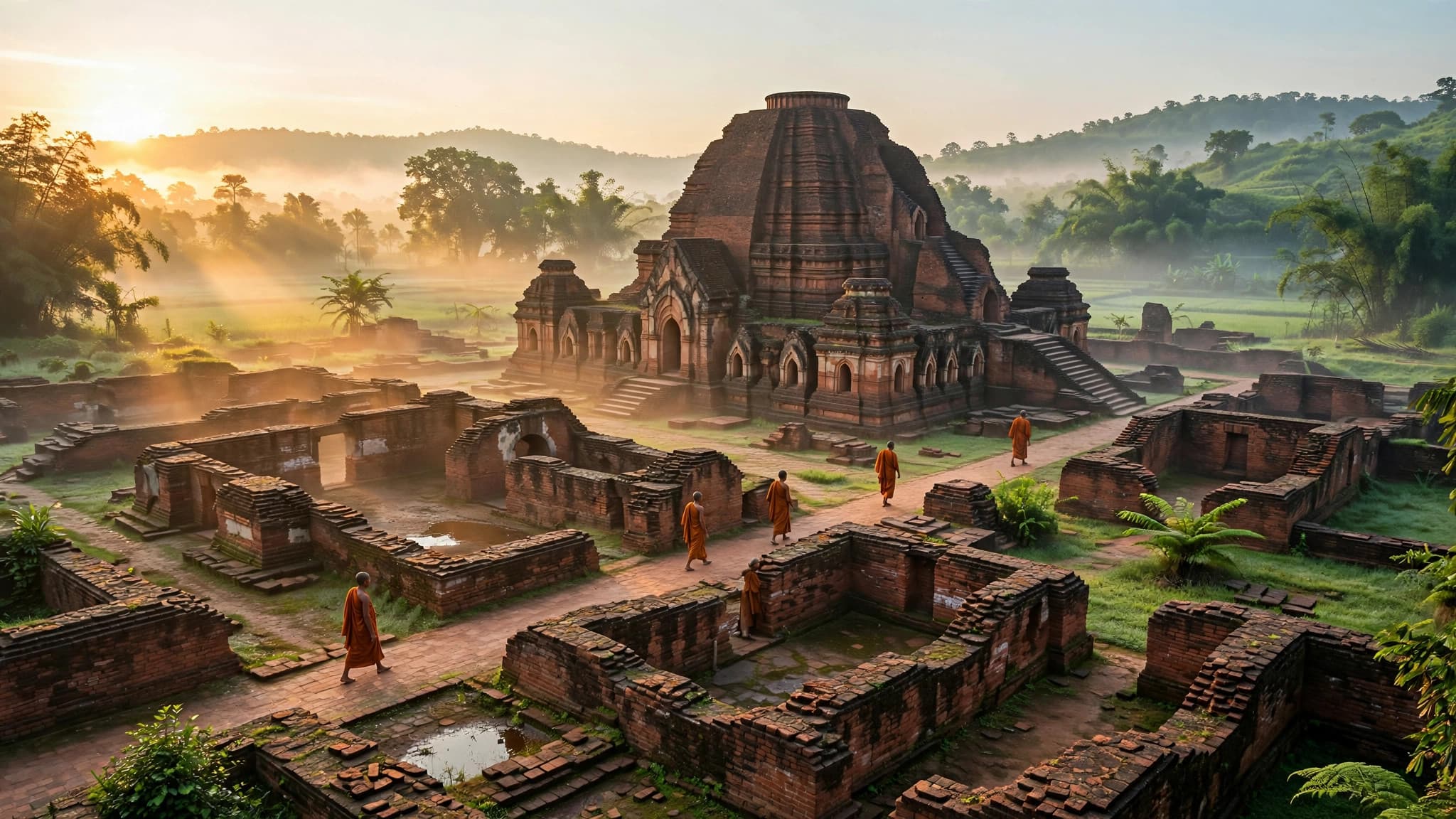
Seven centuries before Oxford opened its doors, a sprawling campus in ancient India housed 10,000 students and 2,000 teachers under one roof. Admission required passing an oral examination before a panel of monks, classes were taught in Sanskrit to scholars from a dozen countries, and the library climbed nine storeys into the sky. This was Nalanda — the world's first great residential university.
Nalanda operated for roughly 700 years, from the 5th century CE to 1193, making it one of the longest-running institutions of higher learning in human history. At its peak it was less like a school and more like a small city devoted entirely to thought. And then, in a matter of days, it was gone.
A campus like no other
Nalanda's story begins in the 5th century CE, during the Gupta Empire — often called India's golden age of culture, art, and science, the era that also gave the world the concept of zero and the decimal system. Emperor Kumaragupta I, who ruled from 415 to 455 CE, is credited with founding the institution in what is now the state of Bihar. The name itself is often rendered as "giver of knowledge."
Successive dynasties — the Guptas, Emperor Harsha of Kanauj, and later the Pala rulers — kept expanding it for centuries. Excavations have revealed a campus of remarkable sophistication: nine monastic complexes arranged around courtyards, temples and stupas, lecture halls, meditation halls, hostels, gardens, lakes, and an advanced drainage and water-management system. A lofty wall ringed the whole, with a single great gate. The famous library stood in a tower said to be nine storeys tall, its pavilions rising, as one visitor wrote, "above the mists in the sky."
What makes Nalanda extraordinary is not just its age but its structure. It was fully residential — students lived, ate, studied, and debated on campus, exactly as they would at a modern university. Nothing like it existed anywhere else in the world at the time. And it ran, in something close to its original form, for seven hundred years.
What 10,000 minds studied
The curriculum at Nalanda would embarrass the idea that ancient education was narrow. Alongside Buddhist philosophy across multiple schools of thought, students studied logic, grammar and linguistics, medicine and Ayurveda, astronomy, mathematics, the arts, and literature — including Vedic texts and non-Buddhist philosophies. Sanskrit was the medium of instruction, and debate was the core teaching method: structured daily disputations where scholars tested ideas against one another in public.
Admission was famously brutal. Prospective students faced an oral examination before a panel of learned monks at the gate, and only a fraction made it through. Once inside, they joined an international community that would look familiar on any modern campus: scholars traveled from China, Korea, Japan, Tibet, Mongolia, Sri Lanka, Persia, Turkey, and Southeast Asia to study there. The most famous was the 7th-century Chinese pilgrim Xuanzang, who studied and taught at Nalanda and carried hundreds of scriptures back to China — leaving behind the detailed accounts that are still historians' richest source on the place. The great mathematician-astronomer Aryabhata is also believed to have been associated with it.
Xuanzang left one of the most vivid snapshots of daily life on campus: hundreds of monks debating from morning to evening, lectures drawing crowds, and a scholarly culture so intense that simply being admitted was a mark of distinction across Asia. Graduates carried Nalanda's prestige home the way modern students carry a degree — Tibet, China, and Korea all trace major parts of their Buddhist traditions to teachers trained within these walls.
Nalanda sat at a crossroads of the ancient world in more ways than one. The same Silk Roads that carried goods across Asia carried Nalanda's students and manuscripts in every direction, making the campus a hub where knowledge flowed like currency.
The library that burned for months
At the heart of Nalanda stood its library, the Dharmaganja — the "Treasury of Truth." It filled three great multi-storey buildings with jewel-bright names: the Ratnasagara (Ocean of Jewels), the Ratnodadhi (Sea of Jewels), and the Ratnaranjaka (Jewel-adorned). Together they held hundreds of thousands of manuscripts on philosophy, medicine, astronomy, logic, and literature — one of the largest collections of knowledge assembled anywhere in the pre-modern world. It rivals the legendary Library of Alexandria as a symbol of everything humanity can lose in a single fire.
That fire came in 1193. A Turkish military commander named Bakhtiyar Khilji, a general serving Qutb-ud-din Aibak, marched on Nalanda. His soldiers killed thousands of monks and set the libraries alight. According to later accounts, the manuscripts burned for months, smoke hanging over the hills for days. Scholars are still, eight centuries later, piecing together what the collection actually contained — the fire did not just destroy books, it destroyed the catalog of what was lost.
The end of Nalanda also marked the beginning of the end of organized Buddhism in India. The university that had outlasted empires fell in days, to an army that may not have even understood what it was burning.
What survived the fire
In one sense, nothing survived: the manuscripts are ash, the monks are dust, and most of what Nalanda taught exists now only as echoes in Chinese translations of lost Sanskrit originals. But in another sense, the idea survived completely. The modern world did not invent the residential university, merit-based admission, the structured curriculum, or the international campus — it reinvented them, a thousand years after Nalanda had already perfected them.
The ruins were rediscovered in the 19th century, and in 2016 the archaeological site of Nalanda Mahavihara was declared a UNESCO World Heritage Site. A new Nalanda University, established under an act of the Indian parliament, launched its academic program in 2014 near the ancient site — seven centuries after the original closed, the name teaches again.
There is a lesson in Nalanda's arc that goes beyond the tragedy of one library. Long before the printing press democratized knowledge, this single campus showed that the university, as an idea, is ancient: gather the brightest minds in one place, make them argue with each other, give them everything written that matters, and open the gates to the world. Nalanda did all of it — and then, for 700 years, it simply kept going.