How Did Persians Store Ice in the Desert?
Persian engineers froze water on winter nights in desert ponds, then kept it through summer inside thick-domed yakhchals. Shade, dry air and earth did the work.
Key takeaways
- A yakhchal made ice in winter and kept it for summer by combining a shaded shallow pond, a deep pit and a thick insulating dome.
- Dry desert air and a clear night sky pulled heat from the pond water, so thin layers froze even where days were warm.
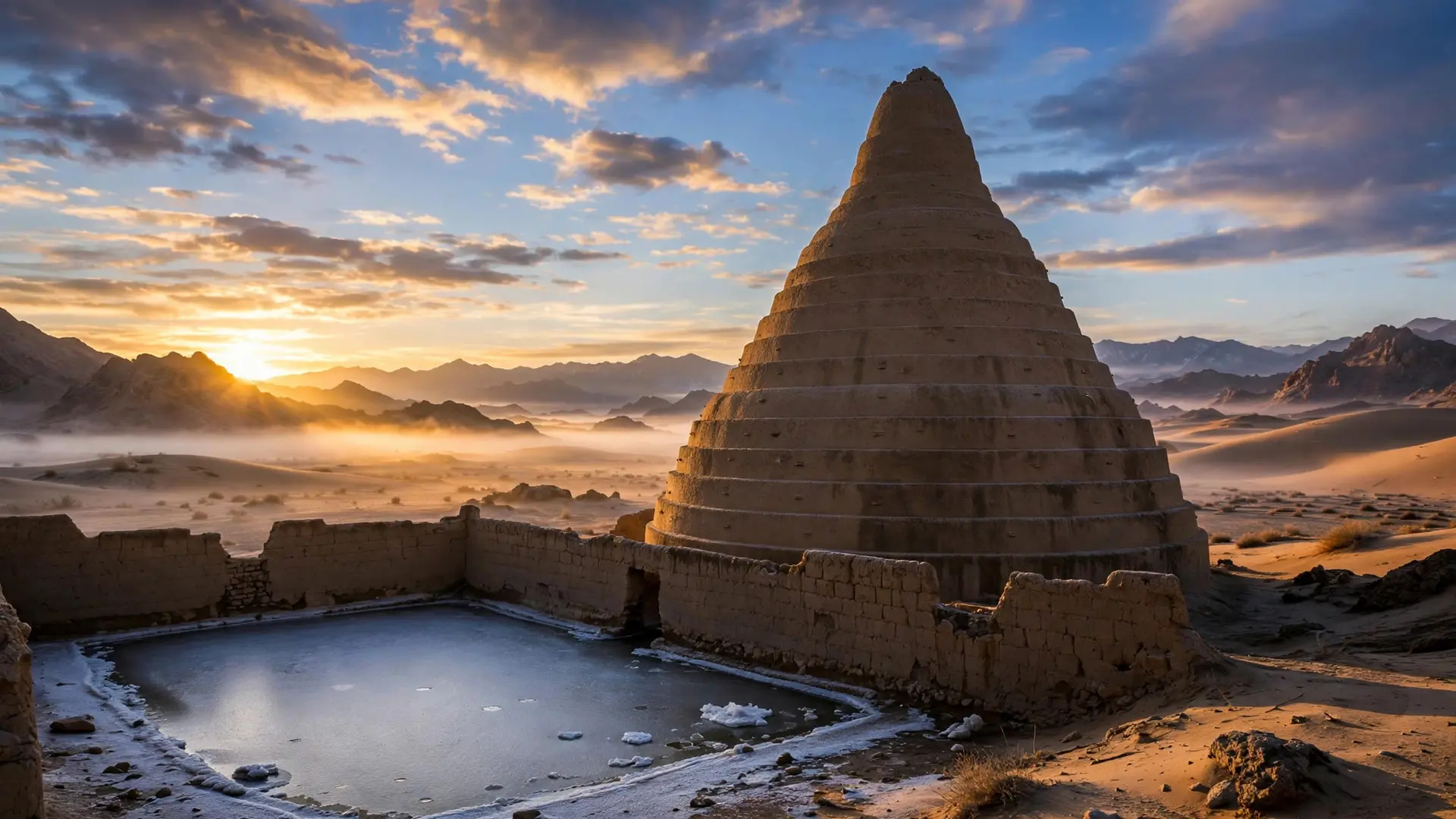
- At Meybod, the dome stands about 15 metres tall over a pit about 5 metres deep, with walls about 2 metres thick at the base.
- Modelling of the Meybod pond suggests one winter season could yield about 50 cubic metres of ice.
- The stored ice chilled food and drinks, and later helped make faloodeh, a Persian frozen dessert.
The trick was not to fight the desert. Persian builders let the desert do the freezing, then used earth, shade and sheer thickness to stop summer undoing it. A yakhchal, a word that means ice pit, was less a single building than a small seasonal factory: a pond where ice was made in winter, a deep chamber where it was kept, and a tall dome that shaded and sealed the whole operation. That sequence matters, because the most surprising part of the story is not the storage. It is the making. In the dry interior of Iran, winter nights can drop below freezing while summer days climb past 40 degrees Celsius. The yakhchal turned that daily and seasonal swing into an advantage, harvesting cold when it was freely available and rationing it through the months when it was not.
How Did a Desert Pond Freeze at All?
Start with the pond, because without it there was nothing to store. Water reached the site through a qanat, an underground channel that brought water from higher ground without exposing it to the sun. Each evening, workers let a thin layer of that water into a shallow pond beside the yakhchal. A tall wall, running east to west, shielded the pond from low winter sun, so the water began the night already cool. Then the sky took over. In a dry climate, the night sky is an efficient heat sink: warmth radiates upward from the water surface and is not trapped by humid air above it. Evaporation helped too, since dry air draws moisture from the surface and carries heat away with it. Modelling of the climate at Yazd, using hourly weather data, found that radiation to the cold night sky was the dominant cooling effect, with evaporation also important. By morning, a thin sheet of ice had formed. Workers could add another layer of water the next night, building the harvest sheet by sheet rather than waiting for one deep pool to freeze solid. Some sites did not rely on pond ice alone. Ice and snow could also be carried down from nearby mountains and packed into the store. But the pond method is the cleverer part of the design, because it made ice on the spot, in a place where a visitor would expect none to exist.
What Kept the Ice From Melting in Summer?
Once cut into blocks, the ice went underground. At Meybod, in Yazd province, the domed yakhchal still standing today is about 15 metres tall, with a storage pit about 5 metres deep beneath it. The dome walls are about 2 metres thick at the base and narrow to about half a metre at the top, where a small opening lets in daylight. A long corridor led down into the chamber, which stayed cool because it was sunk into ground whose temperature changes only slowly through the year. The wall material mattered as much as the shape. Builders used mud brick and a mortar known as sarooj, a mix of sand, clay, lime and ash bound with egg white and goat hair. In the Meybod study, the combination of thick adobe and a thatch covering gave the structure very low heat transmission and very high thermal mass, meaning heat took a long time to travel through the wall. For walls more than a metre thick, researchers found that seasonal lag dominates: it can take roughly a year for a pulse of heat to work its way through, so winter cold stored in the mass still helps in summer. The dome itself acted as a giant sunshade, keeping direct sun off the pit, while its height let warmer air rise away from the ice below. Small openings near the base admitted cooler air, and vents near the top gave warm air a way out. Meltwater was not wasted either: trenches at the bottom caught drips, which could refreeze on cold nights and be added back to the store. None of this made the ice last forever. In the Meybod simulation, with a store full in January and moderate insulation, about a fifth of the ice was predicted to melt by September. That loss was the price of the system, and builders planned around it by making and storing more than the summer strictly needed.
How Much Ice Could One Yakhchal Actually Make?
The Meybod numbers give a useful sense of scale, and also a warning against exaggeration. The ice-making pond there covers roughly 400 square metres. Simulating its winter season, researchers predicted about 50 cubic metres of ice, roughly a fifth of the volume of the pit beneath the dome. That sounds modest beside later claims for huge stores, and the researchers themselves noted several reasons their figure might be low: an average modern year may be warmer than past winters, and extra ice may have been brought in from elsewhere.
That caution is part of the appeal. A yakhchal was not a miracle machine that defeated physics. It was a careful piece of bookkeeping, matching a limited winter harvest against summer demand. Ice went first to food and drink, keeping perishables edible and cooling water in the heat. It also made possible a dessert culture that still survives: faloodeh, thin noodles frozen in sweetened syrup, is traditionally linked to this stored ice. In towns, ice was sold in markets and carried to homes, turning a winter by-product into a summer luxury. It is worth clearing up a common picture of these buildings. Photographs show smooth, reddish-brown domes, but some accounts suggest that in summer the domes were covered in thick straw thatch for extra insulation, which would have made them look more like giant haystacks. The smooth dome we admire today may be the winter, working-season version of the building, not its summer dress. Either way, the principle was the same: slow heat down, keep cold in, and let the desert night do the hardest work for free.
Why Did the Idea Last So Long?
Yakhchals appear from around 400 BCE, and examples in Meybod, Yazd and Kerman still stand centuries later, some restored in modern times. Their longevity owes less to any single invention than to the way several ordinary ideas were stacked together. A shaded pond, an underground pit, a thick dome, a water channel and a thatch coat are each unremarkable alone. Together, they form a cold chain with no fuel, no moving parts and no power supply. That is also why the yakhchal still attracts engineers today. Modern buildings chase the same goals with refrigeration and insulation, spending energy to move heat. The yakhchal spent almost none, instead timing its work to the seasons: make cold in winter, spend it in summer, accept some loss, and start again. For desert towns, that rhythm was enough to keep ice on the table in the hottest months, and to turn a hostile climate into a pantry. The ancient water engineers of Rome faced a different problem, moving water across distance rather than storing cold across seasons, but they shared the yakhchal builders' faith in gravity, masonry and patience over machinery. In Persia, the equivalent patience was seasonal. Wait for the cold night, skim the ice, bury it deep, and trust thick walls to hold the winter until summer needed it.
Frequently asked questions
How could water freeze in a desert?
Desert nights in central Iran can fall below freezing, and dry air lets water lose heat quickly by evaporation and radiation to the clear sky. A shallow pond, kept in shade during the day, therefore froze in thin layers on cold nights.
What was a yakhchal made of?
Builders used local mud brick and a mortar called sarooj, made with sand, clay, lime, ash, egg white and goat hair. The walls were thickest at the base, which slowed heat moving into the stored ice.
What was the stored ice used for?
It kept food and drinks cool through summer, and it chilled desserts such as faloodeh, made with thin noodles and sweetened syrup. Some ice houses also supplied households and sellers in nearby towns.
Sources
- The Physics of Freezing at the Iranian Yakhchal, Max Fordham
- Yakhchāls in Meybod, Atlas Obscura
- Meybod Ice House, an ancient marvel of Persian engineering, Iran Daily