How Did Ancient Qanats Carry Water Underground?
Qanats moved mountain groundwater for kilometres without pumps, using only gravity and a precise slope. How Persian diggers built them, and why some still flow.
Key takeaways
- A qanat taps an aquifer beneath a hillside and carries the water downhill through a gently sloping tunnel, so gravity alone moves it, with no pumping.
- Vertical shafts dug every 20 to 35 metres gave diggers air, a way to remove spoil, and later access for cleaning and repair.
- The tunnel gradient had to be exact: too steep and the flow eroded the walls, too shallow and the water stopped moving.
- UNESCO inscribed eleven Iranian qanats as The Persian Qanat in 2016, recognising both the engineering and the communal system that shared the water.
- Some qanats still supply towns and farms today, though deep wells and falling water tables now threaten many of them.
A qanat carried water without a pump, a wheel, or any fuel at all. Diggers sank a deep well into a hillside until it struck groundwater, then drove a tunnel downhill at a gentler angle than the slope above it, so that the tunnel eventually broke out at the surface far below. From that outlet, the water ran on in open channels to fields and towns. The whole trick was gravity, held to an exact gradient by people working underground with hand tools.
How does a qanat actually move water?
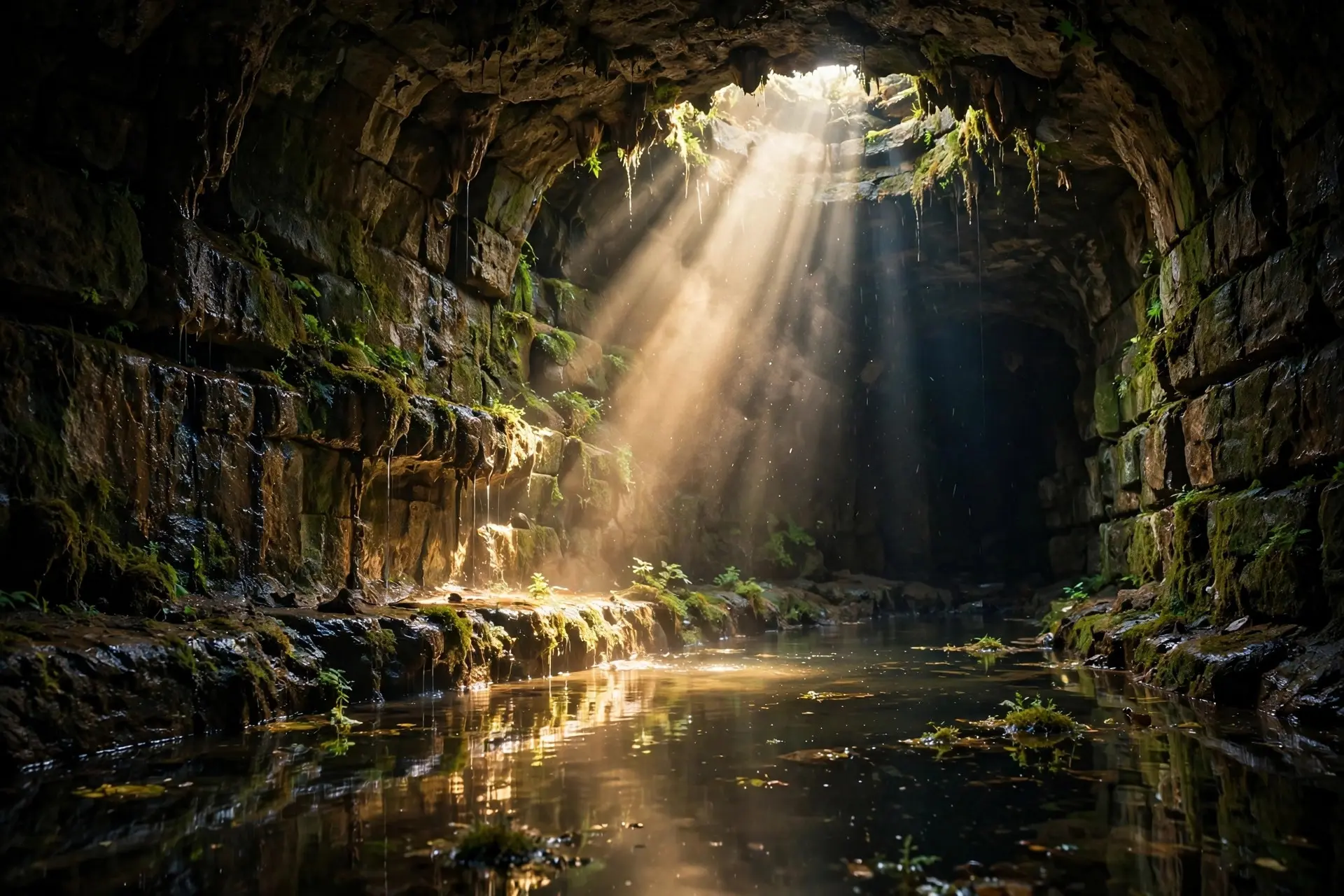
Picture a mountain foothill in a dry land. Rain and snowmelt sink into the gravel at the foot of the slope and gather in an aquifer, a water-bearing layer underground. A qanat begins with a mother well, the deepest shaft, dug down into that aquifer near the hillside. From the bottom of the mother well, diggers opened a tunnel that sloped very gently downhill. Because the land surface above falls away more steeply, the tunnel and the surface eventually meet, and the water emerges at an outlet known as the mazhar, as if from a spring that the builders had placed on purpose. Along the tunnel, the diggers sank a line of vertical shafts to the surface. The Iranian cultural organisation that documents the technique puts these shafts 20 to 35 metres apart. Each shaft served several jobs at once: it let a digger down and spoil up during construction, it ventilated the tunnel, and it gave later maintenance crews a way back in. Seen from the air, the row of spoil heaps around the shaft mouths is the signature of a qanat, a dotted line across the desert pointing from a mountain to a settlement. The water itself needed no lifting, which was the point. A well can only yield as fast as someone hauls water up it, and in a dry climate a shallow well may fail altogether. A qanat, by contrast, draws steadily from the stored water of the aquifer, and its flow changes only slowly as the water table rises and falls with the seasons. It also travels underground, shielded from the sun, so little of it is lost to evaporation on the journey. For a farming village in a land of scorching summers, that steady, sheltered flow was worth years of digging.
Why was the gradient so hard to get right?
The slope of the tunnel was the whole engineering problem, and the margin for error was small. Diggers worked by sighting with lamps, plumb lines and levels, in darkness, through rock and gravel that could collapse without warning. If the tunnel fell too steeply, water rushed through it, scoured the walls, and brought the roof down. If it fell too shallowly, the water slowed, silted up, and never reached the outlet at all. The Iranian account of the craft stresses exactly this danger: a gradient even slightly too steep meant erosion and collapse, and the work was done with nothing more advanced than shovels and pickaxes. The people who did it were specialists called muqannis, and the skill passed within families. According to the same account, a muqanni carried a lamp fuelled by castor oil, which served as light, as a guide for direction, and as a warning device: if the flame went out, the air in that stretch of tunnel was too foul to work in, and another shaft had to be sunk. Construction usually began at the outlet end and worked back toward the mother well, so that each new section could be checked against the water level already established. A long qanat could take years, and a deep one decades, with crews advancing only a few metres a day at great depth. The output varied enormously. The Iranian account reports that some large qanats delivered up to 1,750 litres a minute, while most managed only about 15 litres a minute, and that flow depended on the season, the aquifer, and the soil. That range is a reminder that a qanat was not a machine with a fixed rating. It was a bargain with an aquifer, generous in a wet year and thin in a drought, and a village planned its fields around the flow it could rely on, not the flow it hoped for.
How did qanats shape the places they watered?
A qanat did more than irrigate a field. It decided where a town could exist. UNESCO's decision inscribing The Persian Qanat on the World Heritage List in 2016 describes how, across the arid regions of Iran, farming and permanent settlement were supported by tapping aquifers at the heads of valleys and leading the water along underground tunnels, often over many kilometres. Settlements grew along the line of the tunnel and below its outlet, with gardens, mills and reservoirs arranged around the flow. UNESCO also notes that the system was managed communally, with traditional arrangements deciding shares of water fairly among users, a social invention as important as the tunnel itself.
The eleven qanats in the UNESCO property, from Gonabad in the east to sites in Yazd, Isfahan and Kerman, show how varied the tradition became. Gonabad's Qasabeh qanat is among the oldest and deepest in the country, with its main mother well reported at roughly 200 metres and one branch reaching about 300 metres, and it has flowed for well over two thousand years. Other inscribed qanats are known for their length, their watermills, or their rest stops for workers. Together they preserve not a single monument but a living system: tunnels, shafts, reservoirs, mills, and the councils that still oversee them. The idea travelled far beyond Iran. REVOLVE, a sustainability journal, traces how the system passed into Arabia and across North Africa, then into southern Spain with the Umayyad expansion, and eastward to India and China. In Oman and the United Arab Emirates the same technology is known as falaj, and it still waters palm groves and fields. From Spain it crossed to South America, where similar channels survive in Chile and Peru, though scholars debate whether some of the South American examples were invented locally rather than imported. Whatever the route in each place, the principle stayed the same: find the aquifer uphill, and let the earth do the pumping.
Why are qanats in trouble now?
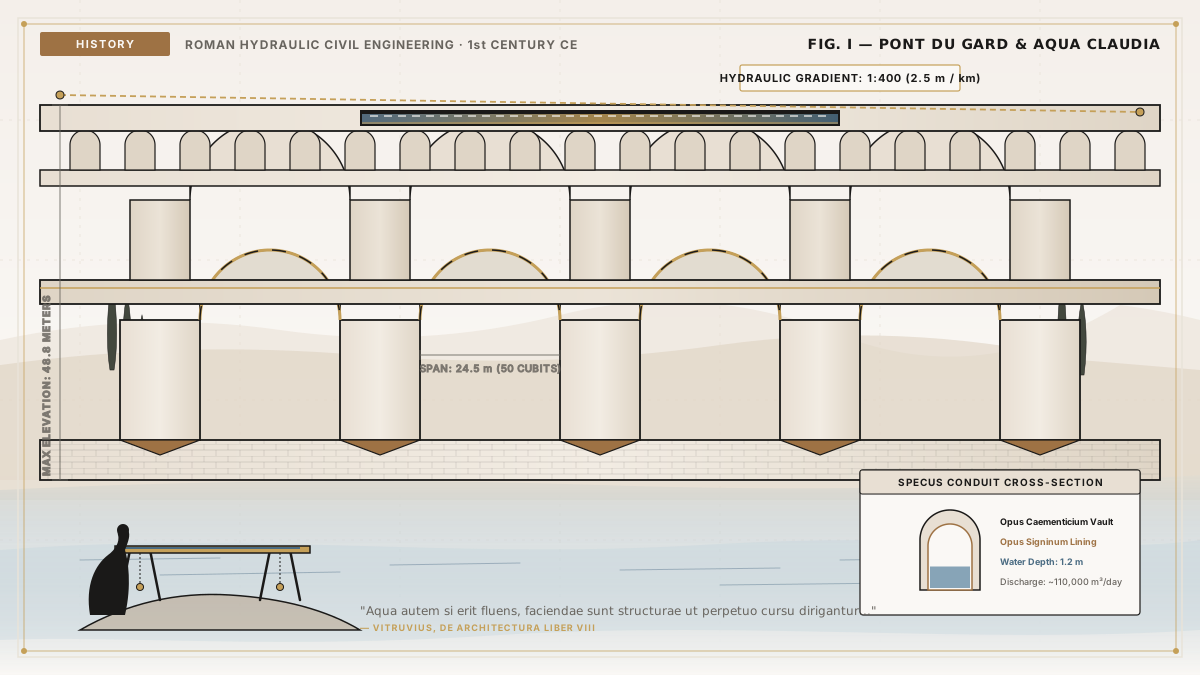
The irony of the qanat is that its greatest virtue, patience, is also its vulnerability. A qanat takes only what the aquifer can spare, because its flow is capped by the water table itself. A motorised deep well has no such limit, and it can drain an aquifer faster than rain refills it, leaving the shallower qanat tunnels dry. Where wells multiply around a qanat, the old channel that fed a village for centuries can stop flowing within a generation. UNESCO's inscription recognises the management system that kept qanats alive, but no management system can protect a tunnel from an aquifer that has been pumped empty. Some qanats still flow, and in places they are being repaired and celebrated as models of low-energy water management. Their lesson is not nostalgia. It is a design rule that modern engineers keep rediscovering: work with the gradient, not against it, and size your demand to the water the land actually stores. The diggers who sank those shafts with hand tools understood something that a diesel pump makes easy to forget, that water in a desert is not a resource to be seized, but a loan from the mountain, repaid only when the rains return. That same discipline links qanats to other ancient waterworks. Roman aqueducts moved water over arches and across valleys with the same respect for gradient, though at far greater visible scale. The desert city of Petra mastered water engineering in a different way, catching and storing every drop that fell on its rock. And the lost cities of the Silk Road show the other side of the bargain, what happens to a settlement when its water fails. The qanat builders, working in the dark beneath the desert, gave their towns the best chance of all: a river they could not see, running steadily, year after year, toward the fields that needed it.
Frequently asked questions
How is a qanat different from a well?
A well lifts water straight up from one spot, which limits how much can be taken. A qanat turns an aquifer into a sloping underground channel, so water flows out on its own at a lower point, often far from the source, and keeps flowing without lifting.
Who built and maintained qanats?
Specialist diggers called muqannis built them by hand and passed the skills down through families. Local councils and water-sharing customs then governed who received water and when, and organised the constant cleaning the tunnels needed.
Why did qanats spread so far?
The idea travelled with Persian rule, Arab expansion and trade, reaching North Africa, Spain, Oman and China. Wherever dry land sat below a mountain aquifer, the same gravity trick solved the same problem.
Are qanats still used?
Yes, in parts of Iran and elsewhere, though many have dried up or been abandoned. UNESCO notes that the eleven inscribed qanats remain in use, but modern pumping can drain the aquifers they depend on faster than rain refills them.
Sources
- UNESCO World Heritage Centre - Decision - 40 COM 8B.21, UNESCO World Heritage Centre
- Qanat, Islamic Culture and Communication Organization
- The Qanat System: Ancient Technology for Sustainable Water Use, REVOLVE