Why Do San Marino and Vatican City Survive Inside Italy?
Why are San Marino and Vatican City independent countries inside Italy? One survived 1,700 years of diplomacy; the other was born from a 1929 treaty.
Key takeaways
- San Marino claims a foundation in AD 301, making it the world's oldest republic by tradition; Italy confirmed its independence by treaty in 1862.
- Italy seized Rome on September 20, 1870, ending the Papal States; the 1929 Lateran Treaty created Vatican City to restore the Pope's sovereignty.
- Vatican City is 44 hectares (109 acres), the smallest sovereign state; San Marino is 61.2 square km (23.6 square miles), Europe's third-smallest country.
- Both survive on treaties and recognition: San Marino's 1862 customs union and the Lateran Pacts, affirmed in Italy's 1948 constitution.
San Marino survived because it was tiny, poor, and useful: Napoleon recognized it in 1797 and Italy confirmed its independence by treaty in 1862. Vatican City was created by the 1929 Lateran Treaty, giving the Pope a sovereign state after Italy seized Rome in 1870. Italy keeps both because treaties, diplomacy, and the world's attention protect them.
Key facts
- San Marino claims a foundation in AD 301 by Marinus, a Christian stonecutter who fled Dalmatia to escape religious persecution, making it the oldest republic in the world by tradition.
- Napoleon allowed San Marino to retain its liberty; it was recognized by the Treaty of Tolentino in 1797 and by the Congress of Vienna in 1815.
- San Marino and Italy signed a treaty of friendship and customs union in 1862, revised in 1872, which confirmed the republic's independence after Italian unification.
- Italian troops entered Rome on September 20, 1870; Pope Pius IX lost all temporal power, creating the "Roman Question."
- The Lateran Pacts were signed on February 11, 1929, creating Vatican City: 44 hectares (109 acres), the smallest sovereign state in the world, ringed by a 9-meter (30-foot) wall.
- Fewer than 400 people live within the Vatican walls, while the Holy See conducts diplomacy through 184 Apostolic Nunciatures around the world.
How did San Marino survive 1,700 years of Italian history?
San Marino's survival starts with being easy to overlook. Because of the poverty of the region and the difficult terrain around Mount Titano, the little republic was rarely disturbed by outside powers, and it generally avoided the factional fights of the Middle Ages. A monastery existed there by at least 885, the Holy See confirmed its independence in 1291, and its written constitution dates to October 8, 1600, one of the oldest still in effect anywhere. Since 1243 it has been led by two Captains Regent, joint heads of state in a tradition drawn from the Roman Republic.
Smallness was a deliberate strategy, not just an accident. When Napoleon offered to enlarge San Marino's territory, the Sammarinese are said to have declined, on the grounds that smallness and poverty alone had kept them from falling prey to larger states. The republic also made itself useful: in 1849 Giuseppe Garibaldi, the liberator of Italy, took refuge from the Austrians in San Marino, and when Italy unified, gratitude translated into law. The 1862 treaty of friendship and customs union confirmed San Marino's independence, and it was revised in 1872. The republic covers 61.2 square km (23.6 square miles), with a population of 31,887 at the March 31, 2011 estimate, making it the third-smallest country in Europe after Vatican City and Monaco. Its highest point, Monte Titano, rises 2,457 feet (749 meters). It even survived the Second World War as a neutral state, sheltering more than 100,000 refugees, though Allied planes bombed it on June 26, 1944. Like Lesotho, another country entirely surrounded by its neighbor, San Marino proves that enclaves survive through politics, not geography.
Why did Italy seize the Pope's lands, then create Vatican City?
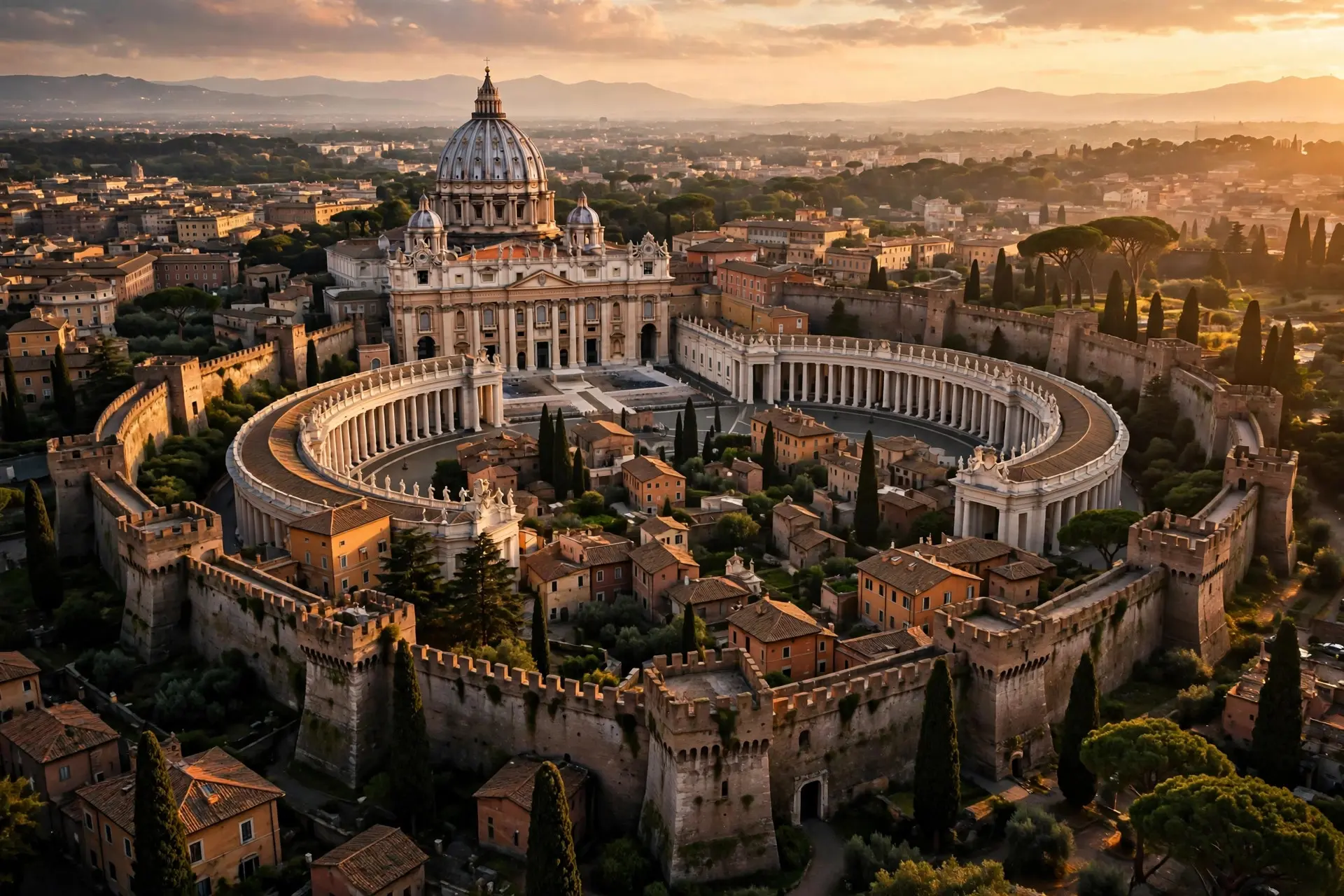
For centuries the popes governed far more than a few Roman hectares: the Papal States formed a strip across the middle of Italy, from one Mediterranean coast to the other. Italian unification consumed them piece by piece until, on September 20, 1870, the troops of the Kingdom of Italy entered Rome, the Pope's last remaining territory. Pius IX lost every temporal power and became only a spiritual sovereign. The six-decade standoff that followed was called the Roman Question. The popes refused every compromise, including Italy's 1871 Law of Guarantees, because accepting land or money from the Italian state would have made the Pope look like a subject of another sovereign. The issue sharpened during the First World War, when countries at war with Italy could not safely keep ambassadors to a Pope living under Italian dominion. After the war, both sides negotiated seriously, and the result was the Lateran Pacts, signed on February 11, 1929. The pacts had three parts: a political treaty creating Vatican City and guaranteeing the Holy See's full sovereignty, a financial settlement for the lost Papal States, and a concordat regulating relations between Italy and the Church. The treaty went into effect on June 7, 1929. Notably, Pope Pius XI insisted on the smallest territory possible: negotiators had floated larger options, but he wanted only the minimum needed to guarantee his independence. Italy, for its part, was already used to hosting a state within its borders, the little Republic of San Marino, which had survived unification intact. Vatican City's territory exists for one purpose: to safeguard the Pope's freedom to govern the Church without dependence on any other political power. It is an elective absolute monarchy, with its own flag, anthem, post office, railway station, radio, printing press, pharmacy, stamps, and a currency tied to the euro. Its courts are real, trying real cases, and several buildings in Rome belonging to the Holy See enjoy extraterritorial status, functioning like embassies. Read more in our profile of Vatican City, the world's smallest country.
Why does Italy put up with both enclaves today?
First, the treaties still bind. San Marino's customs union with Italy, renewed in 1939 and amended in 1971, gives it the benefits of European Union membership, and it adopted the euro in 1999. The Lateran Treaty was written into the Italian Republic's 1948 constitution, and a new concordat in 1984 reaffirmed the Pope's sovereignty over the Vatican territories. These are not informal arrangements; they are constitutional commitments. Second, the relationships are practical. By arrangement, Italy's armed forces are responsible for San Marino's defense against an aggressive power, while San Marino runs its own police and ceremonial military. Vatican City depends on Italy for water, sewage, and policing around St. Peter's Square, the classic economics of an enclave state, and Italy in turn hosts the diplomatic capital of 1.4 billion Catholics without friction. The Belgian and Dutch enclaves of Baarle show the same pattern: neighbors learn to live with dotted borders when the alternative is endless dispute. Third, the world is watching. San Marino joined the United Nations in 1992, and the Holy See maintains diplomatic relations with states across the globe. Absorbing either microstate would buy Italy nothing and cost it enormously in reputation. Small, peaceful, and useful beats conquered.
San Marino vs. Vatican City at a glance
| San Marino | Vatican City | |
|---|---|---|
| Founded | AD 301, by tradition | February 11, 1929 |
| Size | 61.2 sq km (23.6 sq mi) | 44 hectares (109 acres) |
| Population | 31,887 (2011 estimate) | Fewer than 400 within the walls |
| Legal basis | 1862 treaty with Italy, plus centuries of recognition | Lateran Treaty with Italy |
| Head of state | Two Captains Regent | The Pope |
What do people get wrong about these microstates?
The most common error is assuming San Marino is part of Italy. It is a fully independent republic, a United Nations member since 1992, with its own government, laws, and citizenship rules. It uses the euro and sits inside the Italian customs area, but it is not in the European Union and not subject to Italian law. The second error is treating Vatican City as merely a church campus. It is a sovereign state in the strict sense, with territory, population, courts, a 133-strong Swiss Guard for security, and diplomatic relations conducted through 184 nunciatures. Its citizenship is functional and temporary, granted only to those who serve the Holy See. The third error is assuming Italy could absorb both whenever it wished. San Marino survived Napoleon, the Congress of Vienna's redrawing of Europe, Italian unification, and two world wars. The Vatican's sovereignty is anchored in a treaty embedded in Italy's own constitution. Both have outlasted every government that might have swallowed them, which is the strongest argument that they will outlast the next ones too. How we made this article: FactSpire researched and drafted it with AI assistance and checked every fact against the sources listed above.
Frequently asked questions
Is San Marino really the world's oldest republic?
By tradition, San Marino was founded in AD 301 by Marinus, a Christian stonecutter who fled persecution in Dalmatia, which would make it the oldest existing national state in Europe. Its written constitution dates to October 8, 1600, one of the oldest still in effect anywhere.
How small is Vatican City?
Vatican City covers 44 hectares (109 acres), making it the smallest sovereign state in the world. A 9-meter (30-foot) wall surrounds most of it, and fewer than 400 people live within the walls. Its territory exists to guarantee the Pope's independence in governing the Catholic Church worldwide.
Why didn't Italy absorb San Marino during unification?
San Marino had sheltered supporters of Italian unification, including Giuseppe Garibaldi, who took refuge there in 1849. When Italy unified, it signed a treaty of friendship and customs union with the republic in 1862, confirming its independence instead of conquering it.
Who governs Vatican City?
The Pope holds total legislative, executive, and judicial power in Vatican City, an elective absolute monarchy. Day-to-day government runs through Vatican institutions, while the Holy See, the Church's spiritual authority, conducts diplomacy through 184 Apostolic Nunciatures worldwide. Vatican citizenship is functional and temporary, granted only to those who serve the Holy See.
Sources
- How the Vatican Became a Country, EWTN Vatican
- The Lateran Treaty of 1929: Understanding the relationship between Italy and the Holy See, EWTN Vatican
- Vatican City, State of, Encyclopedia.com
- History - San Marino, Nations Encyclopedia
- San Marino, New World Encyclopedia