Why Is Vatican City a Country All of Its Own?
Vatican City covers less than half a square kilometre inside Rome, yet it has its own government, stamps and passports, thanks to a 1929 treaty.
Key takeaways
- Vatican City covers about 0.44 square kilometres inside Rome, making it the world's smallest fully independent state.
- The Lateran Treaty of 1929 recognised its sovereignty, ending nearly 60 years in which popes refused to leave the Vatican grounds.
- Vatican City is not the same as the Holy See: the city is the territory, while the Holy See is the Catholic Church's governing authority.
- It runs its own post office, radio station, bank and pharmacy, and the Swiss Guard has protected the pope since 1506.
Vatican City is a country because a treaty says so, not because it looks like one. Tucked inside Rome on the west bank of the Tiber, it covers about 0.44 square kilometres — smaller than many city parks — yet it has its own head of state, its own stamps and coins, its own radio station and its own police. The puzzle is not how something so small survives, but why it was created at all: the answer is that the state exists to give one of the world's oldest institutions a patch of ground that no other government can claim.
Why Does Such a Tiny Place Count as a Country?
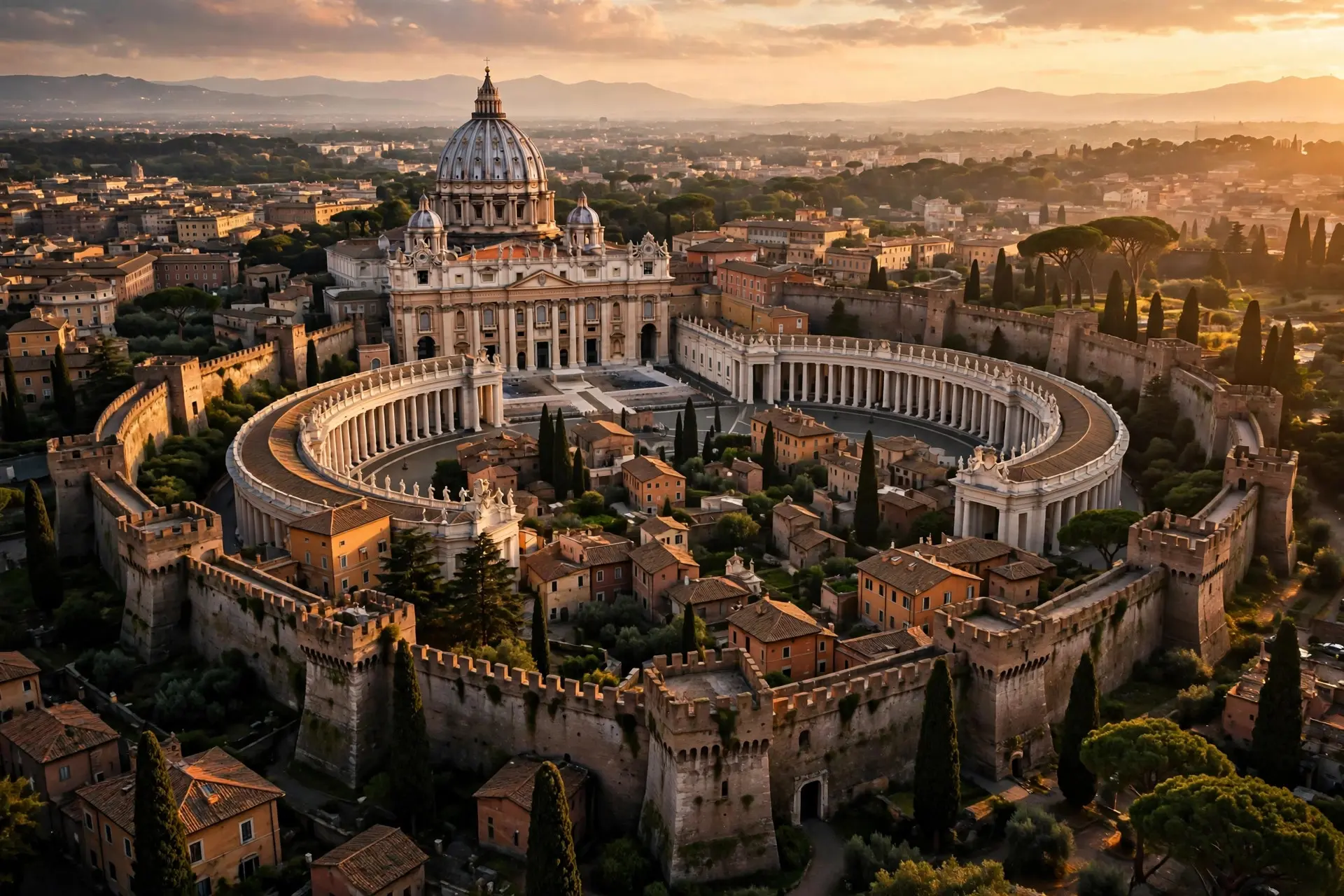
Statehood is not measured with a ruler. The usual checklist asks for a permanent population, a defined territory, a government and the capacity to enter into relations with other states, and Vatican City ticks every box. Its estimated population was 882 in 2024, most of them priests, nuns and several hundred lay workers in secretarial, domestic, trade and service jobs. Its borders are drawn by medieval and Renaissance walls, except on the southeast side, where St. Peter's Square opens into Rome. And its government, the Holy See, deals with states around the world, maintaining embassies abroad and receiving ambassadors in return. The machinery of a normal country is all there in miniature. Vatican City has its own telephone system, post office, gardens, astronomical observatory, radio station, banking system and pharmacy. Its flag is split yellow and white and shows the papal tiara above crossed keys. It mints its own euro coins, issues its own postage stamps and publishes a daily newspaper, L'Osservatore Romano, founded in 1861. Its radio station has broadcast around the world since 1931. Almost everything it consumes, from food to electricity, must be imported, and there is no income tax — but none of that stops it being a state. Size was never the test; recognised sovereignty was.
How Did the Pope End Up Ruling Half a Square Kilometre?
For more than a thousand years, the pope ruled far more than a walled garden. The legal foundation of the Papal States came from the Donation of Pippin in 754, which granted the pope rights over large parts of central Italy, and by about the year 600 the church was already one of the largest landowners in the world. The Vatican itself grew around the tomb of St. Peter, considered the first pope: a first basilica rose there in the 4th century, and the present St. Peter's Basilica was rebuilt during the 16th century. The Sistine Chapel, the Vatican Museums and the Vatican Library grew up alongside it, turning the hill into the administrative and artistic heart of Catholicism. That long run ended with Italian unification. Papal territories voted to join the Kingdom of Sardinia in 1859, Italy annexed the rest of the Papal States by 1870 and made Rome its capital, and each pope after that stayed inside the Vatican grounds in protest, styling himself a voluntary prisoner. The standoff lasted nearly six decades, an embarrassment for both sides: Italy had a capital city containing an unreconciled sovereign-in-waiting, and the church had a global mission run from a compound it did not legally own. The Lateran Treaty of 1929 settled it. Italy recognised Vatican City's independent sovereignty, and the pope finally had a state of his own — deliberately tiny, so that it could never again be mistaken for a territorial power.
What Is the Difference Between the City and the Holy See?
This is the distinction that unlocks the whole oddity. Vatican City is the territory: the walls, the basilica, the square, the gardens. The Holy See is the government of the Roman Catholic Church, led by the pope as bishop of Rome, and its authority reaches Catholics across the globe. Since 1929 the Holy See has resided in Vatican City, which was established as an independent state precisely so the pope could exercise his universal authority without answering to the Italian government.
The pope holds absolute executive, legislative and judicial power within the city, and when the see is vacant those powers pass to the College of Cardinals. Day-to-day legislation is carried out in his name by a commission headed by a cardinal president. The arrangement also explains the extraterritorial quirks: more than ten other buildings in Rome, plus the pope's summer residence at Castel Gandolfo in the Alban Hills, enjoy special privileges even though they sit outside the city walls. Vatican City is the headquarters; the Holy See is the institution it houses. Confusing the two is like confusing a company's head office with the company itself.
Why Does the Whole Country Fit on a Heritage List?
In 1984, UNESCO inscribed Vatican City as a World Heritage site — the rare case of an entire sovereign state appearing on the list in its own right. The listing recognised what visitors already know: the concentration of art and architecture inside those walls is unmatched for the area. The Vatican Museums hold frescoes by Michelangelo in the Sistine Chapel and Raphael's Stanze, the Vatican Library holds some 150,000 manuscripts and 1.6 million printed books, and St. Peter's Basilica remains one of the largest churches in Christendom, erected over the tomb of the apostle himself. There is a pleasing irony in that honour. The state was created to be small and politically harmless, yet it ended up holding some of the most visited rooms on Earth. Millions of people cross its border every year without noticing they have entered another country, because the frontier at St. Peter's Square is a line of white marble between the arms of the colonnade rather than a checkpoint. The Swiss Guard, responsible for the pope's personal safety since 1506, still stands at the gates in Renaissance dress, a reminder that this microstate guards something older than itself. Like other border oddities — the unclaimed desert of Bir Tawil or the ruler-straight lines explored in why some borders are straight — Vatican City shows that borders are legal ideas before they are fences. Vatican City endures because it solved a very specific problem: how to give a universal church a home that belongs to no king, no republic and no empire. Its half a square kilometre is not a leftover of a fallen empire but a deliberate invention, a state designed to be just big enough to be independent and just small enough to threaten nobody. That is why the smallest country in the world is also one of the hardest to argue with: it was never really about land at all.
Frequently asked questions
Why is Vatican City considered a country?
It meets the usual tests of statehood: a defined territory, a permanent population, a government and the ability to deal with other states. The Lateran Treaty of 1929 recognised its sovereignty, and it runs its own institutions, from a post office to a radio station.
How big is Vatican City?
It covers about 0.44 square kilometres, with an estimated population of 882 in 2024. You could walk across it in minutes, and its walls mark most of its boundary, except at St. Peter's Square.
What is the difference between Vatican City and the Holy See?
Vatican City is the small territory inside Rome, while the Holy See is the central government of the Roman Catholic Church, led by the pope. The Holy See's authority extends over Catholics worldwide, and Vatican City gives it an independent home base.
Sources
- Vatican City | History, Map, Flag, Location, Population, & Facts, Encyclopaedia Britannica
- History, Vatican City State
- Holy See - UNESCO World Heritage Convention, UNESCO World Heritage Centre