How the Smallpox Vaccine Became the First Vaccine
Edward Jenner proved in 1796 that cowpox protected against smallpox. His experiment invented vaccination, the tool that eradicated a deadly disease by 1980.
Key takeaways
- Edward Jenner inoculated eight-year-old James Phipps with cowpox on May 14, 1796, then proved the boy was immune by challenging him with smallpox on July 1.
- The word vaccine comes from the Latin vacca, meaning cow — Jenner named his process vaccination after the cowpox that protected milkmaids.
- The modern smallpox vaccine is not literally cowpox: vaccinia was shown in 1939 to be a separate virus, closest in genetics to horsepox.
- WHO's intensified campaign from 1967 ended with smallpox declared eradicated in 1980 — the only human disease ever wiped out.
- Before Jenner, the only protection was variolation: deliberately catching a mild case of smallpox, a gamble that sometimes killed.
The smallpox vaccine earns the title of first vaccine because it was the first time a doctor deliberately used a mild, related virus to build protection against a deadly one. In the spring of 1796, the English surgeon Edward Jenner transferred cowpox from a dairymaid's hand into a local eight-year-old boy's arm, waited, and then deliberately exposed the boy to smallpox — and the boy stayed healthy. That single experiment gave medicine both a technique and the word for it: vaccination.
Why was smallpox so feared in Jenner's time?
In the eighteenth century, smallpox was one of the leading causes of death, and outbreaks of unusual intensity swept through towns with terrifying death tolls. The disease respected no social class: rich and poor alike fell ill, and those who survived were often left with disfiguring scars or damaged eyesight. There was no treatment that could cure it, and no way to predict whom an outbreak would strike next. A disease that kills a large share of everyone it infects, and marks the rest for life, shaped daily life the way few other threats did — which is why the search for protection was so urgent long before anyone understood what a virus was.
What protected people before the vaccine?
The only defense anyone had was a practice called variolation: deliberately infecting a healthy person with "matter" taken from someone suffering a mild attack of smallpox. The idea, which originated in China and India, rested on two observations — that one attack of smallpox usually protected against any later attack, and that a person given a mild case on purpose would acquire that protection safely. In modern terms it was an elective infection, given to someone in good health. The gamble sometimes worked. But the transmitted disease did not always stay mild, and the procedure occasionally killed the person it was meant to protect. Worse, a freshly variolated person could pass smallpox on to others, becoming a new focus of infection in the community. So the best tool available before Jenner was a genuine dilemma: a dangerous disease, or a dangerous attempt to prevent it.
How did a dairymaid's sore hand change medicine?
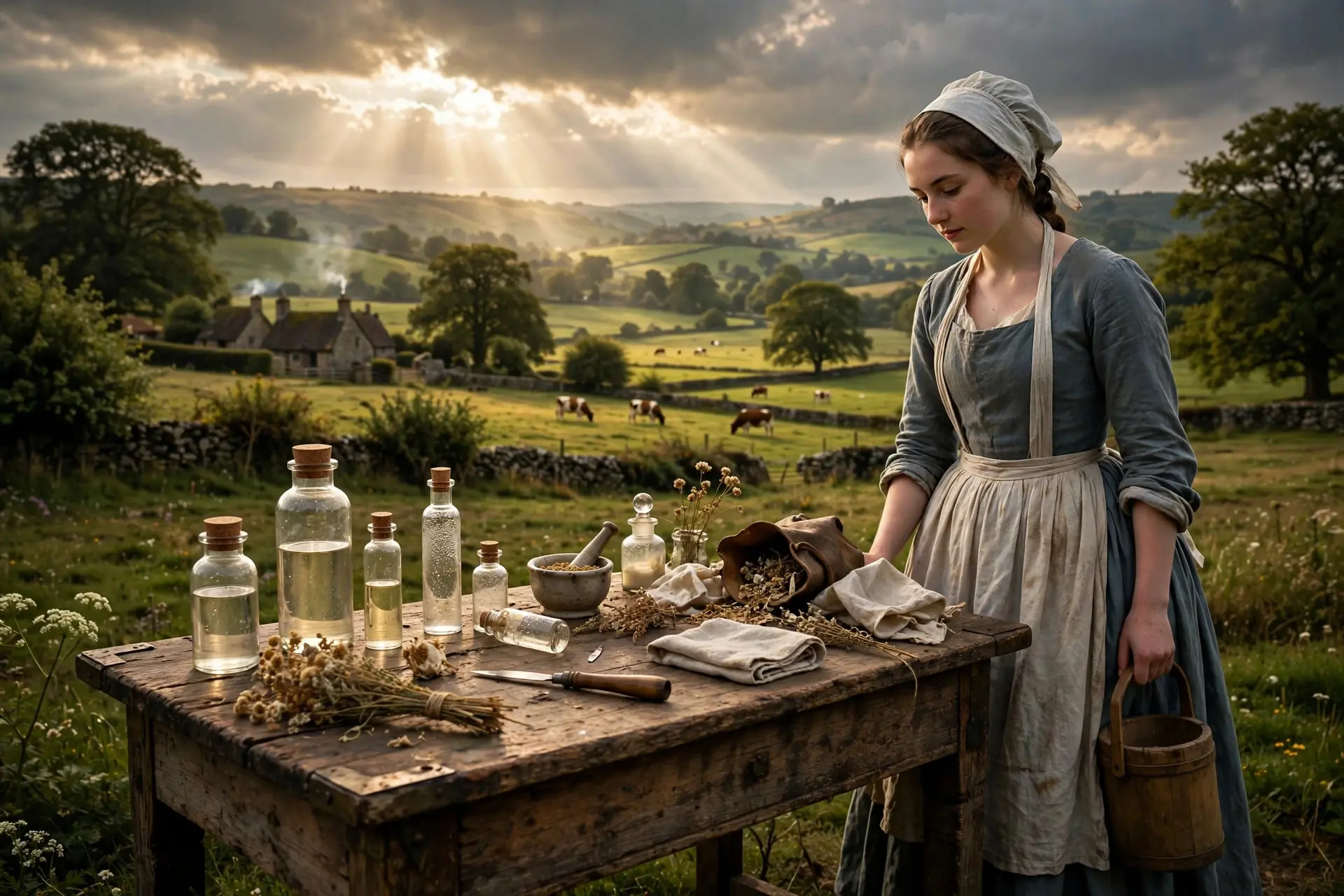
Edward Jenner was born in 1749 in Berkeley, Gloucestershire, and trained as a surgeon first through a local apprenticeship, begun at thirteen, and then in London as the house pupil of the celebrated surgeon John Hunter. Back in country practice, he kept hearing a piece of rural wisdom: that milkmaids and farm workers who had caught cowpox — a relatively harmless disease picked up from cattle — never seemed to catch smallpox. He spent years turning that rumor over in his mind, and concluded that cowpox might not only shield against smallpox but could be deliberately passed from person to person as a protection. In May 1796, dairymaid Sarah Nelmes arrived with fresh cowpox sores on her hand. On May 14, Jenner took infectious matter from those sores and introduced it into the arm of James Phipps, his gardener's eight-year-old son, who had never had smallpox. Phipps grew slightly ill over the following days — feverish and uncomfortable — but was well again by the tenth day. Then, on July 1, Jenner took the decisive step: he challenged the boy again, this time with smallpox itself. Phipps never fell ill — the protection held. Jenner gathered more cases and, in 1798, privately published a slim book, An Inquiry into the Causes and Effects of the Variolae Vaccinae. He called the process vaccination, from the Latin vacca, meaning cow. The Royal Society had declined his initial report, so he put it out at his own expense — a fitting start for an idea the medical establishment took years to accept.
Why did the world adopt vaccination so quickly?
For all the initial skepticism, vaccination proved its value fast and spread rapidly to America and Europe, then around the world. The smallpox death rate plunged wherever the practice took hold. Jenner himself became an indefatigable promoter, giving his time so freely to the cause that his private practice suffered. Parliament voted him £10,000 in 1802 and a further £20,000 in 1806 — rare recognition for a country doctor.
It was not a smooth triumph. One physician, George Pearson, tried to take credit for the discovery; another, William Woodville, contaminated cowpox matter with smallpox virus in his hospital. Critics like Dr. Benjamin Moseley fretted over the "bestial" nature of injecting matter from a cow-borne illness into people, warning of bovine mutations and pointing to an alleged "ox-faced boy." Yet by 1800, about seventy leading physicians had signed a testimonial in the Morning Herald supporting vaccination, and ordinary people — clergymen and society women among them — took up the lancet to vaccinate their own communities. Standardization, including a National Vaccine Board drawn from the Royal Colleges of Physicians and Surgeons, gradually corrected the sloppy techniques that had weakened early results. Decades later, Louis Pasteur's work on germ theory and laboratory-made vaccines would put Jenner's empirical discovery on a scientific footing and extend vaccination to disease after disease.
Is today's smallpox vaccine still Jenner's?
Here the story gains a twist. The vaccine virus used in modern times, called vaccinia, is not literally the cowpox Jenner handled. In 1939 the researcher Allan Watt Downie showed that the vaccine strain had drifted far from cowpox, so scientists classified vaccinia as its own separate species. Modern DNA sequencing places vaccinia closest to horsepox — and, ironically, farthest from the cowpox strains circulating in Britain. Somewhere across two centuries of passage through animals, people, and laboratories, the vaccine's lineage had wandered. Today's smallpox vaccine is the heir of Jenner's method, not the identical virus. The payoff of that method, though, was absolute. The World Health Organization intensified its global eradication program in 1967, and smallpox — the disease that had killed hundreds of millions — was declared eradicated in 1980, the only human disease ever to be wiped out. Routine vaccination of the general public has long since stopped; the vaccine is now produced only for research and as a defense against bioterrorism and biological warfare. A village doctor who trusted careful observation over received wisdom turned a milkmaid's immunity into the founding principle of immunology. Much like the accidental mold observation that led to penicillin, Jenner's breakthrough reminds us that some of medicine's greatest leaps begin not in a laboratory, but in someone paying close attention to what nature was already doing.
Frequently asked questions
Why is the smallpox vaccine called a vaccine?
Jenner coined the name from the Latin word vacca, meaning cow, because his protection came from cowpox. In his 1798 book he called cowpox variolae vaccinae, smallpox of the cow.
Was Jenner the first person to try to prevent smallpox?
No. A older practice called variolation — deliberately infecting a healthy person with matter from a mild smallpox case — originated in China and India. Jenner's method was the first to use a related but milder virus instead of smallpox itself, making it far safer.
Is smallpox really gone?
Yes, as a naturally circulating disease. After WHO intensified its eradication program in 1967, smallpox was declared eradicated in 1980 — the only human disease to earn that distinction. Routine vaccination of the public has stopped, though vaccine is still produced for research and defense against bioterrorism.
Is the modern smallpox vaccine made from cowpox?
Not exactly. In 1939 Allan Watt Downie showed the vaccine virus, named vaccinia, had drifted from cowpox enough to count as its own species — and DNA sequencing now places it closest to horsepox. Today's vaccine descends from Jenner's idea rather than from the exact virus he handled.