How Germ Theory Rewrote the Rules of Medicine
Before germ theory, doctors blamed bad air for infections they carried on their own hands. This is how microbes finally dethroned miasma — and remade surgery.

Key takeaways
- In May 1847 Ignaz Semmelweis ordered doctors at Vienna General Hospital to wash their hands in chlorinated lime — and the maternal death rate fell from 12% to about 1% within two years.
- Semmelweis was rejected by the medical establishment, committed to an asylum in 1865, and died of blood poisoning before germ theory was accepted.
- Louis Pasteur's 1861 swan-neck flask experiments proved that fermentation and putrefaction come from airborne microbes, founding modern germ theory.
- Robert Koch proved that specific bacteria cause specific diseases and set down Koch's postulates; he won the 1905 Nobel Prize for his work on tuberculosis.
- Joseph Lister's carbolic-acid antiseptic surgery, published in The Lancet in 1867, dramatically cut deaths from post-operative infection.
In 1847, a Hungarian doctor proved he could stop women from dying in childbirth — and the medical establishment ruined him for it. Ignaz Semmelweis had no theory of germs, no microscope images, nothing but the numbers. It would take another generation, a chemist's bent-necked flasks and a surgeon's carbolic spray, before medicine admitted what his numbers said: disease rides on invisible microbes, often carried on the doctors' own hands.
What was killing new mothers in 1840s Vienna?
Childbed fever — puerperal fever, a bacterial infection of the birth canal — was carrying off as many as one in three of the women who delivered in some European hospitals. At the Vienna General Hospital, one of Europe's largest teaching hospitals, the maternity service had been split in 1833 into two clinics admitting women on alternating days. The First Clinic trained physicians; the Second Clinic trained midwives. The numbers, published in the hospital's own reports, were damning. Between 1841 and 1846, roughly one mother in ten who entered the doctors' ward died of the fever in the worst years; the midwives' ward lost closer to one in thirty. Women in labor begged to be admitted on the midwives' days. Some gave birth in the street rather than risk the doctors' ward — and, tellingly, those street births almost never developed the fever. The difference was the morning routine. The medical students spent their dawn hours dissecting corpses in the autopsy room, then walked straight to the delivery beds without washing their hands. The midwives never touched a cadaver. Semmelweis, a 28-year-old Hungarian obstetrician on the First Clinic, did the arithmetic — and then a friend's death gave him the mechanism. His colleague Jakob Kolletschka, a forensic pathologist, was pricked by a scalpel during an autopsy and died of an infection whose course mirrored childbed fever exactly. Semmelweis concluded that "cadaverous particles" were being ferried on unwashed hands from the dead to the living.
How did handwashing save lives — and ruin the doctor who ordered it?
In May 1847 Semmelweis ordered every physician and student on his ward to scrub their hands in a solution of chlorinated lime before touching a laboring woman. Soap and water alone would not do — they failed to remove the cadaver smell, so he chose the chlorine. The results were immediate and staggering: within two years the maternal death rate on the doctors' ward fell from 12 percent to about 1 percent, according to records cited by the CDC. He also began washing his surgical instruments. Medicine's response was not gratitude but fury. The dominant theory held that diseases spread through bad air — miasma — or general hospital conditions; the suggestion that doctors themselves carried death on their hands was an insult to the profession. Semmelweis could prove the dying stopped, but he could not explain why it worked — the microbes were invisible, and no theory existed to name them. His contract in Vienna was not renewed. He left for the University of Pest in 1850, where his chlorine regimen cut the death rate to 0.85 percent — and was ignored there too. In 1865 Semmelweis suffered a breakdown and was committed to a Viennese asylum, where he died of blood poisoning from an infected wound. The germ theory of disease was only developed after his death. Today he is recognized as the pioneer of antiseptic prophylaxis — a man who was right about everything except the explanation, and was destroyed for it. His story belongs with the discovery of insulin in medicine's small canon of careful observations that became life-saving treatments.
Who finally proved the microbes were real?
The proof came from an unlikely direction: beer and wine. French chemist Louis Pasteur spent the late 1850s and early 1860s studying fermentation and putrefaction, and concluded both were the work of microorganisms. In 1861 he published his famous experiments with swan-necked flasks — glass vessels whose curved necks let air in but trapped dust and germs — showing that sterilized broth stayed sterile while exposed broth spoiled. Spontaneous generation was dead; the germs of the air were real, and they were identical to the ones that caused fermentation and rot. Pasteur's prestige did what Semmelweis's numbers could not: it gave the invisible a mechanism and a champion. From fermentation he generalized outward — germs could sicken wine, so why not wounds? Why not whole bodies? His later vaccine work, including his studies on rabies, turned germ theory from an explanation into a weapon.
Then came Robert Koch, the German physician who gave germ theory its legal code. In 1876 Koch proved that anthrax in cattle was caused by a specific bacterium, and he formalized the method in Koch's postulates: the microbe must be found in every diseased animal and in none healthy, isolated and grown in pure culture, used to reproduce the disease experimentally, and recovered from that animal. He identified the tuberculosis bacillus in 1882 and won the 1905 Nobel Prize in Physiology or Medicine for it. Even the earliest hints now look prophetic: the Scottish physician Alexander Gordon had called for hygienic measures against childbed fever as early as 1795, and the American Oliver Wendell Holmes did so in 1843. Both were ignored — medicine needed Pasteur and Koch before it would believe its own eyes.
How did Lister turn the theory into survival?
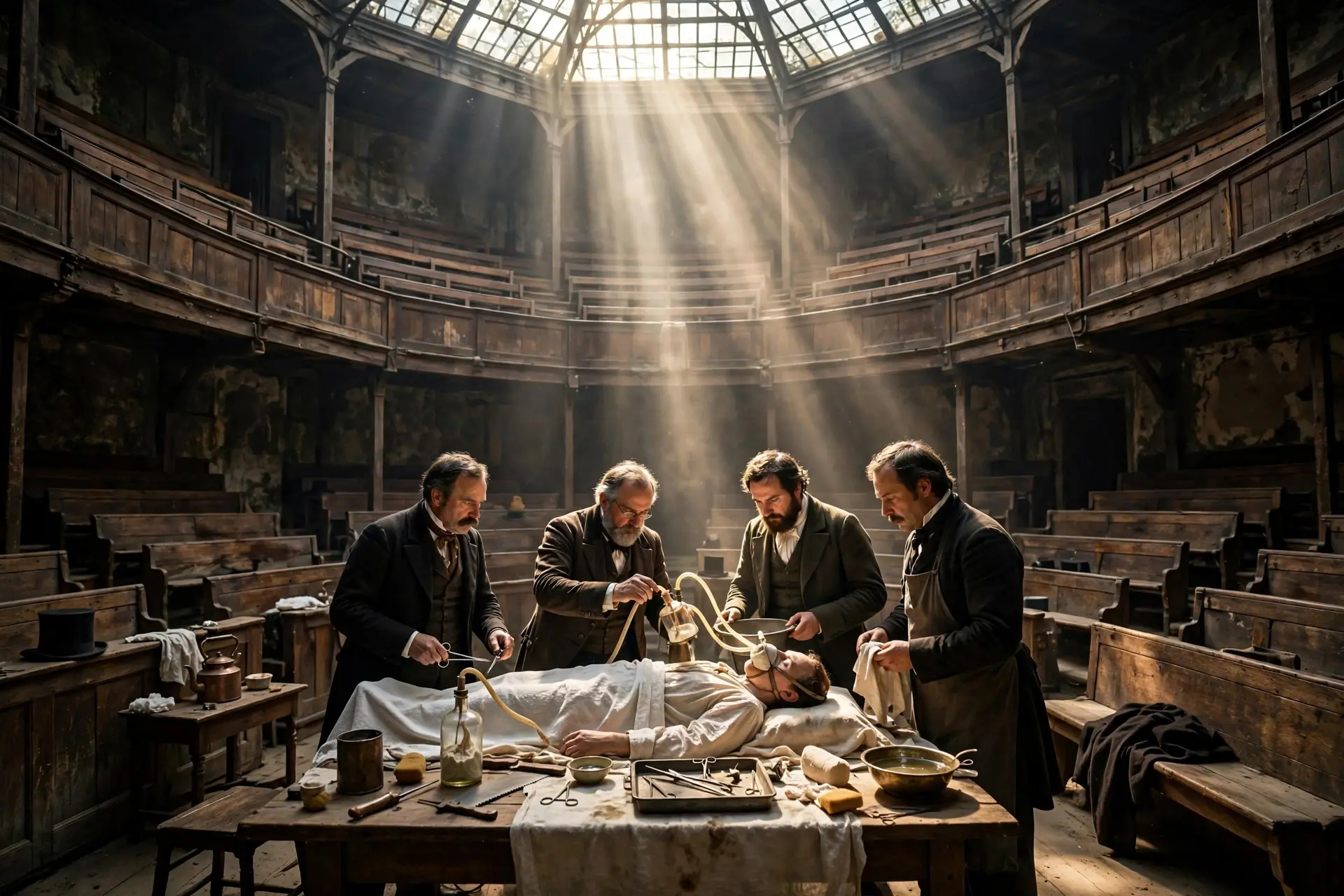
By the mid-1860s, post-operative sepsis was killing nearly half of all patients who underwent major surgery — gangrene, wound infections, the "hospital gangrene" that stalked the wounded. The surgeons' grim joke was that the operation had succeeded but the patient had died. Doctors arrived in street clothes, instruments unsterilized, hands unwashed. Joseph Lister, professor of surgery at the University of Glasgow, read Pasteur's work and made the connection no one else had: the formation of pus in a wound was the same phenomenon as fermentation — putrefaction by microbes from the air. If germs caused it, germs could be destroyed. Beginning in 1865, he began spraying wounds and instruments with carbolic acid — phenol — and codified a full ritual: handwashing, cleaning the wound, carbolic-soaked dressings, waterproof coverings, and the heat sterilization of tools and clothing. In 1867 he published his results in The Lancet in a paper titled "On the Antiseptic Principle in the Practice of Surgery." Infection deaths plummeted, and antiseptic surgery — later refined into aseptic surgery, keeping germs out rather than killing them — became the foundation of every operating room on Earth. Handwashing between patients is now recognized as the single best way to prevent the spread of illness in hospitals; sterile technique and sterile instruments are simply assumed. Germ theory explained the cause, but it was the therapies that followed — antisepsis, vaccines, and eventually antibiotics, the story of penicillin and the accidental spore — that turned the theory into survival. Semmelweis was right and died for it; Pasteur was right and was believed; Lister applied it and saved millions. Germ theory's real discovery was not that microbes exist — microscopes had revealed those for two centuries — but that they rule medicine: they are the reason to wash, the reason surgery survives, and the reason the most dangerous thing in a 19th-century hospital was so often the doctor.
Frequently asked questions
What is the germ theory of disease?
The idea that many diseases are caused by microorganisms — bacteria, viruses and other microbes — invading the body, rather than by bad air or imbalanced humors. It was established in the 19th century through the work of Louis Pasteur and Robert Koch.
Why was Semmelweis ignored even though he was right?
He could prove handwashing saved lives but could not explain why — the germs were invisible and no theory of microbes existed yet. Worse, his finding implied doctors were killing their patients, which the medical establishment refused to accept.
How did germ theory change surgery?
Joseph Lister applied Pasteur's findings in 1865 by treating wounds with carbolic acid; his 1867 Lancet paper on the antiseptic principle turned surgery — where infection had killed nearly half of major-operation patients — into a survivable procedure.