How Anesthesia Made Painless Surgery Possible
In 1846 a Boston dentist proved ether could end surgical pain: the story of anesthesia, from ether frolics and Ether Day to chloroform and painless surgery.
Key takeaways
- On October 16, 1846, dentist William Morton publicly demonstrated ether anesthesia at Massachusetts General Hospital, marking the start of painless surgery.
- Georgia physician Crawford Long had actually used ether first, in 1842, but he never published his work, so credit went to the public demonstration.
- Chloroform, introduced by James Young Simpson in 1847, brought anesthesia to childbirth and made Queen Victoria one of its most famous patients.
- Early anesthetics were crude and dangerous: ether was flammable and nauseating, and chloroform was easy to overdose.
Surgery without pain became possible when doctors learned to block the nervous system's pain signals before the knife ever touched skin. On October 16, 1846, a Boston dentist demonstrated that ether fumes could render a patient completely insensible, ending centuries in which every operation was endured in full, screaming agony.
What anesthesia actually does to the body
Anesthesia is not sleep, and it is not unconsciousness in the ordinary sense. It is the controlled, reversible interruption of sensation. A general anesthetic blocks signals from traveling between the nerves and the brain, so the brain never registers the body's alarm. Local and regional anesthetics do the same for smaller territories: numbing a limb or a patch of skin while the patient stays awake. The effect is pharmacological, not mystical. Modern anesthetics act on the brain's signaling chemistry, dampening the processing of pain, awareness, and memory. That simple-sounding mechanism took until the nineteenth century to discover — not because the chemicals were new, but because nobody had connected their effects to surgery.
Why every operation before 1846 was agony
For most of human history, surgery was an ordeal of speed. With no way to stop pain, the surgeon's greatest virtue was swiftness: the faster the amputation or incision, the less the patient suffered. Patients were held down by assistants while surgeons worked against the clock, and exhaustion, shock, and infection did the rest. That is not to say people did not try. Ancient physicians used mandrake-root preparations, opium, and alcohol to dull pain, but these were unreliable and sometimes as dangerous as the surgery itself. Some worked on reflex or pressure points. None could reliably make a person insensible to a surgeon's knife. Ironically, the chemical that would change everything was already in circulation as entertainment. Ether had been known since 1540, when the German physician Valerius Cordus made it by heating alcohol with sulfuric acid. By the early 1800s, "ether frolics" were fashionable parties at which young people inhaled the vapors and laughed themselves dizzy. The Swiss physician Paracelsus had noted centuries earlier that ether vapors could render chickens unresponsive. Partygoers were gassing themselves for fun while surgical patients suffered — and nobody in the audience made the connection to the operating room.
The race to Ether Day
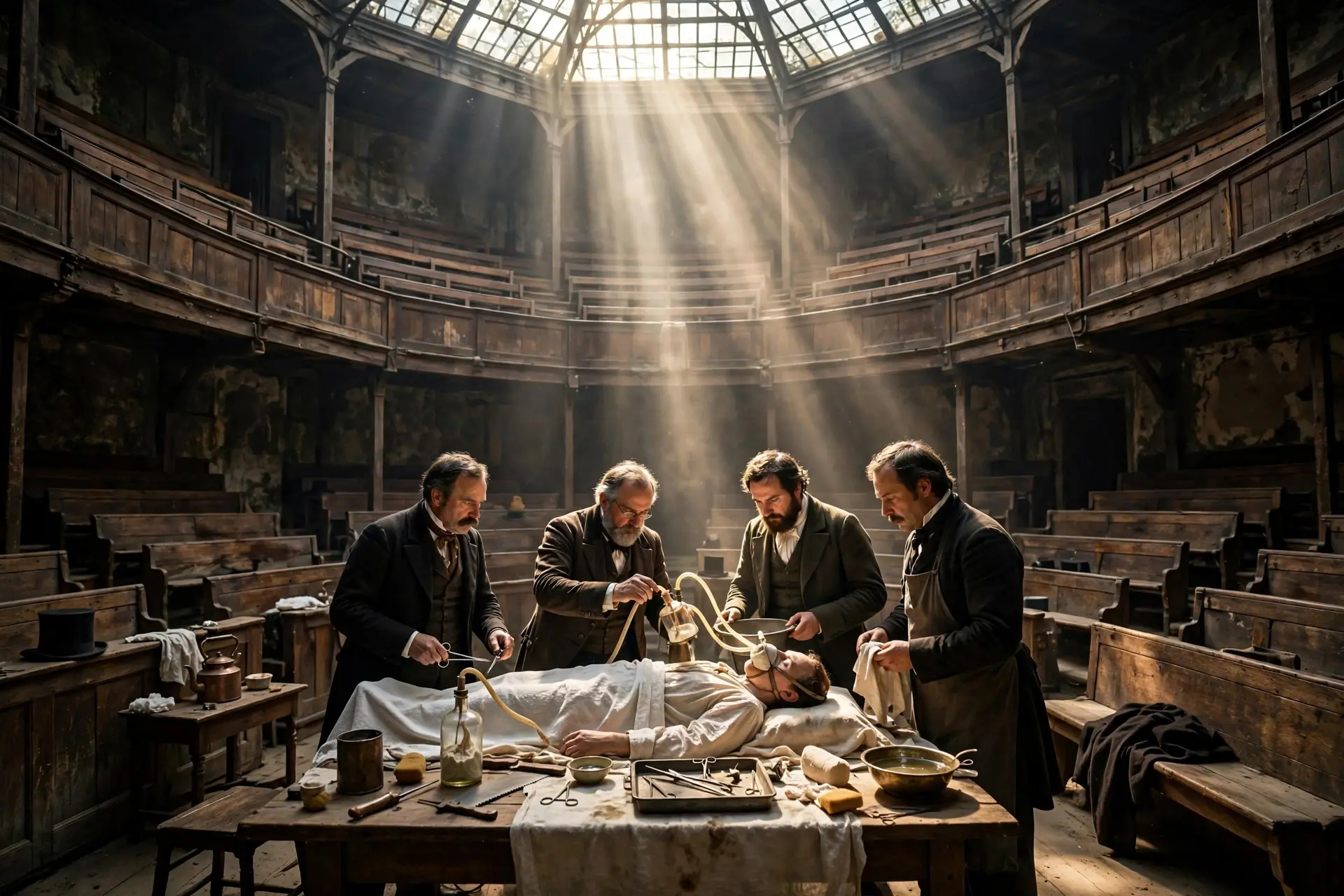
The man who saw the connection first was a country physician in Georgia. On March 30, 1842, Crawford Williamson Long of Jefferson, Georgia, soaked a cloth in ether and placed it over the face of a patient named James Venable while he removed a tumor from Venable's neck. It was the first recorded use of ether as a surgical anesthetic. But Long never published his work. It remained a local curiosity, unknown to the wider medical world. Three years later, another dentist, Horace Wells, tried to demonstrate the anesthetic power of nitrous oxide before a Boston audience. The demonstration failed: the patient groaned in pain as Wells extracted a tooth, and the crowd jeered, shouting "Humbug!" Wells left the hall disgraced, and nitrous oxide's reputation in surgery was ruined for decades. Then came William Thomas Green Morton. A Boston dentist who had experimented with ether on himself and even his dog, Morton arranged a public demonstration in the operating theater of Massachusetts General Hospital — the same hall where Wells had been humiliated. On October 16, 1846, before an audience of skeptical physicians and students, Morton had his patient, printer Gilbert Abbott, inhale ether vapor through an inhaler he had devised. Surgeon John Collins Warren then removed a tumor from Abbott's neck while the patient lay motionless and silent. When Abbott woke, he reported feeling no pain — as if, he said, his neck had only been scratched. Warren turned to the stunned audience and announced, "Gentlemen, this is no humbug." The demonstration was the first effective, public proof that inhaled ether could produce insensibility to pain during a serious surgical operation. Henry Jacob Bigelow quickly published his case series on the technique, news crossed the Atlantic, and The Lancet carried the story in January 1847. In December 1846, the great London surgeon Robert Liston performed the first major operation under ether in Europe — a thigh amputation — and reported its success in a letter to the physician Francis Boott, which The Lancet soon printed. The Ether Day demonstration did not just work once; it convinced the world in a matter of months.
Chloroform, childbirth, and a queen's endorsement
Ether was a beginning, not a solution. It was unpleasant to inhale, slow to take effect, and highly flammable — a serious hazard in candlelit operating rooms. The search for a better agent led to chloroform. In November 1847, the Edinburgh obstetrician James Young Simpson tried chloroform on himself and his assistants around a dinner table and achieved complete success. Where ether had conquered general surgery, chloroform would conquer childbirth — a domain where physicians had long been hesitant to intervene against pain.
The man who turned chloroform into a reliable practice was John Snow, who worked out careful dosing and inhalation techniques and became, in effect, the first dedicated anesthesiologist. In 1853, Snow administered chloroform to Queen Victoria during the birth of Prince Leopold. In her diary the queen wrote, "Dr. Snow gave that blessed chloroform and the effect was soothing, quieting and delightful beyond measure." Royal approval swept away much of the remaining moral and religious resistance — the belief, held in some quarters, that pain in childbirth was divinely ordained. Meanwhile anesthesia proved its worth on the battlefield. During the American Civil War, ether and especially chloroform became indispensable in the thousands of amputations performed on wounded Union and Confederate soldiers. Surgeons could finally work methodically rather than frantically. Combined with the era's other medical revolutions — from Louis Pasteur's germ theory of disease to the accidental discovery of X-rays and eventually the mold that became penicillin — anesthesia helped transform the operating room from a chamber of suffering into a place of healing.
The misconception: anesthesia was not one man's triumph
Popular history credits Morton with "discovering" anesthesia, but the record is messier and more interesting. Long was first in practice but silent in publication. Wells had the right instinct with nitrous oxide but botched the demonstration. Morton won the race because he understood that discovery is a social act: he put the drug before the right audience, at the right place, at the right moment, and made sure the world heard about it. The early decades were not the clean victory the legends suggest, either. A string of deaths from chloroform overdoses in the late 1840s raised early alarms about dosing, and the crudeness of the first techniques — masks, sponges, a finger on the patient's pulse — seems astonishing today. October 16 is still marked around the world as Ether Day, or World Anesthesia Day, and the plaque in Boston's Ether Dome still declares that in that room knowledge of the discovery spread "throughout the civilized world and a new era for surgery began." Before anesthesia, surgery was agony, speed, and dread. After it, surgeons could take their time, reach deeper into the body, and attempt operations that would once have been unthinkable. Morton's tombstone says it plainly: before him, "in all time, surgery was agony"; by him, "pain in surgery was averted and annulled." The real discovery was not ether itself — it was the proof that pain could be switched off, deliberately and safely, at the moment it mattered most.
Frequently asked questions
Who discovered anesthesia?
No single person did. Crawford Long used ether in surgery in 1842 but kept quiet; William Morton demonstrated it publicly in 1846 and got the credit; James Simpson introduced chloroform in 1847; and John Snow refined its use.
What was the first public anesthesia demonstration?
On October 16, 1846, in Boston's Massachusetts General Hospital, Morton anesthetized patient Gilbert Abbott with ether so surgeon John Collins Warren could remove a neck tumor without pain.
Was anesthesia used in childbirth?
Yes. James Simpson used chloroform for labor pain in Edinburgh from 1847, and in 1853 John Snow gave chloroform to Queen Victoria during the birth of Prince Leopold.