Which City Is the Farthest South on Earth?
Ushuaia, Argentina, is the famous city at the end of the world — but since 2019, smaller Puerto Williams across the Beagle Channel sits further south.
Key takeaways
- Ushuaia, Argentina, sits at 54°48′S on the Beagle Channel and is the largest city at the southern tip of South America.
- Since Chile reclassified Puerto Williams as a city in 2019, that smaller settlement across the channel is officially further south, at 54°56′S.
- Ushuaia was formally founded on 12 October 1884 and became the capital of Tierra del Fuego the following year.
- The city grew from a missionary settlement and a penal colony into the world's busiest gateway for Antarctic cruises.
- Despite the 'end of the world' label, Ushuaia's ocean-moderated climate is cool rather than polar, with average temperatures above freezing year-round.
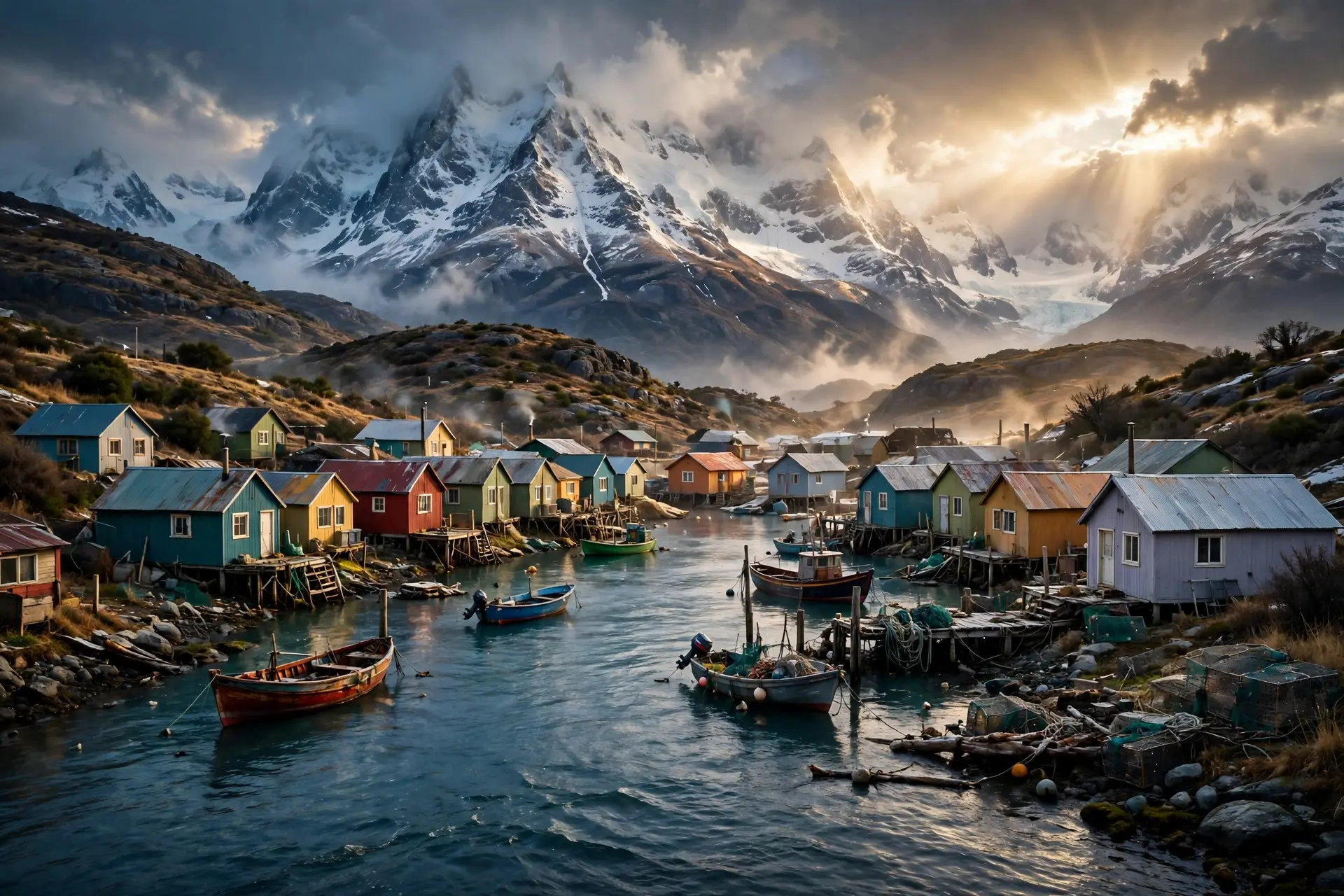
Ushuaia, Argentina, is the city most people mean when they talk about the farthest south a city can be. It sits at 54°48′S on the southern shore of Tierra del Fuego, where the Andes meet the Beagle Channel, and it has marketed itself for decades as the end of the world. But the honest answer has a twist: since 2019, the smaller Chilean settlement of Puerto Williams, just across the channel, has officially held the title of southernmost city. Ushuaia keeps the fame, the size, and the Antarctic gateway traffic — Puerto Williams keeps the latitude.
Where is Ushuaia, and why does it claim the title?
Ushuaia is the capital of Argentina's Tierra del Fuego province, tucked into a wide bay on the southern coast of Isla Grande de Tierra del Fuego. The Martial mountain range rises behind it, and the Beagle Channel laps its southern shore. It lies roughly 1,100 kilometres from the Antarctic Peninsula, which is what makes it one of the world's five internationally recognised Antarctic gateway cities. Its name comes from the Yaghan language, and the most commonly cited meaning is a bay that penetrates westward — a fitting description for a town that feels like the last fold of the map. The claim to southernmost city rests on size and standing, not raw latitude. Ushuaia is a real city of tens of thousands of people, with an airport, a port, and industry, while the settlements further south are far smaller. That distinction matters: plenty of tiny outposts sit closer to the South Pole, but none of them functions as a city in the way Ushuaia does. It is the same logic that separates a town from a city anywhere else — population, infrastructure, and importance, not just a line on a map.
How did a missionary outpost become a city?
Ushuaia's story begins before its official founding. British Anglican missionaries reached the bay in the late 1860s: Waite Hockin Stirling settled there in 1869, and Thomas Bridges arrived with his family in 1871, later leaving the mission to establish the Estancia Harberton sheep farm to the east. When Commodore Augusto Lasserre sailed into the bay aboard the Paraná on 12 October 1884, he found a community of more than 300 people already living there. That day became Ushuaia's official birth date, and a year later it was established by decree as the capital of Tierra del Fuego. Argentina's government had a strategic reason to formalise the settlement: sovereignty. The southern tip of the continent was contested with Chile, and a permanent Argentine town, backed by a naval presence, strengthened the claim. Part of that plan was a prison. Ushuaia's penal colony received its first inmates in 1896, and the prison complex — later merged with a nearby military prison — operated until 1947, when it was closed by executive order. Prisoners built much of the early town with timber from the surrounding forests, including a narrow-gauge railway into the woods that survives today as the tourist attraction known as the End of the World Train. The prison building itself is now the Maritime Museum, one of the city's most visited sites. The second half of the twentieth century changed Ushuaia's fortunes. Tax incentives drew industry, the population grew rapidly, and tourism discovered the spectacular setting. Today the city is the departure point for most Antarctic expedition cruises — the place where travellers board ships to cross the Drake Passage, a role that echoes its history as a launch pad for southern exploration.
So is Puerto Williams actually further south?
Yes — by latitude and by official classification. Puerto Williams sits on Navarino Island on the southern shore of the Beagle Channel, roughly 16 kilometres south of Ushuaia. For years it was classed as a town, so Ushuaia's claim went unchallenged. But in May 2019, the Chilean authorities officially redesignated Puerto Williams as a city, allowing it to claim the southernmost-city title from its far larger Argentine rival. The settlement has only around 3,000 residents, a naval base, and an airstrip, and it still looks and feels like a small town — but under Chile's classification, it counts.
The honest answer, then, is that both cities hold a version of the title. Puerto Williams is the southernmost place officially called a city. Ushuaia is the southernmost large city, the southernmost city most travellers will ever visit, and the one whose "end of the world" branding the world recognises. If someone asks which city is farthest south, the precise answer is Puerto Williams; if they ask where the end of the world feels most real, the answer is still Ushuaia.
What is life like at the end of the world?
Milder than the nickname suggests. Ushuaia's climate is moderated by the surrounding ocean, so average temperatures stay above freezing throughout the year, and summer days commonly reach the mid-teens Celsius. Winters bring snow and wind, but nothing like the deep cold of the Antarctic interior — for a sense of that contrast, consider Vostok Station, where the official record low is nearly ninety degrees below zero. Ushuaia's record low, by comparison, is around minus twenty-one degrees. The city also sits at the end of the road in a literal sense. National Route 3, which runs the length of Argentina, terminates here, and beyond the city there is no further land route south — only the Beagle Channel and, eventually, Antarctica. Travellers who arrive by bus find, as one National Geographic writer put it, that the world simply stops in Ushuaia, and the next leg of any journey must be by water. That is the real meaning of the "end of the world" label: not that civilisation ends here, but that the continent does. Ushuaia's story is also a reminder that superlatives depend on definitions. The driest city, the coldest town, the southernmost settlement — each title hides an argument about what counts. In Ushuaia's case, the argument produced two winners: a small Chilean city with the latitude, and a larger Argentine city with the legend. And for travellers standing on the waterfront, watching the mountains fall into the channel, the distinction hardly matters. Either way, they are about as far south as city life goes — which is why Arica, the driest city on Earth, sits at the opposite end of the same long, narrow continent's catalogue of extremes.
Frequently asked questions
Which city is the farthest south on Earth?
It depends on the definition. Puerto Williams in Chile, at 54°56′S, is the southernmost place officially classified as a city since 2019. Ushuaia in Argentina, at 54°48′S, is far larger and remains the city most people mean by the title.
Why is Ushuaia called the end of the world?
Its Spanish nickname is 'fin del mundo.' The city sits at the southern tip of South America, where the road network of the continent effectively runs out and the next stop south by sea is Antarctica.
How cold does Ushuaia get?
Surprisingly mild for its latitude. The ocean moderates its climate, so average temperatures stay above freezing all year, and summer days commonly reach the mid-teens Celsius — far warmer than Antarctic stations like Vostok.
What is Ushuaia used for today?
It is the main departure point for Antarctic expedition cruises, a provincial capital, and a tourist hub for Patagonian mountains, forests, and the Beagle Channel.
Sources
- Ushuaia: The Little-Known History of Antarctica's Gateway, Oceanwide Expeditions
- Explore Puerto Williams: The Earth's Southernmost City, The Culture Trip
- Bus2Antarctica: Upgrade in Ushuaia, National Geographic