The Tunguska Event: The 1908 Blast That Left No Crater
On June 30, 1908, a fireball flattened 2,150 km² of Siberian forest without leaving a crater. Inside the century-long quest to explain the Tunguska blast.
Key takeaways
- On June 30, 1908, an object from space exploded over the Siberian taiga near the Podkamennaya Tunguska River, knocking down trees across about 2,150 square kilometers.
- Most modern models put the blast at 10 to 20 megatons, hundreds of times the Hiroshima bomb, released about 10 kilometers up, which is why there is no crater.
- Most scientists favor a stony asteroid roughly 50 to 80 meters across; a comet is a minority view, and no large fragment has ever been found.
- Leonid Kulik reached the site in 1927 and found trees flattened outward around a central zone where trunks still stood, stripped of their branches.
- NASA now estimates that Tunguska-sized airbursts happen roughly every 2,000 to 4,000 years, and the UN marks June 30 as International Asteroid Day.
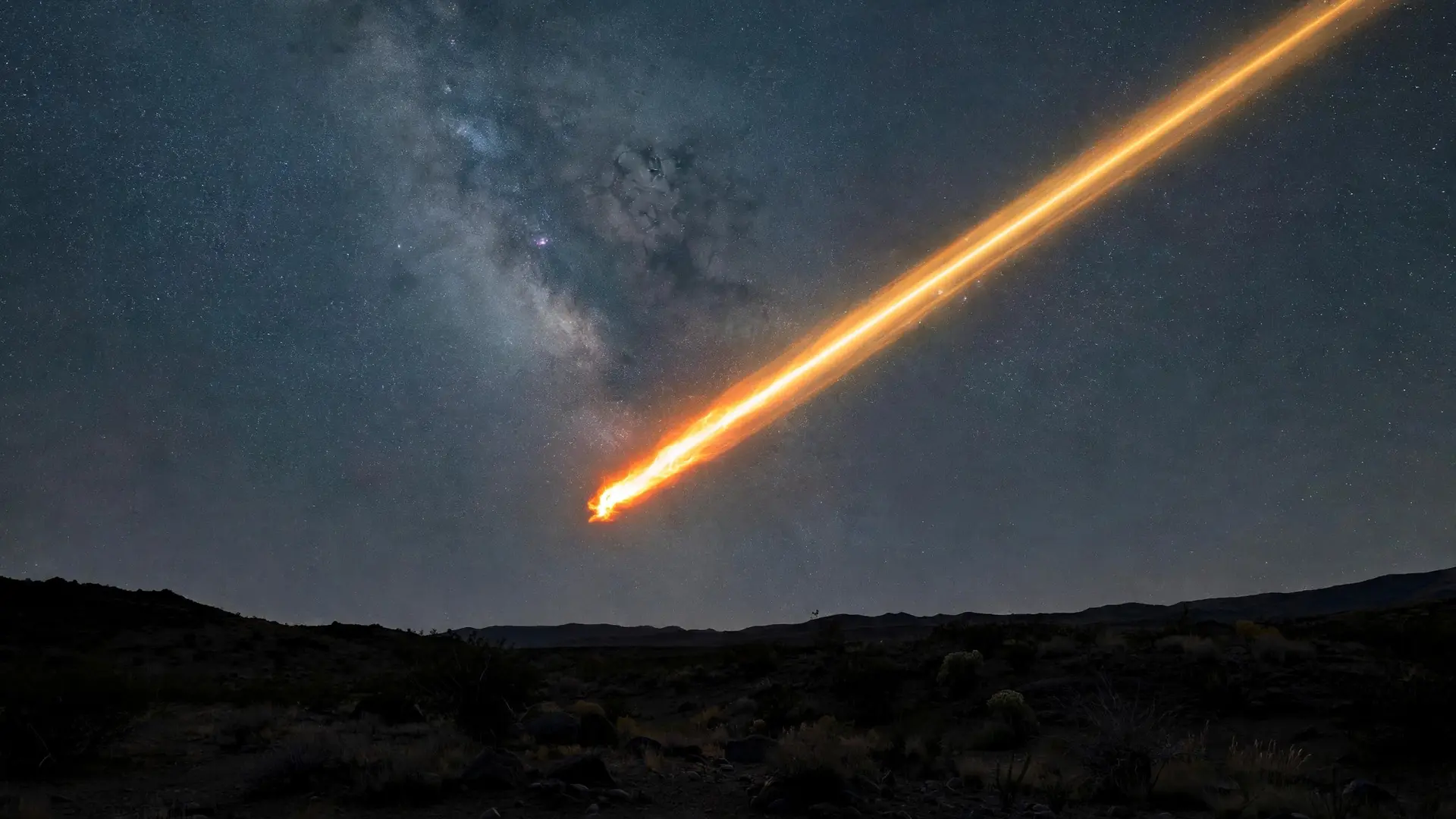
Early on June 30, 1908, something from space exploded above the Siberian forest near the Podkamennaya Tunguska River. The blast knocked down trees across roughly 2,150 square kilometers, an area larger than Greater London, and released energy that most modern models put at 10 to 20 megatons of TNT, hundreds of times the bomb dropped on Hiroshima. Yet when a scientist finally reached the spot nearly two decades later, he found no crater and no meteorite. Tunguska is still the biggest impact event in recorded history, and the object behind it never touched the ground.
What happened on the morning of June 30, 1908?
The explosion came at about a quarter past seven local time (around 00:14 UTC), over one of the emptiest corners of the Russian Empire, in what is now the Evenkiysky district of Krasnoyarsk Krai. People across a wide stretch of Siberia saw a fireball streak across the sky and a flash brighter than the Sun, then heard a thunderous roar. At the Vanavara trading post, about 65 kilometers from the center, a man named Semen Semenov was sitting outside when the sky to the north seemed to split open. He later said the heat felt as if his shirt had caught fire, and the blast knocked him off his seat. Windows broke 200 to 300 kilometers away. A seismograph at Irkutsk, about 1,000 kilometers to the south, recorded the shock, and the pressure wave in the air was measured around the world, including on barographs in England. The strangest effects came over the following nights. Across northern Europe the sky after sunset stayed unusually bright, with the glow peaking on the night of June 30 to July 1, and in Britain people reported reading newspapers outdoors around midnight. This was not the northern lights, which are driven by charged particles striking the upper atmosphere. It was ordinary sunlight, scattered long after dusk by dust and ice thrown high above the Earth. The Times compared it to the vivid skies that followed the eruption of Krakatoa in 1883, and sunlight measurements made at Mount Wilson in California for the Smithsonian Astrophysical Observatory showed a small, temporary drop in the clarity of the air that summer. High-altitude debris can reshape skies a world away, as volcanic dust did again in the year without a summer. The human toll is harder to pin down. The region was home mainly to Evenki reindeer herders, and hundreds of their reindeer were killed. A 2019 review of more than 700 eyewitness accounts concluded that at least 30 people were in or near the zone of fallen trees and that at least three of them died, immediately or later; other researchers say no death is firmly documented. Siberian newspapers reported the explosion, but Russia was soon consumed by war, revolution and civil war, and no scientist reached the site for almost twenty years.
Why did Kulik find no crater?
The scientist who finally went looking was Leonid Kulik, a mineralogist leading a meteorite-hunting expedition for the Academy of Sciences. He first tried in 1921 and could not get through. The stories he heard about the fireball convinced him that a giant meteorite lay somewhere in the taiga, and the hope of recovering tonnes of iron helped him win money for a proper expedition. He reached the blast zone in 1927. What he found there was not a crater. At the center was a patch several kilometers across where trees still stood upright but had lost their branches and bark. NASA's Don Yeomans later put it simply: "They looked like a forest of telephone poles." Beyond that patch, trunks lay flat on the ground with their tops pointing away from the center. Aerial photographs taken in 1938, and ground surveys in later decades, showed that the flattened area has the outline of a giant butterfly. The missing crater was the clue. The object had blown apart in the air. A rocky body plunging in at roughly 15 to 20 kilometers per second meets such intense air pressure and heating that it can shatter in a fraction of a second, dumping its energy as a fireball and a blast wave. A 2018 NASA review of the evidence put the burst at about 10 kilometers up. The standing trees fit that picture: directly beneath the explosion, the blast struck from above and tore off the branches without toppling the trunks, while farther out it hit the forest at an angle and knocked it flat. The flash scorched the trees and started fires, though the blast that followed probably snuffed out many of them.
What exactly fell from the sky?
Here the story gets humbler, because the Tunguska object was almost entirely destroyed. No large fragment has ever been recovered. Soviet and later Italian teams reported tiny spherules of melted material in peat and tree resin from 1908, which hint at an extraterrestrial source but fall short of proof. The object's identity still rests mainly on physics. That physics points to a stony asteroid. The 2018 NASA review concluded that if the impactor resembled the Chelyabinsk meteor in composition, it was roughly 50 to 80 meters across, and the most likely models converged on 10 to 20 megatons; published estimates run from about 3 to 50. Earlier modeling showed why the type of rock matters. An iron body of that size would have reached the ground and blasted a crater, while a comet or a fragile carbon-rich asteroid would have broken up too high to flatten the forest the way it was flattened. A comet still has defenders, who point to the bright nights and unusual high clouds over Europe as signs of water from an icy body, but it is a minority view. NASA's history office says most scientists now believe the culprit was an asteroid.
Seeing the mechanism in action took another century. On February 15, 2013, an asteroid about 18 meters across exploded over the Chelyabinsk region of Russia with the energy of roughly 440 to 500 kilotons. The shock wave shattered windows across the region, and about 1,500 people were hurt, most of them by flying glass. A space rock does not have to land to do damage.
Which Tunguska myths refuse to die?
A blast with no crater was always going to attract speculation. Over the decades, writers have blamed it on a nuclear blast, an unusual volcanic eruption, antimatter, a crashing alien spacecraft and a tiny black hole. A 2018 NASA review filed the first four under "bizarre explanations," and the black-hole idea, published in Nature in 1973, was rebutted in the same journal the following year. One persistent legend pins the blast on Nikola Tesla, claiming that a wireless-power test from his Wardenclyffe Tower went catastrophically wrong. But Wardenclyffe was never finished: the project stalled when its financier, J. P. Morgan, pulled out, and the tower was scrapped in 1917. A more stubborn myth is the near miss. For years, popular accounts claimed that if the object had arrived a few hours later, it would have destroyed St Petersburg. In 2024, a group of 14 impact researchers, including scientists from NASA and JPL, listed that claim among the event's myths. In those hours Earth would have traveled roughly half a million kilometers along its orbit, so the object would have missed the planet entirely. The same group argued that the famous figure of 80 million fallen trees is probably about four times too high.
How often does a Tunguska happen?
Less often than once thought. NASA scientists used to say every few hundred years; in 2019 the agency said the interval is on the order of millennia instead. The 2018 review put it at roughly 2,000 to 4,000 years for a Tunguska-sized airburst anywhere on Earth, and about three times longer for one over land. Rare is not never, though, and the 1908 object arrived without warning. That is what planetary defense is for. NASA set up its Planetary Defense Coordination Office in 2016 to find and track near-Earth objects. In September 2022 its DART spacecraft deliberately crashed into the small asteroid Dimorphos and shortened its orbit by about half an hour, the first time humans had changed the motion of a celestial body on purpose. The United Nations picked the anniversary of the blast for International Asteroid Day, adopted by the General Assembly in December 2016, and NASA is building NEO Surveyor, an infrared space telescope designed to hunt for the asteroids and comets that could one day threaten Earth. The Tunguska event is ultimately a story about evidence winning slowly. A remote wilderness, a shattered forest, a scientist who went hunting for an iron meteorite that was never there, and a conclusion stranger than any crater: the sky itself can explode. We know this because Kulik went and looked. The next time something this size comes, the aim is to see it coming.
Frequently asked questions
Why is there no crater at Tunguska?
The object never reached the ground. It broke apart and exploded in the air, most likely about 10 kilometers up, so the blast wave flattened the forest without digging a crater.
What caused the Tunguska explosion?
Most scientists think a stony asteroid, probably 50 to 80 meters across, burst in the atmosphere. A comet is a minority alternative, and no large piece of the object has been recovered.
Did anyone die in the Tunguska event?
Accounts differ. A 2019 review of eyewitness records concluded that at least three people died, while other researchers say no death is firmly documented. Hundreds of reindeer were killed.
Could a Tunguska happen over a city?
In principle, yes: the flattened zone was larger than Greater London. But NASA estimates such airbursts strike only every few thousand years, and it now tracks near-Earth asteroids to spot threats early.