How Venice Built a Maritime Empire That Ruled the Seas
With no farmland and no great army, Venice built a sea empire on shipyards, armed convoys and one extraordinary gamble — the sack of Constantinople.
Key takeaways
- Venice's empire began with the Fourth Crusade: a 1201 transport contract worth 85,000 silver marks ended in the 1204 sack of Constantinople.
- The conquest gave Venice Crete, Aegean islands and eastern ports — the Stato da Mar, a sea empire held together by ships rather than armies.
- The state-run Arsenal could outfit nearly a galley a day at its peak, while armed muda convoys and the gold ducat of 1284 secured its trade.
- Venice's decline came from Ottoman expansion and the shift of trade to the Atlantic; Napoleon ended the republic in 1797.
In 1204, a city built on wooden piles in a salt marsh helped sack the greatest Christian city on earth — and kept the spoils. Venice had no farmland, no great army and no natural resources, yet it ruled the trade between Europe and the East for centuries. It did so by operating less like a kingdom and more like a corporation, turning the sea itself into its territory.
How did a swamp city get rich?
Venice began with almost nothing. Its first inhabitants were refugees and lagoon-dwellers who fished, gathered salt and ferried goods across the shallow waters of the northern Adriatic. Because the land beneath them was mud and water, they could not grow rich from wheat or vineyards — so they grew rich from moving other people's goods instead. Salt, fish and timber went out; everything else came in. By the 11th century Venice was already a wealthy merchant city, but its decisive break came in 1082, when the Byzantine emperor Alexios I Komnenos granted Venetian merchants sweeping commercial privileges across his empire. In exchange for Venice's naval help against the Normans, Venetians could trade through Byzantine waters and ports on exceptionally favorable terms — the so-called Golden Bull. Venetian merchants already knew the eastern Mediterranean intimately, trading with Byzantium, Egypt and the Levant. Now they had a legal advantage over every rival, and the profits began to compound. Behind the merchants stood the institution that made everything else possible: the Arsenal. Begun around 1104 under Doge Ordelafo Faliero, the state shipyard concentrated every part of shipbuilding — timber, rope, sails, weapons — inside one walled complex. A major expansion around 1320 let Venice build and maintain its whole navy and its largest merchant ships in a single place. At its peak in the early 1500s, some 16,000 workers used standardized parts and a production-line system — building ships frame-first rather than hull-first — to fully equip, arm and load a galley within a single day. No other pre-industrial worksite on earth matched its scale.
What turned a trading city into an empire?
The Fourth Crusade was meant to sail for Egypt, and Venice was hired to carry it there. In 1201 the crusade's leaders signed a vast contract: Venice would build and supply the ships for the army, at a price of 85,000 silver marks. The republic suspended much of its normal commerce to prepare — 50 war galleys and 450 transports were readied, crews were hired, and timber, rope and money were poured into the yards. Then the crusaders failed to show up. Far fewer men arrived than expected — roughly 12,000 instead of 33,500 — because many sailed from other ports or never came at all. They could pay only about 35,000 marks at first, with another 14,000 squeezed out later, leaving tens of thousands unpaid. Venice, which had disrupted its entire economy for this expedition, refused to let the fleet sail without payment. This was the moment the crusade became Venice's instrument. Doge Enrico Dandolo — elderly, blind, and one of the shrewdest politicians of the age — proposed a deal: Venice would forgive the crusaders' debt if they helped the republic recapture Zara, a rebellious port on the Dalmatian coast that had slipped under Hungarian control. In an emotional ceremony in St Mark's Basilica, Dandolo took the cross himself, and thousands of Venetians followed. Zara was captured in November 1202. The expedition did not stop there. Drawn into a Byzantine succession dispute, the crusaders and Venetians turned on Constantinople itself, and in April 1204 they seized and sacked the city. Churches, palaces and homes were looted, and the spoils flowed west. From the division of the Byzantine Empire, Venice took Crete, Euboea, islands across the Aegean and ports around the Morea — the birth of its overseas empire. The doge even assumed the title of Lord of a quarter and a half of the Eastern Roman Empire. What had begun as an unpaid shipping contract ended with Venice as the pre-eminent maritime power in the eastern Mediterranean.
What held the sea empire together?
Venice's overseas possessions became known as the Stato da Mar — the State of the Sea. Ports and islands from Istria and Dalmatia to the Greek islands and eventually Cyprus served as naval bases, sources of revenue and stopping points for convoys. The great historian Fernand Braudel later described these islands as functioning like a stationary fleet for the republic: each one extended the reach of Venetian power without requiring a single soldier to occupy the mainland between them.
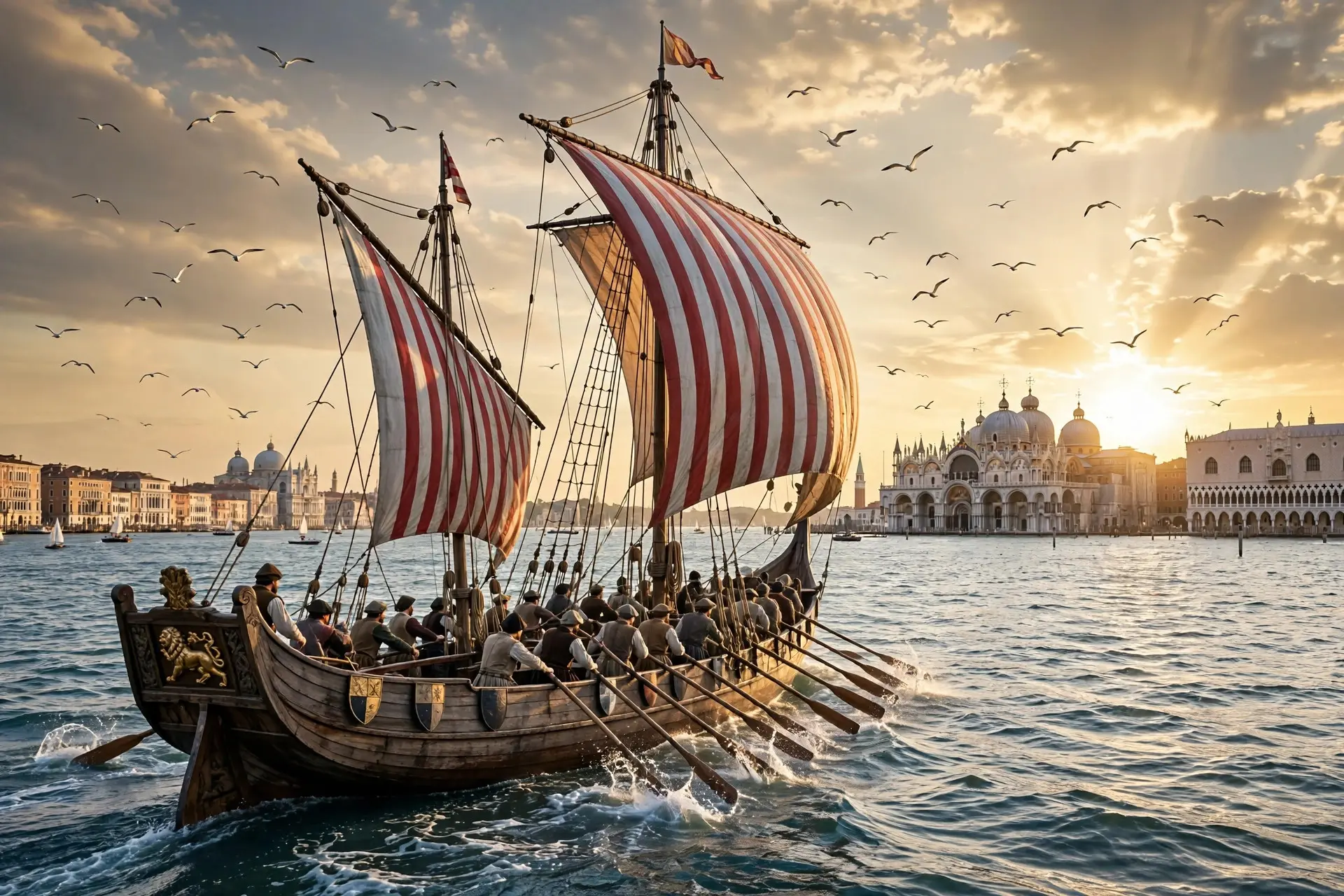
The system ran on organization as much as on ships. Venice operated the muda — armed, state-regulated trade convoys that sailed on fixed routes to the Levant, North Africa and Flanders. Galleys passed into public ownership, and private merchants were limited to chartering space aboard the state's vessels. This turned commerce into a scheduled, protected public utility. The goods were the stuff of medieval luxury and survival alike: spices, silk, grain, timber, metals, enslaved people and manufactured goods moving along routes that linked Europe, North Africa and Asia. And the money that paid for it all was trusted everywhere: the gold ducat, introduced in 1284, became one of the Mediterranean's most reliable currencies. Commerce needed defending, and Venice fought for its position repeatedly. Its fiercest rival was Genoa, and the struggle peaked in the War of Chioggia from 1378 to 1381, when Genoese forces occupied Chioggia at the southern edge of the Venetian lagoon itself. Venice mobilized every ship, coin and sailor it had, blockaded the attackers and forced their surrender — a victory that secured its command of the Adriatic and confirmed its supremacy among the Silk Road's lost cities and the trading world beyond.
Why did it fall?
A sea empire is only as strong as the sea routes it controls. Venice's long decline began when those routes shifted: the Ottoman Empire expanded across the eastern Mediterranean, squeezing Venetian holdings one by one — a process sealed when the Ottomans conquered Constantinople in 1453 — while Portuguese and Spanish ships opened new Atlantic routes to Asia and the Americas. The eastern trade that had made Venice rich no longer had to pass through Venice at all. The republic that had married itself to the sea — every Ascension Day, the doge sailed the Bucintoro, his gilded ceremonial barge, to the mouth of the lagoon to renew the city's wedding vows with the water — watched the world's commerce sail around it. The end came in 1797, when Napoleon dissolved the thousand-year-old republic. Venice's rise remains one of history's strangest success stories: a city with no soil to farm and no hinterland to tax became one of the richest states in Europe, not by conquering land but by mastering the sea between other people's lands. Its empire was an empire of contracts, convoys, currencies and shipyards — built on a gamble that an unpaid debt could be collected in the form of Constantinople. Few gambles in history have ever paid off so completely, or lasted so long.
Frequently asked questions
Why was Venice so powerful?
It controlled the trade between Europe and the East through a chain of island bases, armed convoys and a trusted gold currency, making it one of Europe's richest states by the late 14th century.
What was the Stato da Mar?
The 'State of the Sea' — Venice's network of overseas possessions, from Istria and Dalmatia to the Greek islands and Cyprus, which served as naval bases, revenue sources and convoy stops.
How did the Fourth Crusade benefit Venice?
When the crusaders could not pay the 85,000 silver marks owed for transport, Venice redirected the crusade against Zara and then Constantinople, seizing territories and trade privileges worth far more than the debt.