How Cold Must It Be to Freeze Boiling Water Instantly?
How cold does it have to be to freeze boiling water instantly? The real answer is about −42°F (−41°C), far colder than most viral videos suggest.
Key takeaways
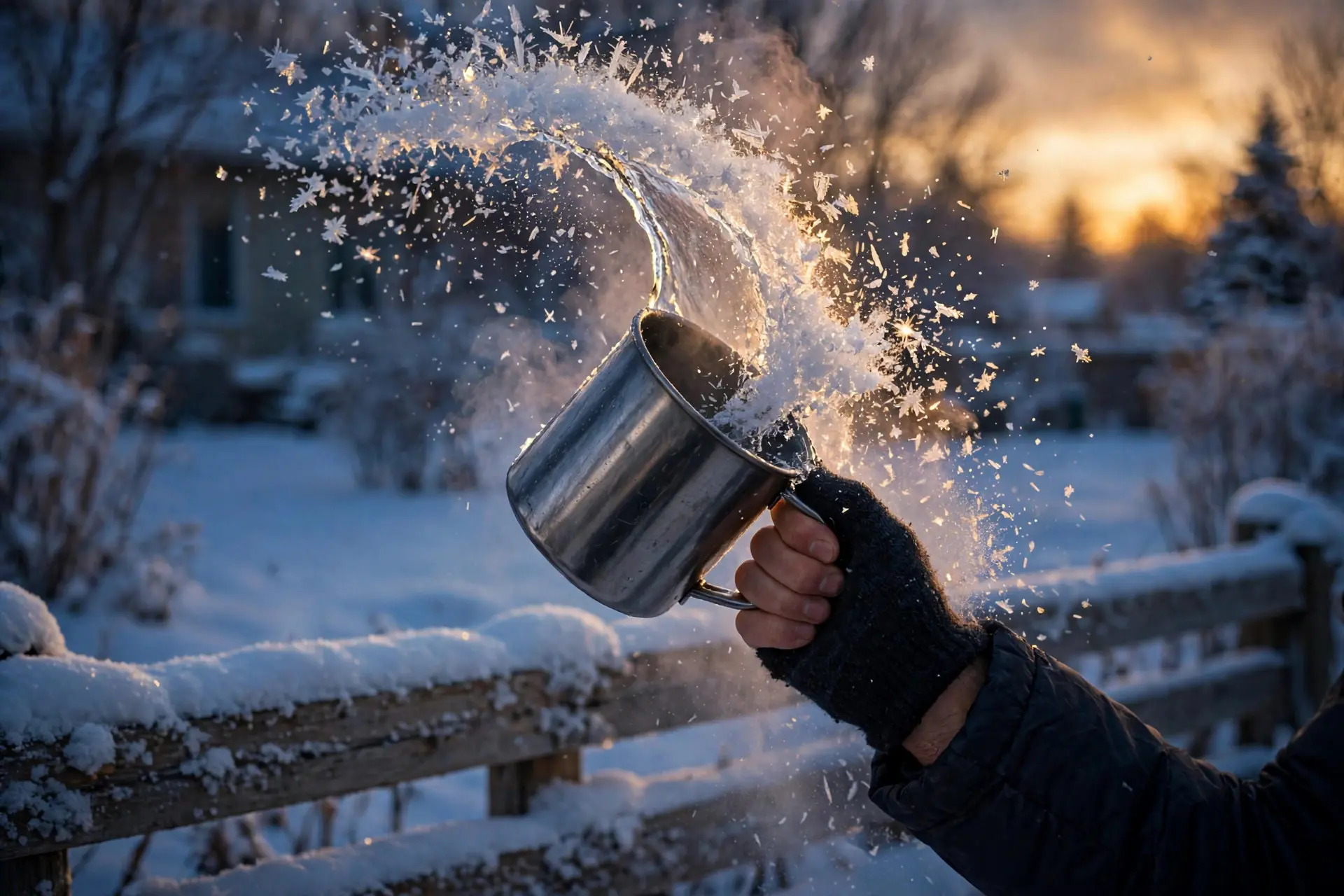
- Boiling water truly freezes in mid-air only near −42°F (−41.1°C), says physicist Jeff Terry; viral clips at −14°F mostly show condensing steam.
- The white cloud in those videos is condensate, not snow. Cold air simply cannot hold all the vapor that boiling water releases.
- The trick works because boiling water evaporates far faster than cold water, not because of the Mpemba effect.
- It takes at least −25°C (−13°F) for any visible effect, and wind chill does not count.
- Throwing boiling water is never risk-free: in the 2019 polar vortex, at least eight people were hospitalized with burns.
About −42°F (−41.1°C). That's the temperature a physicist says boiling water actually freezes in mid-air, far below the −14°F (−25.6°C) of the famous viral videos. What those clips show at milder cold is mostly steam condensing, not ice forming instead. Key facts:
- Real mid-air freezing of boiling water needs about −42°F (−41.1°C), says Jeff Terry, professor of physics at the Illinois Institute of Technology in Chicago (NYT, 2019).
- At −14°F (−25.6°C), the famous white cloud is condensate, not snow: it drifts away like breath on a winter day (NYT, 2019).
- Boiling water works because it evaporates "much, much more rapidly than cold water," says Washington University physicist Jonathan I. Katz (NYT, 2019).
- The trick needs air of at least −25°C (−13°F) to show anything at all, and wind chill does not count (The Weather Network).
- In Ontario, steam from a water gun fired into −41°C (−41.8°F) air condensed into ice crystals instantly (National Geographic, 2014).
- During the 2019 polar vortex, at least eight people who tried the experiment were hospitalized with severe burns (The Weather Network).
How cold does it have to be to freeze boiling water instantly?
About −42°F (−41.1°C), if you mean genuinely freezing the water solid while it is still in the air. That is the line Jeff Terry gives: at −14°F, he says, "It's not an instantaneous freezing of the water," and you don't see ice crystals falling to the ground. Colder, though, and the theory changes. "Theoretically, if it were colder, you could actually see that." There are really two different effects hiding behind one viral trick, and the air temperature decides which one you get:
| Air temperature | What actually happens |
|---|---|
| Warmer than −25°C (−13°F) | The trick fails. Most of the water falls back down as liquid, which is exactly how burns happen. (The Weather Network) |
| −25°C to about −30°F (−13°F to −34.4°C) | You get the famous white cloud, but it is mostly condensing vapor, not snow. At −22°F (−30°C), crystals can appear only if the air is extremely dry. (The Weather Network, Live Science) |
| About −42°F (−41.1°C) and below | True flash-freezing. Tiny droplets turn into ice crystals before they can fall. The Ontario water gun at −41°C (−41.8°F) showed how fast this transition can be. (NYT, 2019, National Geographic) |
| Notice that wind chill does not change any of this. The Weather Network stresses that only the actual air temperature counts, because wind chill describes how fast heat leaves human skin, not how cold the air itself is. |
Why does the water need to be boiling hot?
The whole trick runs on evaporation, not on some magic property of hot water. Jonathan I. Katz puts it plainly: "Boiling water or hot water evaporates much, much more rapidly than cold water," and the amount of vapor "increases very rapidly as the temperature goes up." When you fling the pot, the water shatters into countless tiny droplets with enormous combined surface area, and each one sheds vapor in a hurry. Evaporation carries heat away with it, so the droplets cool fast. Cold air then does the rest. Cold air can hold far less moisture than warm air, so the vapor has nowhere to go. Taneil Uttal, an arctic climatologist with the National Oceanic and Atmospheric Administration (NOAA), describes the sequence: the hot water breaks into hot droplets, the droplets vaporize, and since cold air can't hold that much water vapor, it condenses. When the air is extremely cold, those condensed droplets freeze and fall as ice crystals. Mark Seeley, a climatologist at the University of Minnesota, adds a subtle detail from a −22°F (−30°C) video: the vapor needs something to cling to. In that frigid air, the extra moisture precipitates out onto microscopic particles such as sodium or calcium and forms crystals, the same way snowflakes build up in a cloud. Seeley also says that in Minnesota, they don't even attempt the experiment until it is −30°F (−34.4°C), though at −22°F with very low humidity "you can get away with it." Dry air matters as much as cold air. This is also why cold water won't give you the show. Cold water evaporates too slowly to build up that overload of vapor, so it simply arcs through the air and lands with a splash, still liquid. Iowa PBS uses exactly this contrast in its classroom lesson: boiling water tossed into air at −14°F or lower produces the effect, while cold water does not.
Where did the viral trick come from?
The modern version took off during the January 2014 polar vortex, when a Wisconsin meteorologist, Eric Holthaus, filmed himself throwing a pot of boiling water into his front yard and posted it online. National Geographic covered the video on January 10, 2014, noting that it "seems to freeze instantly in the air and then falls to the ground as snow." The same article documented a man in Ontario who shot steam from a water gun at −41°C (−41.8°F) and watched it condense into ice crystals on the spot.
The tradition returned with every deep freeze after that. In late January 2019, when another polar vortex brought sub-zero air to the central United States, Midwesterners revived what the New York Times called "a cherished internet-era tradition," and Jeff Terry filmed his own version in −14°F air to show what the cloud really is. If you live in the Southern Hemisphere, the calendar is flipped: this is a Northern Hemisphere winter sport, so Australians would be watching July and August cold snaps instead of January ones.
What do people get wrong about the "instant snow" trick?
The biggest misunderstanding is that every white cloud in these videos is ice. It usually isn't. At −14°F (−25.6°C), the temperature of most viral clips, the big cloud is condensate, Terry's own word. The smaller streaks falling toward the ground are condensed water coming off falling droplets, "not water that has frozen mid-air." A second misunderstanding is that the Mpemba effect is responsible. It isn't. The strange story of hot water sometimes freezing faster than cold water is a different puzzle, and Katz says the principle in the boiling-water toss is simply "how fast the water evaporates." Hot water wins this contest by shedding vapor, not by breaking any freezing rule. A third mistake is trusting wind chill. A −10°F day that feels like −30°F will not produce the effect; only the actual thermometer reading matters, because the air itself must be cold enough to condense and freeze the vapor. Finally, people overestimate how quickly the freezing really happens. Even at −42°F, what freezes is the mist of tiny droplets, not a solid splash of water. Large blobs of water still fall; it is the finest spray that vanishes into crystals. That is why Terry advises to "try and disperse the water as much as you can" to maximize evaporation. If you love the physics of how freezing rain coats roads in ice, the same sensitivity to tiny temperature differences is at work there. The winter drama of snow squalls and the rare rumble of thundersnow come from the same cold-air chemistry, and the jet stream is what shoves those Arctic air masses south in the first place.
What should you know before trying it yourself?
Do this only outdoors, only in genuinely still, deep cold, and only with the wind, never against it. Terry's shortest piece of advice is also the most important: "You never want to throw it into the wind." Use a small thermal bottle with a narrow opening rather than an open pot, throw the water away from your body with your arm extended to the side, and make sure nobody is anywhere the vapor could reach, including downwind. The Weather Network is blunt about the risk: there is no truly safe way to do this experiment. When the polar vortex hit in 2019, at least eight people who tried it ended up in the hospital with severe burns, which prompted doctors to warn others off. Never let a child attempt it. The bottom line is simple: the "instant snow" trick is real, but what you are watching depends on the thermometer. Around −14°F you get a beautiful cloud of condensate; near −42°F you get the real thing, water flash-freezing into ice crystals while it is still in the air. Know which one you are seeing, and the video gets even better. How we made this article: FactSpire researched and drafted it with AI assistance and checked every fact against the sources listed above.
Frequently asked questions
Can boiling water freeze instantly at −20°F?
No. At −14°F (−25.6°C), physicist Jeff Terry showed that the famous white cloud is mostly condensation, not frozen water. True mid-air freezing needs about −42°F (−41.1°C). Between those temperatures you get a dramatic drifting vapor cloud, and only at the coldest, driest end of that range do real ice crystals form.
Why do you need boiling water for this trick?
Boiling water evaporates far faster than cold water, because hot molecules escape as vapor much more readily. When tossed, the water breaks into tiny droplets with huge surface area, so evaporation and cooling happen all at once. Cold water thrown the same way mostly falls back down as liquid.
Is the white cloud from the trick actually snow?
Usually not. At typical demonstration temperatures the cloud is condensed vapor, like your visible breath in winter. It only becomes true ice crystals when the air is cold enough, near −42°F, or in extremely dry air around −30°F (−34.4°C), as University of Minnesota climatologist Mark Seeley notes.
Is it safe to throw boiling water in the air?
It is never fully safe. The Weather Network warns that at least eight people were hospitalized with severe burns after trying it during the 2019 polar vortex. If you try it, use a small thermal bottle, throw with the wind away from your body and from other people, never do it indoors, and never let a child try it.
Sources
- The science behind tossing boiling water into minus-14-degree air, Gulf News (New York Times reprint via The Free Library)
- Science Behind 3 Viral Polar Vortex Videos: Instant Snow, Ice Fog, Frozen Bubbles, National Geographic
- Want to try this famous cold weather experiment? Keep these tips in mind, The Weather Network
- How Can Boiling Water Turn into Snow?, Live Science
- Throwing Boiling Water into Freezing Air, Iowa PBS