Why Is Antarctica Called the Coldest Desert on Earth?
Antarctica gets about 2 inches of precipitation a year, less than Phoenix, yet holds 70% of Earth's fresh water. Why this frozen desert is also the largest.
Key takeaways
- Antarctica is the world's largest desert at about 14 million sq km, and its coldest: the continent averages roughly 2 inches of precipitation a year.
- NASA defines deserts by precipitation, not heat: roughly 10 inches or less per year qualifies, and Antarctica gets far less.
- The McMurdo Dry Valleys have seen no significant precipitation for nearly two million years, making them the driest and coldest desert on Earth.
- The continent holds about 90% of the world's ice and 70% of its fresh water, yet new snowfall is so scarce that old snow is endlessly recycled by wind.
The coldest desert on Earth is Antarctica. Despite its miles-thick ice sheet, the continent averages only about 2 inches (5 cm) of precipitation a year, less than Phoenix, Arizona, which makes it a true desert by every scientific definition, and the coldest one by an enormous margin. Key facts
- NASA defines deserts by precipitation, not heat: roughly 10 inches or less per year qualifies as desert, and Antarctica gets far less. (Fox Weather)
- The U.S. Antarctic Program reports that the continent receives an average of roughly 2 inches of precipitation per year; Phoenix, Arizona, gets about 7.5 inches. (NOAA Climate.gov)
- At 5.4 million square miles, Antarctica is roughly 1.5 times the size of the Sahara Desert. (Fox Weather)
- The continent holds about 90% of the world's ice and 70% of its fresh water, yet new snowfall is so scarce that the wind endlessly recycles ancient snow crystals. (Fox Weather)
- NOAA classifies Earth's polar regions as polar deserts: under 10 inches of precipitation a year and annual mean temperatures of 10°C (50°F) or lower. (Poseidon Expeditions)
- The McMurdo Dry Valleys have seen no significant precipitation for nearly two million years, making them the driest and at the same time the coldest desert on Earth. (Polar Journal)
How can a frozen continent be a desert?
Because a desert is not a hot place. It is a dry place. The scientific definition cares about one thing: how much water falls from the sky in a year. Anything under roughly 10 inches qualifies, and Antarctica, continent-wide, averages about 2.
The reason is physics, not paradox. Cold air holds very little moisture, so the air masses that reach Antarctica's high interior arrive stripped nearly dry. What little snow does fall near the coasts, where storms can dump the equivalent of 10 feet of water, never reaches far inland. The interior gets so little precipitation that NOAA calls it a frigid desert outright. The result is a continent that is at once the wettest-looking place on Earth and one of the driest: a desert made of ice. That dryness is also why the ice is ancient. With almost no new snow arriving, the miles-thick sheet is the accumulation of millions of years, and the snow you see blowing across it is not a fresh storm but old crystals being endlessly recycled by the wind.
How cold, and how dry, is it really?
The numbers are hard to absorb. The polar deserts together cover roughly 28 million sq km of the Arctic and Antarctica, the world's largest desert type. Antarctica alone covers 14 million sq km (5.5 million sq miles). The continent's interior averages precipitation of only a few inches a year, while the record minimum temperature, −89.2°C (−128.6°F), was logged at Vostok Station in 1983. For perspective on the cold, the Arctic's Greenland ice sheet and the Sahara's daytime highs of around 30°C (86°F) sit at opposite ends of the same desert definition: both get under 10 inches of precipitation, while their temperatures are polar opposites.
The driest corner: the McMurdo Dry Valleys
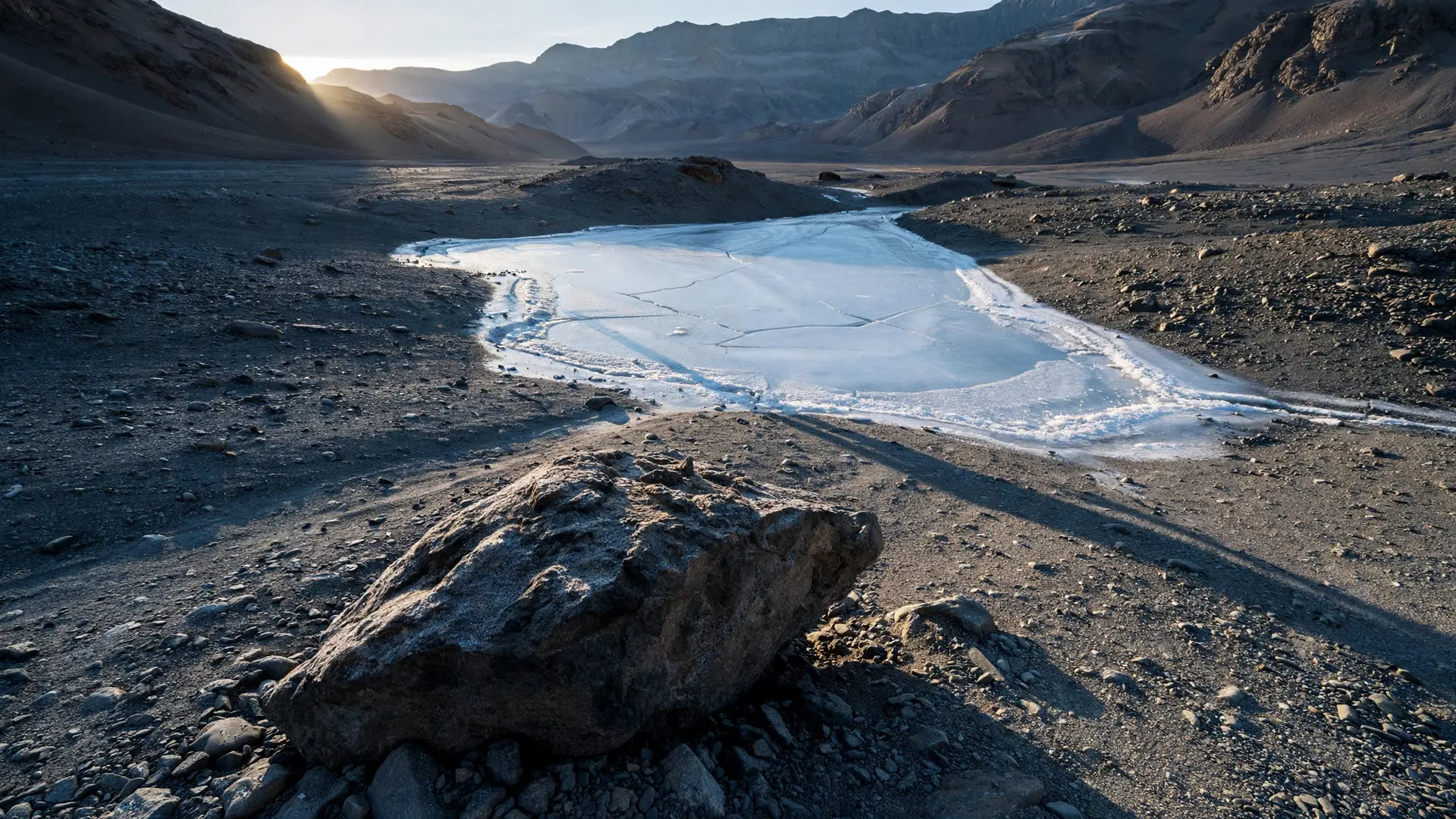
If Antarctica is a desert, the McMurdo Dry Valleys are its driest dunes. This chain of valleys west of McMurdo Sound covers about 4,800 sq km of almost completely ice-free ground: bare rock, dry soils and hypersaline lakes, in a place where neither rain nor snow has fallen in any significant amount for nearly two million years. Two forces built this landscape. The massive Transantarctic Mountains act as a wall, blocking moist air masses from the Antarctic Ocean. And katabatic winds, extremely cold, dense air currents descending from the Antarctic high plateau, sweep through at up to 320 km/h, stripping snow of any moisture and forcing it to sublimate directly into water vapor.
British explorer Robert Falcon Scott discovered the valleys in 1903. Today they are one of the busiest natural laboratories on the continent: NASA has tested instruments and robots there since the 1970s, because the Dry Valleys are the closest thing on Earth to the surface of Mars. As the agency puts it, "The desert conditions in Antarctica are like the conditions on Mars."
What most people get wrong about the coldest desert
The biggest misconception is the picture in the word itself. People hear "desert" and imagine sand, so Antarctica's classification feels like a trick. It is not: precipitation is the measure, and by that measure the driest hot desert, the Atacama, and Antarctica are the same kind of place wearing opposite climates. The second misconception is that Antarctica is all ice. It is not. The Dry Valleys prove that whole regions of the continent are bare earth, and they stay bare because the air is too dry to ever bury them. The third is a subtler one: that all that blowing snow means it is snowing. It usually is not. With almost no new precipitation, the snow streaming across the landscape is ancient crystals being endlessly recycled by the wind, not a fresh storm.
| Feature | Antarctic desert | Arctic desert |
|---|---|---|
| Area | 14 million sq km (5.5 million sq miles) | 13.9 million sq km (5.4 million sq miles) |
| Precipitation | Less than 10 inches a year; about 2 inches continent-wide | Less than 10 inches a year |
| Record cold | −89.2°C (−128.6°F), Vostok, 1983 | Extreme cold, but no station has matched Vostok |
| People | No country owns it; research stations only | Inuit communities live here; polar bears roam |
| Ice-free extreme | McMurdo Dry Valleys, 4,800 sq km of bare rock | Svalbard, Greenland and others partly ice-free |
The takeaway
Antarctica forces us to retire the postcard definition of a desert. Heat is optional; thirst is the requirement. By the only definition that matters, the coldest desert on Earth is also the largest, the driest, and the most otherworldly, a place where snow behaves like sand and the closest analogue is another planet. If you want the full story of the coldest single spot, the record night at Vostok is where to go next, and why Antarctica is a continent while Greenland is an island completes the picture. How we made this article: FactSpire researched and drafted it with AI assistance and checked every fact against the sources listed above.
Frequently asked questions
Is Antarctica really a desert if it is covered in ice?
Yes. A desert is defined by precipitation, not temperature, and Antarctica averages only about 2 inches a year, well under the roughly 10-inch threshold. The ice sheet built up over millions of years; almost no new snow falls, and the wind simply recycles ancient crystals across the surface.
What is the coldest temperature ever recorded in Antarctica?
The official record is −89.2°C (−128.6°F), measured at Russia's Vostok Station on 21 July 1983. Satellites have since detected colder snow surfaces nearby, but those are surface readings, not standardized air measurements, so Vostok's reading stands.
Are there really places in Antarctica with no ice at all?
Yes: the McMurdo Dry Valleys cover about 4,800 sq km of bare rock, dry soil and saline lakes. The Transantarctic Mountains block moist ocean air, and katabatic winds up to 320 km/h strip away snow, sublimating it directly into vapor.
Is the Arctic a desert too?
Yes, the Arctic desert covers about 13.9 million sq km and gets less than 10 inches of precipitation a year. Unlike Antarctica, it is inhabited: Inuit communities have adapted to it, and polar bears roam it. Antarctica has no permanent residents, only research stations.
Sources
- Antarctica is colder than the Arctic, but it's still losing ice, NOAA Climate.gov
- The world's biggest desert has zero sand and it is not where you think, Fox Weather
- Polar Deserts in Antarctica And Arctica, Poseidon Expeditions
- Extremely Dry, Extremely Cold: Antarctica's McMurdo Dry Valleys, Polar Journal