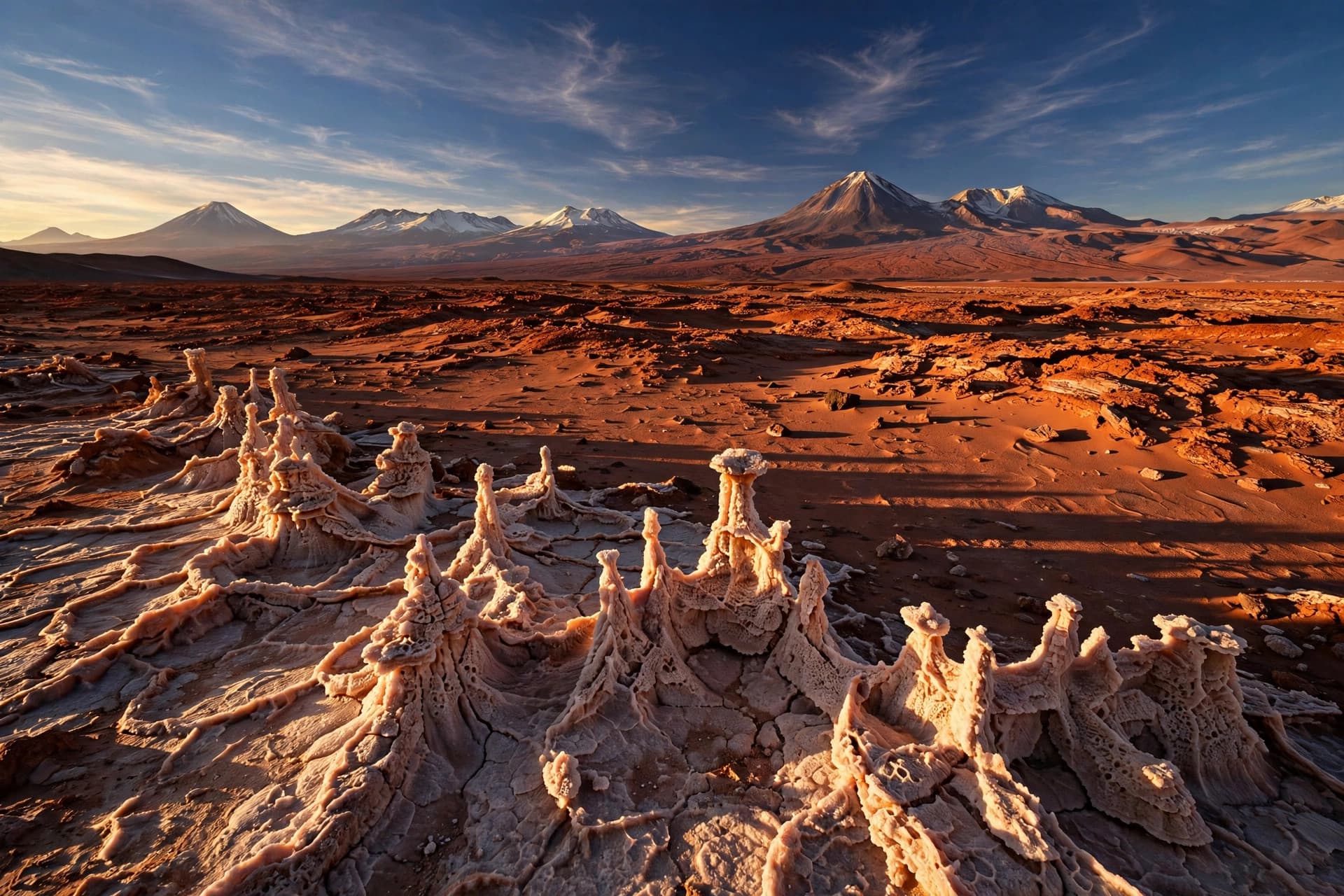
In one corner of northern Chile, instruments sat watching the sky for four full years and caught a single rain event: 2.3 millimeters, barely a heavy dew. Over the same period, liquid water was present in the soil beneath the surface for a grand total of 65 to 85 hours — less than four days out of nearly 1,500. This is the hyper-arid core of the Atacama Desert, the closest thing on Earth to the surface of Mars, and the reason NASA keeps coming here to rehearse for the red planet.
The Atacama is a 1,600-kilometer ribbon of desert along Chile's Pacific coast, covering roughly 105,000 square kilometers west of the Andes. It is the driest non-polar desert on the planet — the only polar-excluded claim that survives scrutiny, since a few frozen valleys in Antarctica are technically drier. Yet "non-polar" undersells it: the Atacama may be the oldest desert on Earth, with hyper-arid conditions stretching back at least to the Miocene epoch. And its secret is not heat. Mean air temperatures hover around a mild 16 degrees Celsius. The Atacama is not a scorched furnace like the Sahara; it is something stranger — a cool desert trapped in a geographic ambush.
A desert starved from both sides
Rain needs a delivery route, and the Atacama has been cut off from every one of them. To the east, the towering Andes block moist air from the Amazon basin. To the west, the Chilean Coast Range blocks moisture from the Pacific. The desert sits in a double rain shadow, dry coming and dry going.
Two more mechanisms slam the door shut. The cold, north-flowing Humboldt Current chills the air off the coast, suppressing evaporation and rainfall along the shoreline. Above it all, the South Pacific high-pressure system parks permanently overhead, pressing air downward and wringing out any cloud formation. The result is a desert 50 times drier than California's Death Valley, where average annual rainfall sits around 15 millimeters — and where, in the hyper-arid core, rain is measured in millimeters per decade.
The extremes have a geological memory. Some weather stations in the Atacama have never recorded rain at all. There is evidence the desert may have gone without significant rainfall from 1570 to 1971 — four centuries in which the sky simply refused to deliver. Rain does arrive eventually, typically in El Niño years, roughly once a decade. When it does, the desert responds with the famous desierto florido, a flowering-desert bloom that carpets the barren ground in color so suddenly it feels like a trick.
Mars, rehearsed on Earth
It was this extremity that drew NASA to a place called Yungay, about 80 kilometers southeast of Antofagasta. Between 1994 and 1998, researcher Christopher McKay and colleagues ran a four-year climate and moisture experiment there, publishing their results in the journal Astrobiology. Their findings were stark: the one rain event, probably a fog that condensed and fell, gave the soil its only taste of liquid water in four years. Dew formed often after humid nights but contributed almost nothing. Even the strong 1997–98 El Niño, which soaked Peru's deserts to the north, skipped the central Atacama. And where water vanishes, so does the bottom of the food chain: the study found an apparent absence of the under-stone cyanobacteria that serve as the only primary producers in other extreme deserts.
Later, a team from NASA's Ames Research Center returned with a different question: how dry is too dry for life? Traveling from the desert's slightly wetter southern reaches to its parched core, astrobiologist Mary Beth Wilhelm and colleagues pinned down what they called a dry limit of habitability — the point at which microbes stop being alive and well and start merely surviving in dormancy. The Atacama's non-uniform dryness made it the perfect transect: a gradient from "a few millimeters of rain per year" to "a few millimeters per decade," all within one desert.
The rehearsals got physical, too. Under NASA's ASTEP program, researchers from Carnegie Mellon, NASA Ames, the Jet Propulsion Laboratory, and others spent weeks driving a solar-powered rover named Zoe across the desert, drilling holes and analyzing soil with instruments designed as candidates for future Mars missions. High UV radiation, low atmospheric pressure, big day-night temperature swings, altitude — "On Earth you cannot find Mars," one researcher explained, "so you find someplace similar."
Water you can catch in a net
Here is the Atacama's paradox: it is the largest fog desert on Earth. Though rain is a rumor, a dense coastal fog called the camanchaca rolls in from the Pacific and drifts inland, draping the mountain slopes in white. It drops no rain — but engineers have learned to harvest it. Villages along the desert coast string up polypropylene nets called fog catchers; droplets condense on the mesh and drip into collecting troughs, producing genuine running water in places that would otherwise have none. People in the Atacama drink the sky without it ever raining.
Recent science has found subtler water, too. A 2022 study published on the cover of Astrobiology showed that water-vapor adsorption — water molecules clinging directly to soil grains from the air — can add as much water to the Atacama's hyper-arid soils as all the annual rainfall combined. It is a whisper of moisture, but in a place this dry, a whisper is an ecosystem.
Life, remarkably, answers. The desert hosts specialized microorganisms studied by teams like Germany's GFZ, and its barrenness has a payoff for science: the dry air, high altitude, and near-total absence of light pollution make the Atacama one of the world's premier astronomical sites, home to the Atacama Large Millimeter Array and the Very Large Telescope.
Not quite the Moon — better
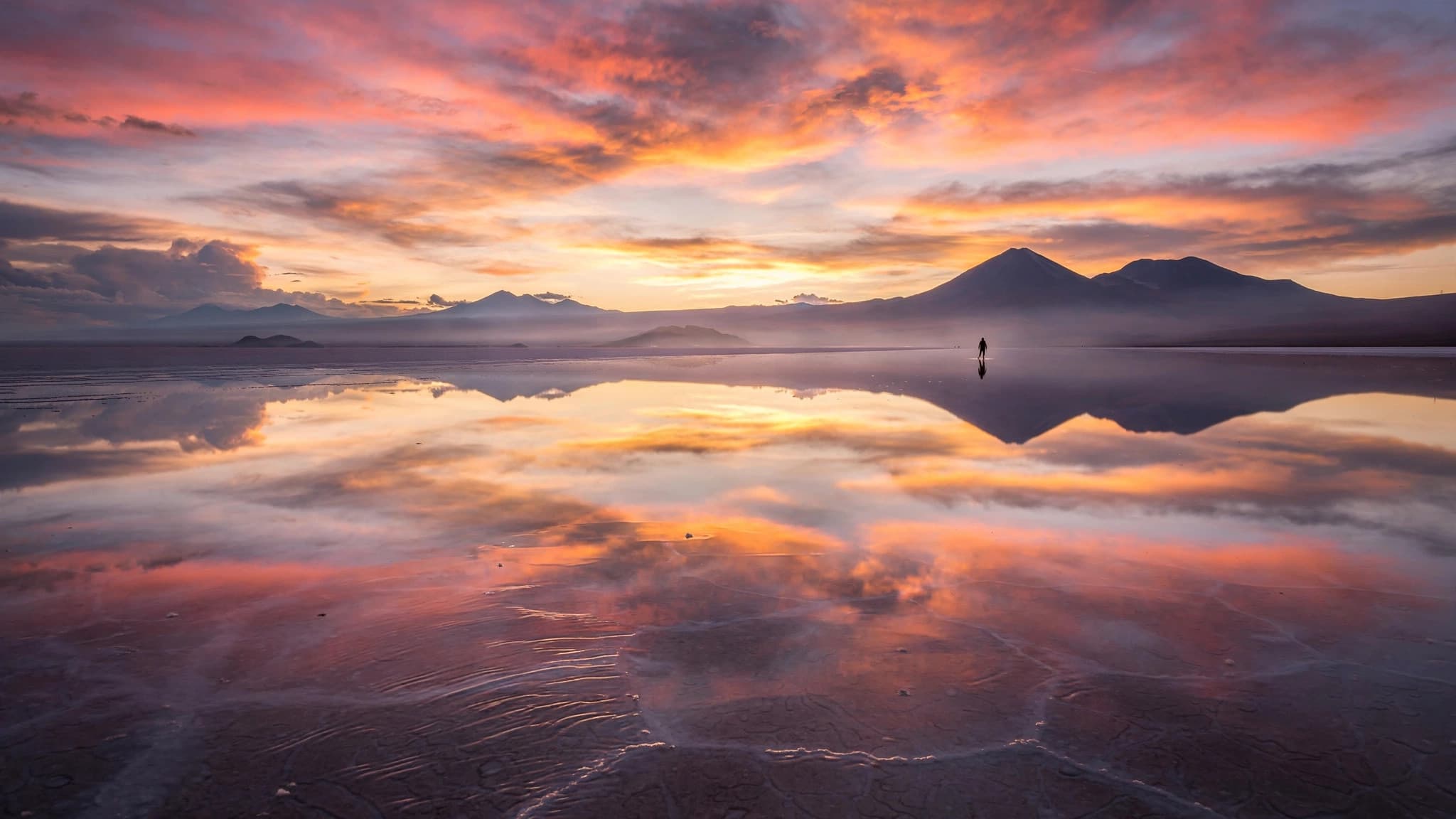
The Atacama resists easy myth-making, and that makes it more interesting. It is not lifeless — it is nearly lifeless, which is exactly why it matters. Its alien landscapes, from the wind-sculpted rock of the Valle de la Luna to salt flats like those at Salar de Uyuni, recall the tortured terrain of the Danakil Depression, another Earth place that barely qualifies as Earthly. It has surprises: a 36-foot giant hand sculpture rising from the desert floor south of Antofagasta, fossil skulls of penguins the size of people from 36 million years ago, and a 2011 snowstorm that buried the plateau under 30 inches — the most snow in nearly two decades.
So yes, it is the driest place on Earth outside the poles. But the Atacama's real distinction is subtler: it is where dryness stops being weather and becomes a world — a world where NASA learns to hunt for life on Mars, where villagers harvest drinking water from fog, and where a four-year wait for 2.3 millimeters of rain counts as a data point. The sky forgets this desert. The desert remembers everything anyway.