No river runs straight. Einstein knew why — and he explained it with a cup of tea. In 1926, Albert Einstein published a short paper, "The Cause of the Formation of Meanders in the Courses of Rivers and of the So-Called Baer's Law," arguing that river bends are not accidents of terrain but the inevitable product of a hidden corkscrew current swirling inside every flowing channel. A river doesn't meander because something is in its way. It meanders because water itself refuses to flow straight.
The teacup that explains a river
Einstein's paper opens not with a river but with a stirred teacup. Stir your tea, let it settle, and the leaves gather in the middle of the bottom instead of being flung outward to the rim. That is the tea-leaf paradox: centrifugal force should push the leaves outward, yet friction between the rotating fluid and the cup's bottom slows the lowest layer of tea. With the bottom layer slowed, the pressure pushing outward weakens near the bottom, and the resulting imbalance drives a secondary circulation — surface tea flows outward, bottom tea flows inward, and the leaves ride that bottom current into a neat pile at the center.
A river bend is the same machine, scaled up and laid sideways. Water rounds a bend, and the faster surface flow is thrown toward the outside of the turn while friction slows the water near the bed. The imbalance creates a helical, corkscrew-like secondary flow: near the surface the current pushes outward, and along the riverbed it sweeps inward. It is an invisible screw thread running down every curve, and it quietly decides where the river will bite and where it will build.
The machine that eats one bank and feeds the other
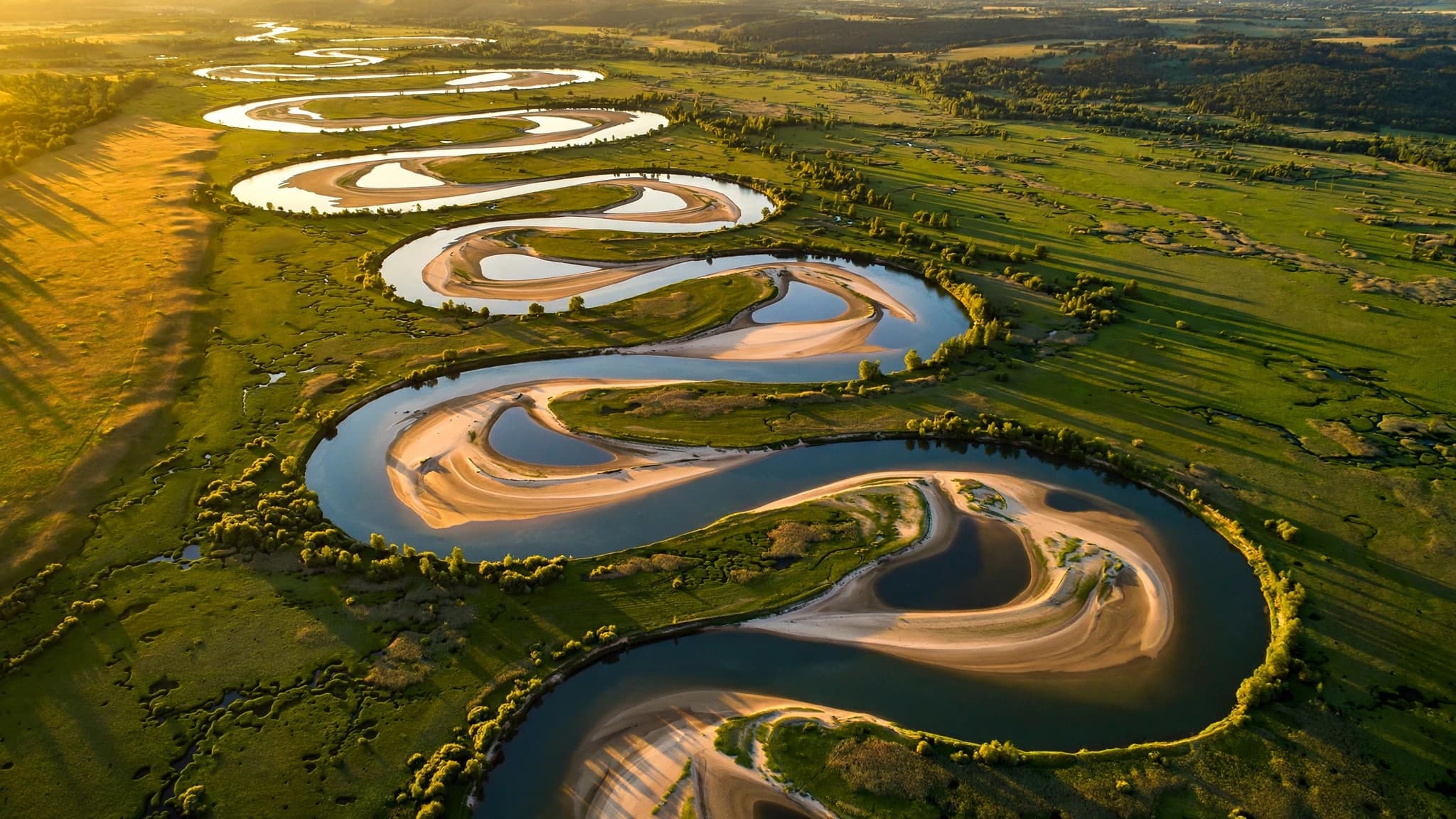
This corkscrew is what grows a bend. On the outside of a curve, the fast surface water slams into the bank and erodes it, carving a steep face engineers call the cut bank. On the inside, where the water slows, sediment drops out of suspension and piles up into a gently sloping point bar. The river erodes one side and builds the other, so the whole bend migrates sideways across the floodplain, swinging wider with every season.
Crucially, the process feeds itself. Any small wobble in a straight channel — a pebble bank, a slightly softer patch of mud — makes the flow swing, and the swing strengthens the corkscrew, and the corkscrew deepens the bend. Cut a perfectly straight channel through uniform sediment, run water down it, and it still refuses to stay straight. The instability is built into the physics, not imposed by the landscape.
And there is a hidden regularity to it. Measure the distance from one bend to the next one going the same way, then divide by the river's width, and you get roughly the same number almost everywhere: about ten to fourteen, on a stream you can step over and on the Mississippi alike. Six decades of measurements have rarely pushed the ratio outside that narrow band. Even meltwater channels etched into Greenland's ice sheet, with no sediment banks at all, obey the same rule — as do the fossilized river channels preserved at Aeolis Dorsa on Mars, formed under a third of Earth's gravity where nothing has ever grown. The wavelength of a meander is not a fact about dirt or plants. It is a fact about water.
Loops, cutoffs, and lakes that used to be river
A bend cannot grow forever. As the loop swings wider, the neck of land between its two ends narrows until a flood punches through, and the river takes the shortcut. The abandoned loop is left behind as a crescent-shaped oxbow lake — a retired piece of river, slowly filling with sediment and marsh. Along the great meandering rivers of the world, oxbows litter the floodplain like dropped parentheses, each one a signature of a bend that grew too far.
The process keeps rivers restless on human timescales. Mark Twain wrote in Life on the Mississippi that the river's steamboat pilots traveled up and down the river even when they weren't working, just to memorize the latest changes in the channel's course. The Amazon, the Mississippi, the Alabama — wherever steady water flows over flat, fine-grained land, the loops grow, pinch off, and start again. Geomorphologists even use a number for it: sinuosity, the channel length divided by the straight-line distance. A river with a sinuosity of 1.5 or more counts as a meandering stream.
Where the rule bends, and the name itself
Not every river meanders, and the exceptions sharpen the rule. Where the gradient is steep and the flow fast, rivers cut downward instead of swinging sideways. Where the banks are rock rather than loose sediment — the Grand Canyon's incised meanders were locked in stone as the river downcut — the loops fossilize instead of migrating. And humans have flattened plenty of rivers deliberately: levees and straightened channels stop the swing cold, which is why engineers now study meandering before "fixing" it, since killing the corkscrew lets sediment clog the bed instead of sweeping through.
The word itself is a souvenir. It comes from the Meander — the Büyük Menderes River of western Turkey — whose course wound so extravagantly that the ancient Greeks turned its name into a common noun. Strabo wrote that its course "is so exceedingly winding that everything winding is called meandering." Luna Leopold and W. B. Langbein later showed the deeper logic: a river seeks the path that spreads resistance to flow as evenly as possible along its length, so the curve is smooth, not jagged — the same even, sinuous S you find in the hem of a pleated curtain.
That is why no map shows a straight river and no engineer can force one to stay straight for long. Give water a channel, and the teacup's little secondary flow grows into a landscape-scale machine that eats one bank, feeds the other, and carves the land into loops — until the loops touch themselves and the river, like the tea leaves, finds the center again. Rivers meander because water, left to its own physics, can do nothing else.