What Is the Largest Desert on Earth? Not the Sahara
The largest desert on Earth is Antarctica, at 14.2 million square kilometers. A desert means under 250 mm of rain a year, and the South Pole gets far less.
Key takeaways
- The largest desert on Earth is the Antarctic Polar Desert, about 14.2 million square kilometers, more than 50% larger than the Sahara.
- A desert is defined by precipitation, under 250 mm a year, not by heat; Antarctica averages about 166 mm a year.
- The Sahara, at 9.2 million square kilometers, is the largest hot desert and is actually drier than Antarctica on average.
- The Arctic Polar Desert is the world's second-largest desert at about 13.7 million square kilometers.
- Parts of Antarctica's Dry Valleys have seen no significant precipitation in nearly 14 million years.
The largest desert on Earth is the Antarctic Polar Desert: about 14.2 million square kilometers of ice that receive less than 250 millimeters of precipitation a year. The Sahara is only the largest hot desert. A desert is defined by how little water falls from the sky, not by heat, and by that measure Antarctica beats the Sahara by more than 50%.
- The conventional threshold for a desert is fewer than 250 millimeters (about 10 inches) of precipitation per year; Antarctica meets it across essentially its entire surface. (Space Daily)
- Antarctica covers about 14.2 million sq km and averages about 166 mm of precipitation a year, with the high inland plateau getting 50 mm or less. (Space Daily)
- The Sahara covers about 9.2 million sq km and averages about 76 mm a year, with its hyperarid cores under 20 mm: the drier of the two on a per-square-kilometer basis. (Space Daily)
- At the South Pole, the average yearly rainfall over the past 30 years was a tiny 10 mm (0.4 inches). (Aurora Expeditions)
- The Antarctic interior averages around 50 mm (1.9 in) a year, mostly as snow or ice crystals, while the coastline can exceed 200 mm. (Aurora Expeditions)
- Some parts of the Dry Valleys are believed to have received no significant precipitation for nearly 14 million years. (Space Daily)
Why does temperature not enter the definition?
Because the ecological problem deserts pose is water scarcity. Plants and animals in arid regions are limited by the absence of moisture, whether it would have arrived as rain, snow, mist, or fog. A region where almost no water reaches the ground is hostile to most life, whether it sits at 50°C (122°F) in the Algerian Sahara or at minus 60°C (minus 76°F) on the East Antarctic plateau. The two environments are physically different but biologically analogous. The precipitation deficit in Antarctica is not even about moisture being absent from the air. Extremely cold air simply cannot hold much water vapor: the relative humidity of air at the South Pole is often as low as 0.03%, according to the British Antarctic Survey. Cold air has dramatically less moisture-carrying capacity than warm air, which is why even the relatively humid Antarctic coast deposits far less snow than a mid-latitude weather system would drop as rain.
How do the great deserts rank?
| Rank | Desert | Area | Type |
|---|---|---|---|
| 1 | Antarctic Polar Desert | 14 million sq km (5.4 million sq miles) | polar |
| 2 | Arctic Polar Desert | 13.7 million sq km (5.3 million sq miles) | polar |
| 3 | Sahara Desert | 9.2 million sq km (3.5 million sq miles) | subtropical, hot |
| 4 | Arabian Desert | 2.3 million sq km (800,000 sq miles) | subtropical, hot |
| 5 | Gobi Desert | 1.295 million sq km (500,000 sq miles) | interior, cold-winter |
| The two polar deserts together cover roughly twice the area of the Sahara. And Antarctica is not just the largest desert but also the coldest desert on Earth, while the Sahara remains the largest hot desert, a title it holds without dispute. For the driest hot desert on the planet, the crown goes to the Atacama, and the oldest desert title belongs to the Namib. |
The runner-up deserves a closer look. The Arctic Polar Desert, at about 13.7 million square kilometers of dry tundra and ice, is nearly as large as Antarctica's and works on the same principle: bitterly cold air that cannot hold much water vapor, so precipitation stays under the desert threshold. (Space Daily) But where the Arctic is a patchwork of ocean, islands, and ice, Antarctica is one continent-sized desert, which is why the southern one takes the title outright.
Where is Antarctica's driest spot?
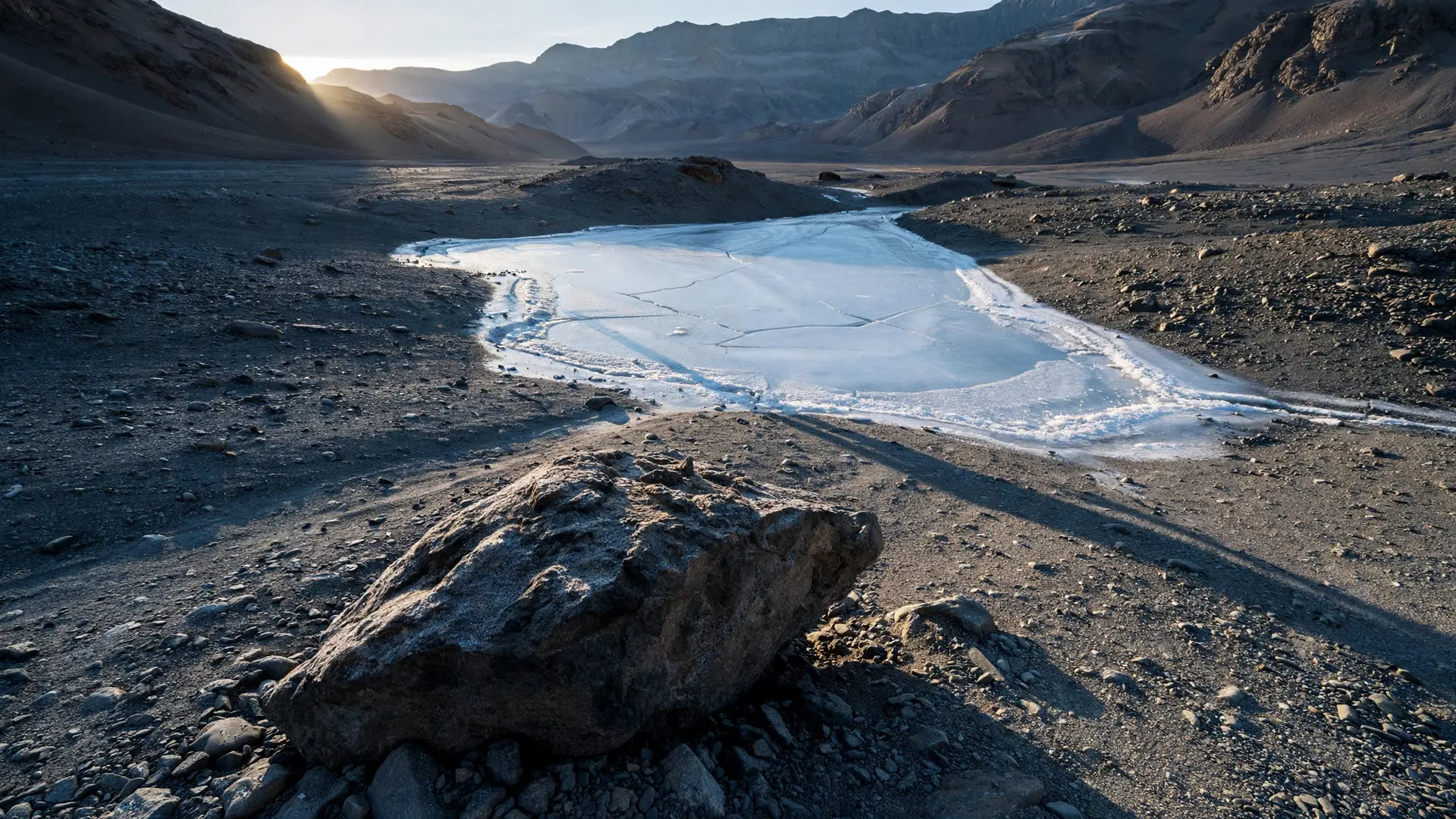
Within the continent, the McMurdo Dry Valleys on the coast of Victoria Land are the most extreme example of polar aridity. They are almost entirely free of ice, despite sitting on the most ice-covered continent on Earth. The Transantarctic Mountains block moisture-laden air from the Southern Ocean, and powerful katabatic winds, gravity-driven downslope winds flowing off the East Antarctic plateau, strip away whatever residual moisture remains and accelerate evaporation. The result is a hyper-arid environment that NASA uses as a terrestrial analogue for Mars, on the grounds that conditions on the floor of Wright Valley or Taylor Valley are closer to surface conditions on Mars than anywhere else on Earth. An even more extreme example, also in the Dry Valleys region, is the Friis Hills: research presented at the Geological Society of America found no water has flowed across them for approximately 14 million years. Ancient lake beds and tundra-moss fossils preserved on the hilltops record a vanished, warmer climate, with nothing having reset the landscape since.
What do people get wrong about the world's largest desert?
First, the mental image. Rolling dunes, palm trees, and beating sun capture one variety of desert well; they do not capture the largest one. The world's largest desert is a continent of ice the size of the United States and Mexico combined, sitting at the bottom of the globe. Second, the confusion between largest and driest. On an average-per-square-kilometer basis, the Sahara is the drier of the two. What makes Antarctica the larger desert is the sheer scale of the surface that qualifies: nearly the entire continent falls under the 250-millimeter line. Third, the idea that the ice contradicts the desert. The Antarctic ice sheet holds about 90% of the world's freshwater and took some 45 million years to grow to its current thickness. But desert is a measure of what falls from the sky, not how much water is already stored on the ground. The ice is a reservoir accumulated under conditions that strongly limit melting, not evidence of heavy snowfall today. How we made this article: FactSpire researched and drafted it with AI assistance and checked every fact against the sources listed above.
Frequently asked questions
Why is Antarctica a desert if it is covered in ice?
Because a desert is a place that gets very little precipitation, not a place that is hot. Antarctica averages about 166 millimeters of precipitation a year, well under the 250-millimeter desert threshold, and its high interior gets 50 millimeters or less. The kilometres of ice below are thousands of years of meagre snowfall that never melted, not evidence of heavy precipitation today.
Is the Sahara bigger than Antarctica?
No. The Sahara covers about 9.2 million square kilometers, while Antarctica covers about 14.2 million, making Antarctica more than 50% larger. The Sahara is the largest hot desert and is drier on an average basis, at about 76 millimeters of precipitation a year, but it is the third-largest desert overall, behind both polar deserts.
What is the driest place in Antarctica?
The McMurdo Dry Valleys on the coast of Victoria Land are almost entirely free of ice, kept that way by the Transantarctic Mountains blocking moist air and by katabatic winds stripping away residual moisture. NASA uses the valleys as a terrestrial analogue for Mars. In the nearby Friis Hills, no water has flowed for approximately 14 million years.
How much of the world's freshwater is in Antarctica?
About 90% of the world's freshwater is locked in Antarctica's permanent ice sheet, which covers roughly 98% of the continent and reaches up to 4.5 kilometers thick. If it all melted, global sea levels would rise about 60 meters. That frozen reservoir took about 45 million years to accumulate.
Sources
- The Sahara is usually depicted as the world's largest desert, but because a desert is defined by rainfall rather than temperature, the entire continent of Antarctica is technically the largest desert on Earth, Space Daily
- Is Antarctica a desert? YES. Find out why, Aurora Expeditions
- Antarctic factsheet & geographical statistics, British Antarctic Survey