What Is the Oldest Desert on Earth? It's the Namib
What is the oldest desert on Earth? The Namib of Namibia has been arid for 55 to 80 million years, at least eight times older than the Sahara.
Key takeaways
- The Namib Desert has been arid or semi-arid for roughly 55 to 80 million years, making it the oldest desert on Earth.
- The earliest hard proof is the Tsondab Sandstone: fossil dunes 55 million years old, per conservation scientist Brian John Huntley.
- The Namib Sand Sea's ancient dune foundation is at least 21 million years old, with a younger active layer about 5 million years old.
- Cold Atlantic fog, not rain, is the primary water source for the sand sea's plants and animals.
- The Namib Sand Sea joined the UNESCO World Heritage list in 2013 on all four natural criteria.
The Namib Desert of southwest Africa is the oldest desert on Earth, with dry or semi-dry conditions lasting roughly 55 to 80 million years, at least eight times older than the Sahara. The earliest hard evidence is fossil dune rock, the Tsondab Sandstone, dating back 55 million years. The key facts, each confirmed in a source you can open:
- The Namib has endured arid or semi-arid conditions for roughly 55 to 80 million years, and the European Space Agency calls the 55-million-year-old desert "the oldest desert on Earth."
- The earliest unequivocal evidence of desert conditions is the Tsondab Sandstone Formation, extensive fossil dunes 55 million years old, described by conservation scientist Brian John Huntley in 2023 (IFLScience).
- The Namib Sand Sea's ancient dune foundation has existed for at least 21 million years, with a younger active sand layer about 5 million years old (European Space Agency).
- The "Big Daddy" dune near Sossusvlei stands about 325 m (1,066 ft) tall, roughly the height of New York's Chrysler Building (Discover Wildlife).
- In the driest parts, annual rainfall of just 2 mm (0.08 in) is normal; fog rolling in from the Atlantic is the primary water source for the sand sea (IFLScience, European Space Agency).
- The Namib Sand Sea was inscribed as a UNESCO World Heritage Site in 2013 on all four natural criteria, covering 3,077,700 hectares with an 899,500-hectare buffer (UNESCO).
How old is the Namib Desert?
The Namib runs about 2,000 km (1,240 miles) along the Atlantic coast, through Namibia with reaches into Angola and South Africa. Its name comes from the Nama language, usually translated as "vast place," though some render it "the place where there is nothing." Both translations fit. The age claim rests on geology, not guesswork. Fifty-five million years ago, when the earliest fossil dunes of the Tsondab Sandstone were laid down, the Atlantic was young, South America was still close to Africa, and the ancestors of horses were the size of dogs. The Namib was already a desert. By one widely cited comparison, it is at least eight times as old as the Sahara: when the Namib's dunes were already ancient, northern Africa was still an "aquatic monster world," as IFLScience puts it.
That said, the experts hedge. ESA says the Namib is "considered" the oldest desert on Earth; most encyclopedias write "may be." The hedge exists because "desert" is a climate description, and climates shift: the claim is that the region has endured arid or semi-arid conditions for 55 to 80 million years, not that every dune is that old. The Atacama, the only serious rival, is hyper-arid since at least the Miocene, but the Namib's fossil-dune evidence reaches much further back.
What has kept the Namib dry for so long?
The desert owes its longevity to the Benguela Current, the cold ocean current that cools the air along the coast and locks in the arid conditions. Cold air holds little moisture, so instead of rain the coast gets fog: dense banks of it rolling in from the Atlantic, thick enough to have wrecked nearly 1,000 ships along the Skeleton Coast, the stretch the Khoisan peoples called "the land God created in anger" and the 15th-century Portuguese explorer Diogo Cão labeled "The Gates of Hell." That fog is the desert's real water supply. The Namib Sand Sea is, in UNESCO's words, the world's only coastal desert with extensive dune fields influenced by fog, and the fog feeds an entire community of plants and animals that have learned to drink the air. The dunes themselves are built from sand with an extraordinary travel history: material eroded from the interior of Africa, carried thousands of kilometers by rivers, ocean currents and wind before the desert ever got hold of it.
What lives in the oldest desert?
Fifty-five million years is a long time to adapt, and the Namib's wildlife shows it. The desert is home to thousands of animal and plant species, and for a surprisingly high percentage of them it is the only place they live. Desert elephants roam vast distances for water. Dune larks have figured out how to live without ever drinking. The Tok Tokkie beetle harvests water from morning fog by tilting its body so droplets run down into its mouth. Gemsbok, springbok, ostriches, brown hyenas, aardwolves and bat-eared foxes all make a living in the dunes. The most famous resident is a plant: Welwitschia mirabilis, a "living fossil" that can survive more than 1,000 years on fog moisture, growing just two long strap-shaped leaves its entire life. A director of the Royal Botanic Gardens at Kew once called it the most wonderful and the ugliest plant he knew. Then there are the fairy circles: bare discs of sand from 1.5 m (5 ft) to 25 m (82 ft) across, each ringed by a single species of grass, scattered across the gravel plains. The Himba people say they are the footprints of the god Mukuru. Scientists have proposed poisoned soil, self-organizing grasses, and termite colonies; a 2020 field study rejected the poisoning theory, and the debate continues. It is a fitting mystery for a desert this old.
What is Deadvlei?
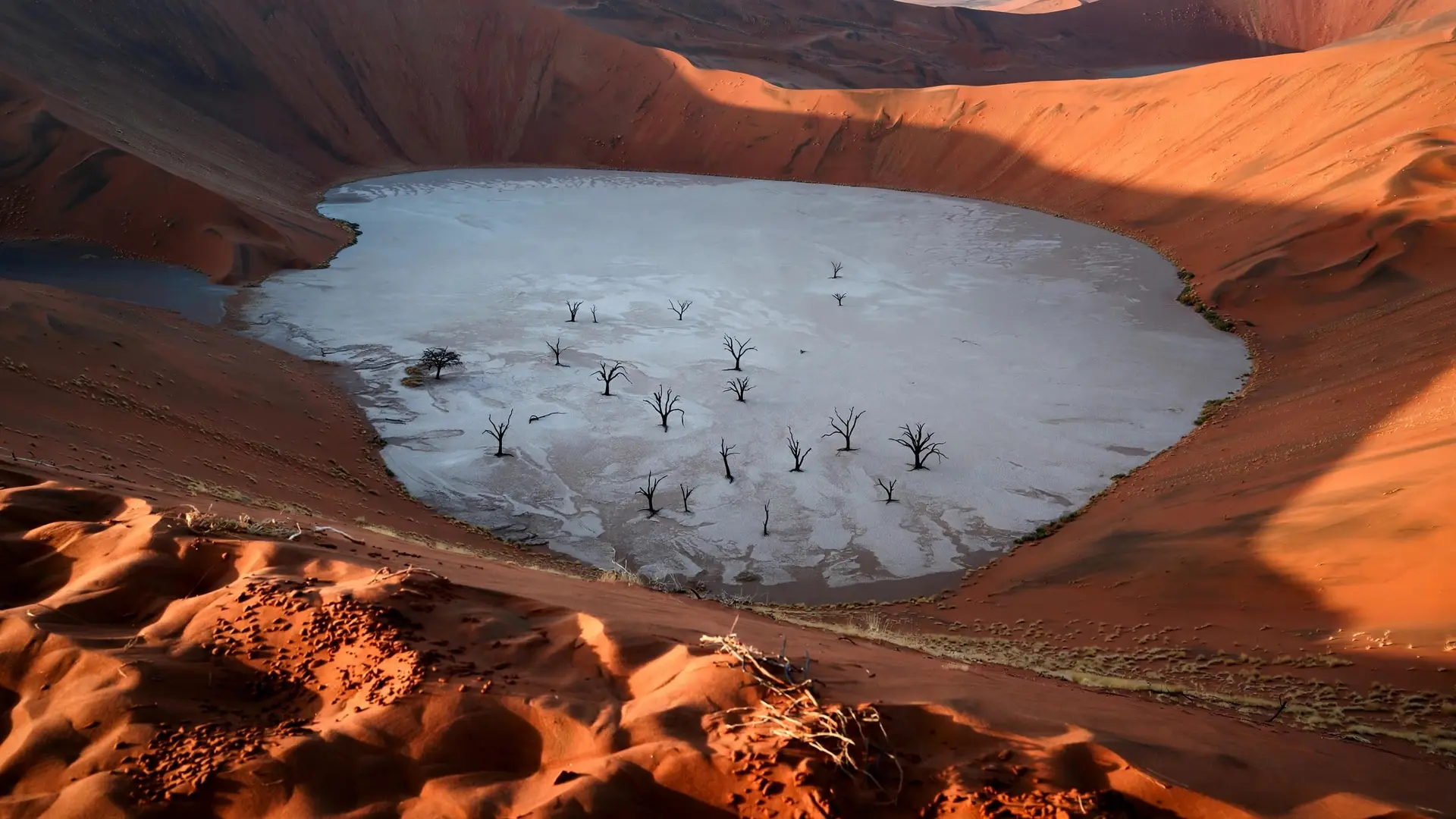
In the southern Namib, inside the Namib-Naukluft National Park, lies a white clay pan called Deadvlei, ringed by some of the tallest dunes on Earth. About 900 years ago, the nearby Tsauchab River flooded and filled the pan; camel thorn trees grew in the temporary abundance of water. Then the climate shifted, drought arrived, and marching dunes cut the pan off from the river for good. With no water, the trees died 600 to 700 years ago. They still stand, scorched black by the sun, because the air is too dry for them to decompose. The dunes around them owe their rust-red color to age: the sand has been oxidizing, essentially rusting, for thousands of years. The tallest, nicknamed Big Daddy, rises about 325 m (1,066 ft). Standing among the dead trees with red dunes towering on every side is one of the most photographed scenes in Africa.
What do people get wrong about the oldest desert?
The biggest misconception is that "oldest desert" means "oldest dunes." It does not. The Namib Sand Sea is two deserts stacked on top of each other: an ancient, semi-consolidated sand sea at least 21 million years old, buried under a younger active layer about 5 million years old. The climate is 55 million years old; the dunes you climb are newcomers. Here is the deep timeline:
| When | What happened | Source |
|---|---|---|
| ~55 million years ago | Fossil dunes of the Tsondab Sandstone record desert conditions | IFLScience |
| 21+ million years ago | The ancient sand sea foundation forms | ESA |
| ~5 million years ago | The younger active dune layer builds on top | ESA |
| ~900 years ago | Shifting dunes cut Deadvlei off from the Tsauchab River | Discover Wildlife |
| 600-700 years ago | Deadvlei's camel thorn trees die and are preserved by the dry air | Discover Wildlife |
| 2013 | The Namib Sand Sea is inscribed as a UNESCO World Heritage Site | UNESCO |
| The second misconception is that the Namib is empty. "The place where there is nothing" is a name, not a census. UNESCO inscribed the sand sea on all four of its natural criteria, a rare honor, precisely because the fog-fed ecosystem is so rich: endemic invertebrates, reptiles and mammals with adaptations found nowhere else, from beetles that drink fog to plants that live a thousand years. Compare that with Lut Desert, where the claim to fame is heat, or Antarctica, the coldest desert on the planet: the Namib's distinction is time itself. | ||
| Fifty-five million years of dryness is hard to picture. It helps to stand it against human history: the Namib was already old when the first primates appeared, already ancient when the Sahara was green, and it will likely still be a desert long after our cities are dust. The fog keeps coming off the Atlantic, the beetles keep tilting into it, and the dead trees of Deadvlei keep standing guard over a whiteness ringed in red. | ||
| How we made this article: FactSpire researched and drafted it with AI assistance and checked every fact against the sources listed above. |
Frequently asked questions
How old is the Namib Desert?
The Namib has endured arid or semi-arid conditions for roughly 55 to 80 million years. The earliest unequivocal evidence is the Tsondab Sandstone Formation, fossil dunes 55 million years old. That makes the Namib at least eight times older than the Sahara, by one widely cited comparison.
Why has the Namib stayed a desert for so long?
The cold Benguela Current cools the air along the coast, creating the arid conditions that have defined the region for tens of millions of years. Moisture arrives mostly as dense Atlantic fog rather than rain, and the great dune systems recycle ancient sand carried thousands of kilometers by river, ocean current and wind.
What is Deadvlei?
A white clay pan in the Namib-Naukluft National Park, ringed by rust-red dunes. About 900 years ago, shifting dunes cut it off from the Tsauchab River; its camel thorn trees died 600 to 700 years ago and still stand, preserved by air too dry for them to rot.
What animals live in the Namib Desert?
Desert elephants, gemsbok, springbok, ostriches, brown hyenas, aardwolves and the fog-harvesting Tok Tokkie beetle, which tilts its body so droplets run into its mouth. The iconic Welwitschia mirabilis plant can live over 1,000 years, drinking fog through its long strap-shaped leaves.
Sources
- Namib Desert, European Space Agency
- The Oldest Desert On Earth Is Home To "Fairies", Miracle Plants, And... Toto?, IFLScience
- UNESCO World Heritage Centre - Decision - 37 COM 8B.8, UNESCO
- It's hidden between dunes as high as the Chrysler Building – and sits in the oldest desert in the world, Discover Wildlife (BBC Wildlife)
- Exploring the Namib Desert: Secrets of the World's Oldest Desert, Namibia Today