What Is the Hottest Inhabited Place on Earth?
Dallol's record is not one scorching afternoon but relentless year-round heat, and the salt trade that still draws workers into Ethiopia's Danakil furnace.
Key takeaways
- Dallol's yearly average was 34.6°C from 1960 to 1966, the highest yearly average recorded at an inhabited place.
- Its single-day peak of 48.9°C is far below Death Valley's 56.7°C, so Dallol wins on endurance, not one spike.
- Below-sea-level air, scarce rain and a thin, rifting crust keep heat trapped in the Danakil Depression.
- Afar salt miners still cut salt tiles by hand and move them by camel and donkey toward Berahile.
- Dallol's old mining site looks abandoned today, even though work and settlement continue across the wider depression.
Dallol, in Ethiopia's Danakil Depression, is the hottest inhabited place on Earth — not because it ever recorded the planet's highest temperature, but because its yearly average, 34.6°C between 1960 and 1966, has not been beaten by any other inhabited location. That distinction is the whole story: Dallol wins by endurance, by heat that rarely pauses, rather than by one afternoon spike.
Why does Dallol win on average, not on a single day?
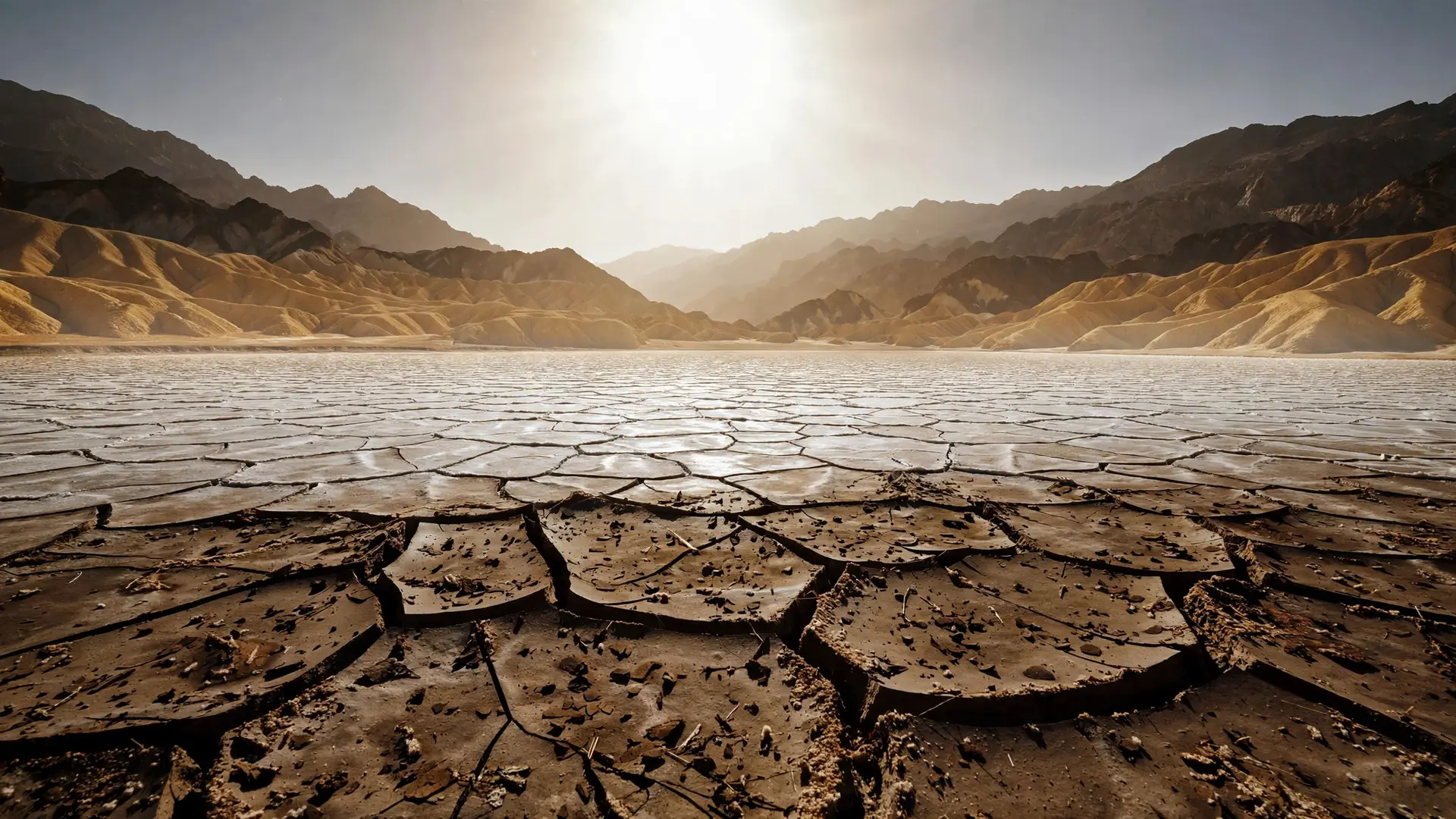
Most heat records are snapshots. A thermometer somewhere catches a freak afternoon, the number enters the books, and the place becomes famous for a moment it may never repeat. Dallol's claim works the other way round. Its yearly average folds in every night, every cloudy spell and every supposedly cooler month, and still comes out at 34.6°C (94.3°F). Even its hottest month averaged a daily high of 46.7°C over the same period, according to the desert-by-desert comparison that tabulates the station figures. The contrast with Death Valley makes the point sharply. Furnace Creek in Death Valley recorded 56.7°C on 10 July 1913, still accepted as the highest air temperature measured at a weather station. Dallol's own peak in the same tabulation is 48.9°C, set in 1966 — almost eight degrees lower. If the question is "where was it hottest for a day?", Dallol loses. If the question is "where did people live through the most heat, day after day, year after year?", Dallol is still the answer. That is also why a different kind of record does not displace it: satellite readings of ground surface, such as the 70.7°C measured in Iran's Lut Desert, describe how hot the soil gets, not the air people breathe at a weather station. Dallol's record is an air-temperature average at a place where people lived and worked, and that is a harder, more human test.
How did a mining outpost end up in such a place?
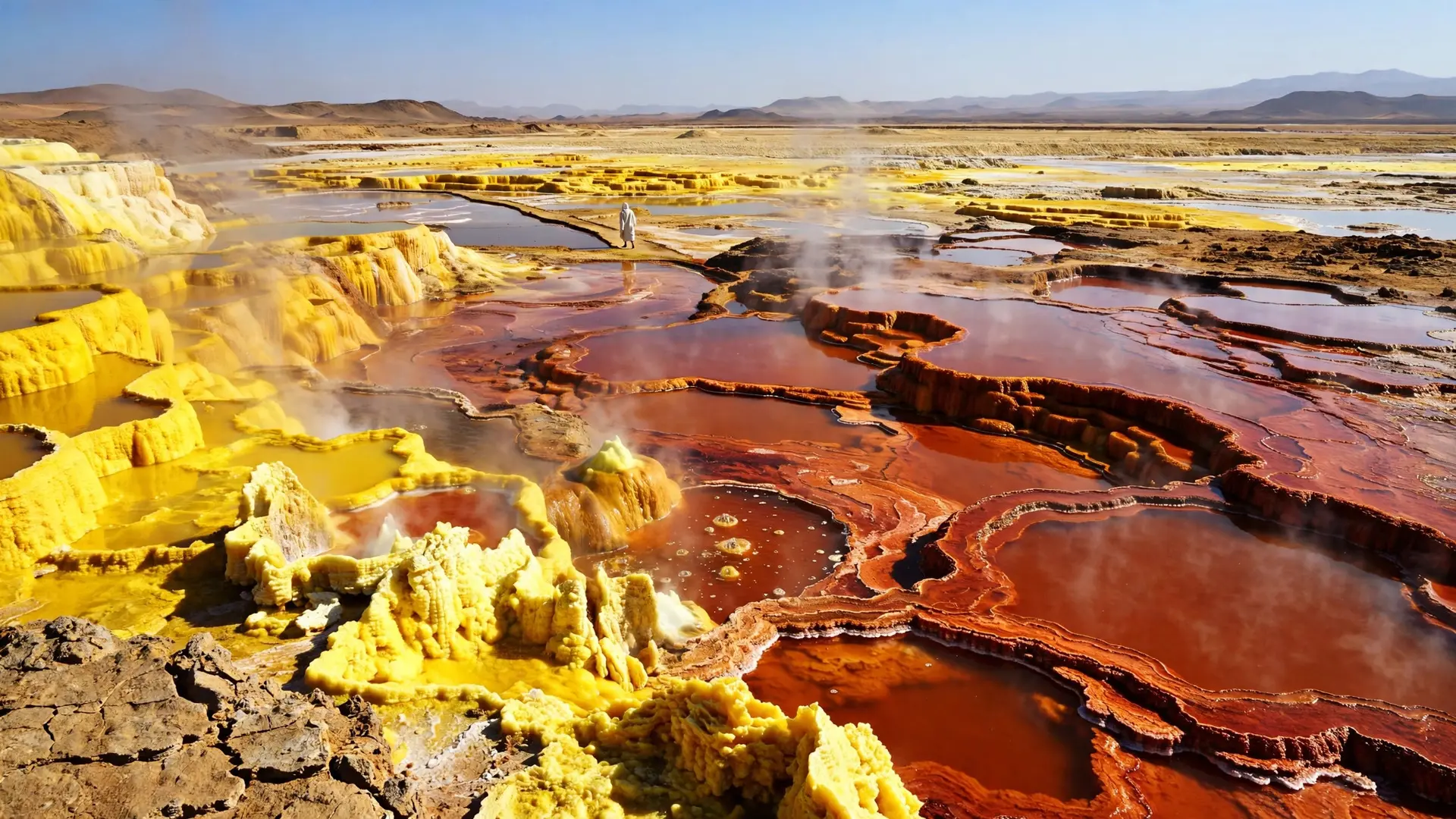
Nobody would choose this ground for a town. The draw was what lay under it: salt, and later potash, the potassium-rich mineral used in fertiliser. In 1912, Italian brothers Adriano and Tullio Pastori secured a 35-year mining lease from the Ethiopian ruler, and five years later the permission passed to the Compagnia Mineraria Coloniale. The venture ran into the same problem every later scheme would meet — getting anything out of one of the most remote corners of Africa cost more than the minerals were worth once larger suppliers elsewhere came online. Production stopped after the First World War, attempts to reopen it between 1920 and 1941 failed, and after the Second World War the mining infrastructure was deliberately damaged. What remains is a skeleton: salt-block walls, a few rusted trucks and boilers, and the sense of an industrial gamble abandoned to the heat. That history matters because it explains what Dallol is. It was not a village that grew up naturally and then happened to get hot; it was an outpost planted on top of a mineral deposit, in a landscape that never stopped pushing back. The wider Danakil Depression around it, with its acid springs and salt flats, was the reason the outpost existed at all — and the reason it could not last in its original form.
What keeps the heat from ever letting up?
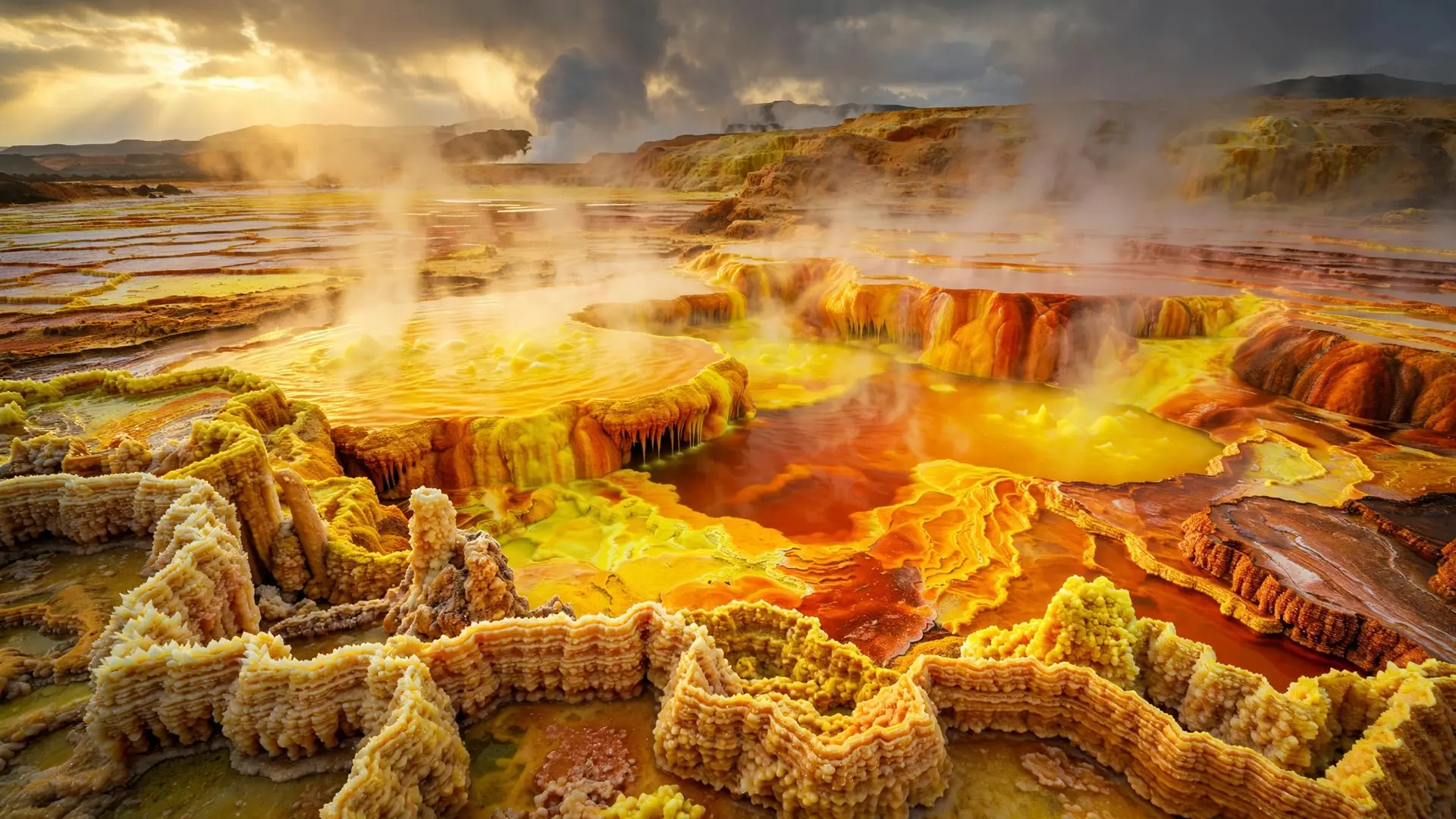
Dallol sits about 130 metres below sea level in a basin formed where three tectonic plates are pulling apart, thinning the crust. The European Space Agency describes this setting, the Afar Triple Junction, as the force behind the depression's salt flats, volcanoes and hot, acidic springs. Sinking air in such a deep basin is compressed and warmed further, and there is almost nothing to interrupt the process: the surrounding Danakil Desert receives less than 25 millimetres of rain a year, and the space agency notes that what little rain does fall evaporates quickly. Low elevation also means the heat has nowhere to drain away to. In a mountain town, hot air rises and cooler air moves in; in a bowl below sea level, the warm air lingers, and the ground itself radiates heat back. Add a thin crust with magma close beneath, and the landscape contributes its own warmth through steaming springs and mineral vents. The result is not a heatwave but a climate: winter days that stay above 93°F and summer days reaching 122°F, as Atlas Obscura reports, with toxic chlorine and sulphur vapours hanging over ground where groundwater bubbles up near boiling. People do not visit Dallol to escape winter. There is no season that offers an escape.
What does working in Dallol actually involve?
The work that endures here is older than the potash schemes and far more stubborn: salt. Afar miners cut the salt flats by hand, shaping the mineral into rectangular tiles with simple tools, then loading them onto camels and donkeys for the journey out. The Weather Channel's photo report on the trade puts the workforce at around 750 miners, with about 2,000 camels and 1,000 donkeys passing through daily, carrying salt toward Berahile, roughly 46 miles away, for sale across Ethiopia. Many of the tiles end up with farmers, who buy them to supply their animals with essential minerals.
The working day is organised around the heat rather than the clock. Miners start before sunrise, when temperatures are still punishing — the same report says they rarely drop below 120°F even then — and each load involves a four-day round trek to and from the salt flat. Photographer Joel Santos, who documented the miners, put their pay at roughly 100 to 200 euros a month and called it probably one of the toughest lives in the world. One camel herder and salt merchant, Kidane Berhe, 45, told Reuters, in the Weather Channel's account: "You forget about the sun and the heat." He added that he had lost a friend on the salt desert, a man who had worked too much with no protection from the sun and eventually collapsed. That is the human meaning of a yearly average of 34.6°C: it is not a statistic on a chart, but a working environment in which shade, water and rest are not comforts but survival equipment. Modern interest in the region's potash has not removed that problem. A groundwater study of the Danakil Depression notes that solution mining for potash would need large volumes of water in one of the driest hyper-arid regions on Earth, and that much of the groundwater found there is highly saline — up to three to five times the salinity of seawater — and can reach 50°C. In other words, even the water is hot and salty. Any future industrial return would have to solve the same puzzle the Pastori brothers and their successors could not: how to run a thirsty operation in a place that has almost no fresh water to spare.
Is Dallol still inhabited today?
The honest answer is split, and it is the most common misunderstanding about the record. The old mining site at Dallol looks abandoned, its salt-block ruins standing in a landscape that no longer supports the industrial settlement that built them. That does not mean the wider depression is empty. Afar miners still work the salt flats, caravans still cross the desert, and the groundwater study refers to settlements within the Danakil basin that would need a freshwater supply. Dallol's title, then, is best read as a historical record for an inhabited location: it describes the place as it was measured in the 1960s, and a working landscape that has changed shape since, rather than a bustling town that exists in the same form today. That nuance does not diminish the record. If anything, it sharpens it. Tristan da Cunha, the most remote inhabited island on Earth, is famous for isolation; Dallol is famous for a different kind of remoteness, a place so hostile that even the settlement built to exploit it did not survive, while the older, slower salt trade around it did. The people who lasted were not the ones with trucks, boilers and a railway-era business plan. They were the ones who learned to start before dawn, cut salt by hand, and walk out with camels before the day turned lethal. Dallol's heat, in the end, is not a curiosity about a thermometer. It is a measure of what a place demands from anyone who tries to live or work there — not for an afternoon, but for a year, and then another, with no cool season coming to rescue them.
Frequently asked questions
Is Dallol hotter than Death Valley?
Not on a single day. Death Valley's 56.7°C reading from 1913 beats Dallol's 48.9°C peak, but no inhabited place has beaten Dallol's 34.6°C yearly average from 1960 to 1966.
Do people still live in Dallol itself?
The old mining site looks abandoned, with salt-block ruins and rusted equipment left behind. People still work the wider Danakil salt country, but Dallol is best understood as a historic inhabited location rather than a thriving town today.
Why does Dallol stay hot all year?
It sits in a deep, dry basin below sea level in a rift zone, where sinking air warms as it compresses and almost no rain arrives to break the heat.
Sources
- Hottest Deserts in the World: 10 Record-Breaking Deserts, Geography Worlds
- Earth from Space: The Danakil Depression, European Space Agency
- Stunning Images of the Ethiopian Salt Miners Who Work in 140F Heat at the 'Gateway to Hell' (PHOTOS), The Weather Channel
- Ethiopia's Strange Volcanic Landscapes Are Irresistible to Scientists (and Tourists), Atlas Obscura
- Groundwater resources of the Danakil Depression – hydrogeology in the hottest place on Earth, GWD
- Dallol, Only Natural Energy