How Long Is Australia's Dingo Fence, and Why Was It Built?
How long is the Dingo Fence? The barrier runs 5,614 km (3,488 miles), built from 1946 to protect sheep country — and it reshaped a third of the continent.
Key takeaways
- The Dingo Barrier Fence runs 5,614 km (3,488 miles), from Jimbour in Queensland to the cliffs of the Nullarbor Plain in South Australia.
- Construction began under South Australia's Dog Fence Act 1946; Queensland's section was not finished until the late 1950s.
- It was built to protect the sheep industry from dingoes and wild dogs, and still shields 26.5 million hectares of grazing country.
- Researchers counted 1 dingo and 3,245 kangaroos inside the fence, against 85 dingoes and 8 kangaroos outside it.
- Where dingoes vanished, kangaroo overgrazing stripped vegetation and depleted soil nutrients, a cascade documented by a UNSW study.
At 5,614 km (3,488 miles), Australia's Dingo Barrier Fence is the longest environmental barrier on Earth, stretching from Jimbour in Queensland to the cliffs of the Nullarbor Plain in South Australia. It was built from 1946 to keep dingoes and wild dogs away from sheep country. A determined dingo, though, can get past the wire itself.
- 5,614 km (3,488 miles): the full barrier's length, from Jimbour on Queensland's Darling Downs to the cliffs above the Great Australian Bight in South Australia. (Biologia Futura)
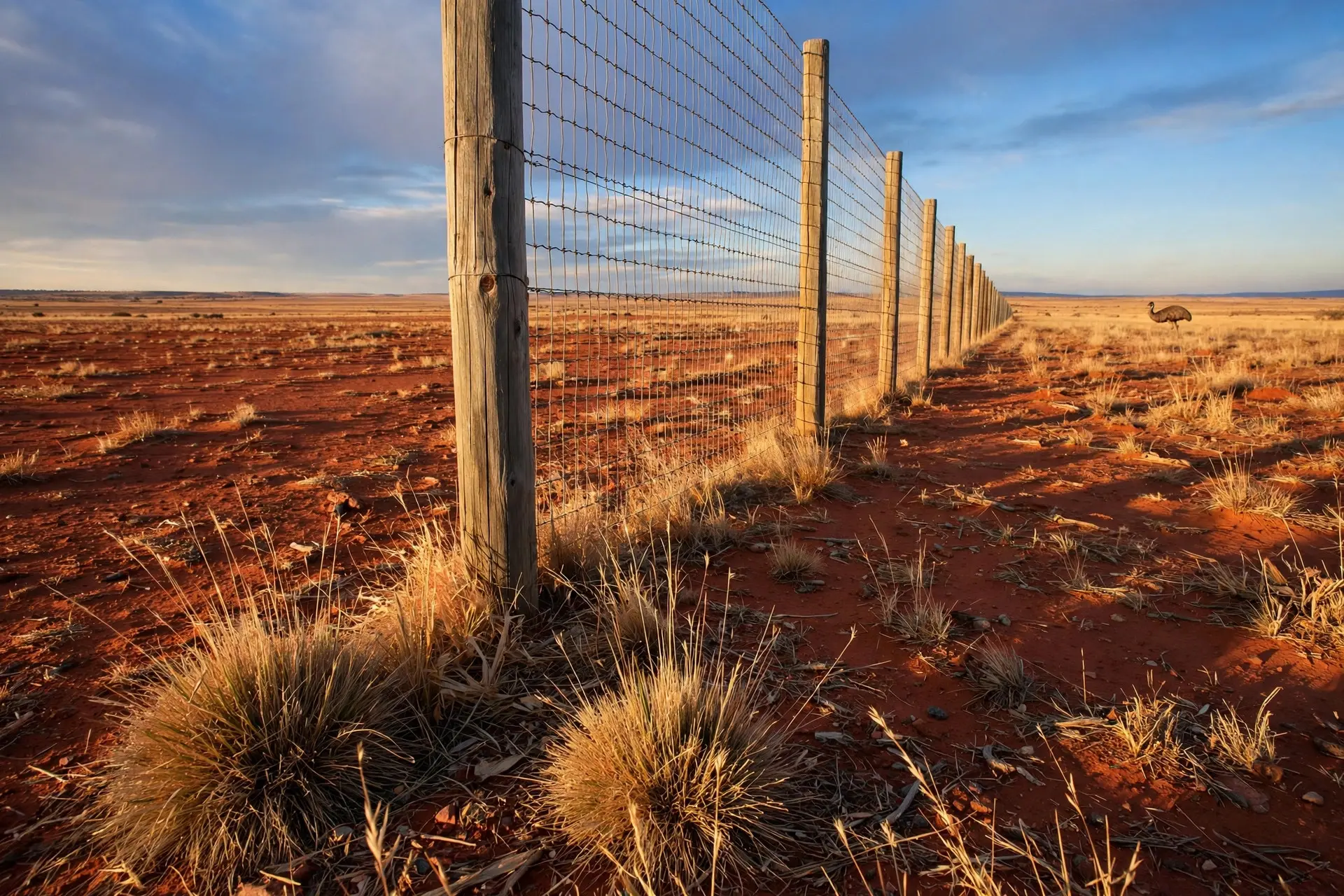
- About 1.7 m (5 ft 7 in): the height of the wire-mesh structure; police agility tests in 1946 found dingoes unimpeded by fences more than 2 m high. (Biologia Futura)
- 1946 to the late 1950s: South Australia's Dog Fence Act passed in 1946; Queensland's barrier, first proposed in the late 1940s, was not finished until the late 1950s. (PIRSA; Queensland DPI)
- 26.5 million hectares (about 65.5 million acres): the sheep and cattle grazing country Queensland says the fence protects today. (Queensland Government)
- A$2.3 million: Queensland's 2025-26 commitment to maintaining its section of the fence. (Queensland Government)
- 1 dingo and 3,245 kangaroos: what researchers counted at study sites inside the fence, against 85 dingoes and 8 kangaroos outside it. (ScienceDaily) First, a picture correction: the Dingo Fence is not one unbroken wire. It is a patchwork of barriers run by three states, following property boundaries and older fences, stitched together over decades.
How long is the Dingo Fence, exactly?
It depends on which part you measure. The whole connected barrier is 5,614 km (3,488 miles). Inside that total sit very different state sections. Queensland's Wild Dog Barrier Fence is about 2,500 km (1,553 miles), administered by Biosecurity Queensland; a 2025 ministerial statement gives the current figure as 2,400 km (1,491 miles), reflecting rebuilt and realigned sections. South Australia's Dog Fence runs 2,110 km (1,311 miles) from the Great Australian Bight near Fowlers Bay to the New South Wales border. New South Wales contributes its border fence along the SA and Queensland boundaries. The barrier's endpoints are specific: Jimbour on the Darling Downs in Queensland at one end, and the Nullarbor Plain cliffs above the Great Australian Bight in South Australia at the other. It crosses three states (Queensland, South Australia and New South Wales) and no more. It does not enter Western Australia.
The 5,614 km figure is enough for the superlative: peer-reviewed researchers call it the longest environmental barrier in the world, and the "longest fence" claim has appeared in Guinness World Records. A 1960 newspaper once claimed 6,000 miles (9,656 km), but that folded in related fencing never part of one system — treat it as a historical claim, not a measurement.
Why was the fence built?
The answer begins with rabbits, not dingoes. In 1890, the New South Wales government built a rabbit-proof fence, and the "corner fence" joining the South Australian border to the Queensland-New South Wales border fence was completed around the same time, all aimed at keeping European rabbits out of South Australia. The dog barrier came later, and it was about wool. Dingoes and wild dogs were killing sheep by the thousands, and pastoralists lobbied for a barrier. The lobbyist who succeeded was Byron MacLachlan, a pastoralist with 17 sheep stations covering more than 3.5 million hectares, who pressed the government to build the fence and fund its upkeep through a tax on pastoralists. South Australia responded with the Dog Fence Act 1946, which established the Dog Fence and the board that still administers it. The project linked older isolated fences into one continuous system. Queensland proposed its own barrier in the late 1940s to protect sheep from wild dog attacks, though construction was not completed until the late 1950s. In the early 1980s, Queensland rebuilt almost half of the original barrier (2,500 km of the original 5,600 km) and realigned large sections, creating the modern Wild Dog Barrier Fence. The funding model survives: rates on large landholdings in the fence area, a levy on sheep sold in South Australia, and dollar-for-dollar government matching. The fence is still a working asset. South Australia began rebuilding its 2,110 km section in May 2020, passing 1,070 km by June 2025 with completion expected in June 2026. In 2025 New South Wales added a 32 km extension closing the gap with the SA fence, and the two states agreed on up to 290 km of new dog fence. Like Korea's demilitarized zone, it is a barrier still being maintained long after its founding crisis.
What does the fence actually stop?
Dingoes and wild dogs are the target, though Queensland's "wild dog" definition also covers feral domestic dogs and hybrids. But the fence blocks more. Kangaroos, emus and feral camels press against it and damage the mesh, and repair crews list them alongside wild dogs as the main causes of fence failure. Inside, the objective has been to remove dingoes and wild dogs entirely. The fence itself is modest: about 1.7 m (5 ft 7 in) of wire mesh on posts. Police agility tests in 1946 found dingoes unimpeded by barriers over two meters high, so the fence works as part of a system: a treated buffer zone about 35 km wide runs along the outside, where ground and aerial poison baits knock down dog numbers before they reach the wire. Maintenance is relentless. Landowners in South Australia must inspect their sections at least every 14 days and keep them "dog proof." Queensland's section is administered by Biosecurity Queensland and overseen by a Wild Dog Barrier Fence Panel drawn from local government, industry and the department. The wire slows dogs down; the baiting does the real work.
What did the fence change about the land?
Removing the top predator from a third of the continent changed the ecology in ways nobody planned. A UNSW study published in the Proceedings of the Royal Society B, and reported by ScienceDaily, surveyed four Strzelecki Desert sites over four years. Where dingoes were rare, inside the fence, researchers sighted 1 dingo and 3,245 kangaroos. Where dingoes were common, outside the fence, they sighted 85 dingoes and 8 kangaroos. Without dingoes to check them, kangaroos multiplied and overgrazed the vegetation. Less plant cover meant thinner soils, and the researchers measured lower levels of soil phosphorus, nitrogen and carbon inside the fence line. It was a trophic cascade: the predator's absence rippling down through herbivores, plants and soil chemistry, and the researchers concluded that kangaroo numbers needed much greater control across the third of Australia where dingoes are now rare. The peer-reviewed history of the fence agrees. It describes the barrier as an obstacle to ecological restoration in the arid zone, limiting seed dispersal and genetic transfer and coinciding with falling biodiversity inside the fence line. It also notes the economics have shifted: sheep numbers in the arid zone have contracted more than 75% since 1991, and the protected zone now carries only 4.5 million sheep against 48.5 million in higher-rainfall areas. The fence crosses five deserts, three inland salt lakes, the Maralinga nuclear test site, the Woomera rocket range, and the traditional lands of at least 23 Aboriginal language groups.
| Year | What happened |
|---|---|
| 1890 | NSW builds a rabbit-proof fence; SA's corner fence completed |
| 1946 | South Australia's Dog Fence Act; work begins linking isolated fences |
| Late 1950s | Queensland's barrier fence finally completed |
| Early 1980s | Queensland rebuilds and realigns ~2,500 km |
| May 2020 | South Australia starts rebuilding its 2,110 km section |
| 2025 | NSW adds a 32 km extension; 1,070+ km of SA rebuild done |
| June 2026 | SA rebuild completion expected |
What do people get wrong about the Dingo Fence?
"It runs in a straight line across the continent." It does not. Like why some country borders are straight lines, the fence's path has a logic, but it is the logic of property boundaries and older fences, so it zigzags for thousands of kilometers. "It covers Western Australia." No — it ends at the Great Australian Bight; WA has its own separate barrier fence. "The wire alone keeps dingoes out." The 1946 agility tests settled that. Without baiting and trapping, a 1.7 m mesh fence is an obstacle, not a seal. "It is one fence." It is three state systems, built at different times and joined at the borders. The single name is a convenience. The Dingo Fence began as a shield for sheep and became one of the longest-running ecological experiments on Earth. The lesson, visible in the red dust of the Australian outback, is that a fence this long does not just divide a country — it divides its ecology. How we made this article: FactSpire researched and drafted it with AI assistance and checked every fact against the sources listed above.
Frequently asked questions
Is the Dingo Fence really the longest fence in the world?
At 5,614 km it is described in peer-reviewed research as the longest environmental barrier in the world, and Guinness World Records has listed it as the longest fence. Shorter sections are often confused with the whole barrier.
Does the fence actually stop dingoes?
The wire helps, but it is not enough on its own. Police agility tests in 1946 found dingoes could clear fences over two meters high, so the barrier works together with baiting, trapping and a treated buffer zone outside it.
Which states does the Dingo Fence cross?
Queensland, South Australia and New South Wales. It does not reach Western Australia or the Jervis Bay area; it ends at the Great Australian Bight on the Nullarbor Plain.
Who maintains the fence and what does it cost?
Landowners inspect their sections at least every 14 days under South Australia's Dog Fence Act 1946, while Queensland's fence is run by Biosecurity Queensland. Queensland committed A$2.3 million for the 2025-26 year.
Sources
- The Dingo Barrier Fence: Presenting the case to decommission the world's longest environmental barrier in the United Nations Decade on Ecosystem Restoration 2021–2030, Biologia Futura
- Wild dog barrier fence, Queensland Department of Primary Industries
- Investing in the Wild Dog Barrier Fence to protect livestock sector, Queensland Government
- The Dog Fence in South Australia, Primary Industries and Regions SA
- Rebuilding the Dog Fence, Primary Industries and Regions SA
- Dingo fence study shows dingo extermination leads to poorer soil, ScienceDaily