Why the Korean DMZ Is Earth's Most Fortified Border
Why is the Korean DMZ the most fortified border? It holds 2 million landmines and up to two million troops across a 250 km buffer drawn by the 1953 armistice.
Key takeaways
- The DMZ runs about 250 km (155 miles) long and 4 km (2.5 miles) wide, created by the armistice that took effect on July 27, 1953.
- Around 2 million landmines are buried in and around the DMZ; South Korean military data from October 2026 says North Korea planted roughly 960,000 of them since 2024.
- Up to two million troops face each other across the border, with most of both armies' strength stationed close to it.
- Four infiltration tunnels are known beneath the DMZ; the first, found in 1974, could move 2,000 soldiers per hour.
- Sealed from human activity for over 70 years, the zone shelters about 6,168 species, including 102 classified as endangered.
The Korean DMZ is the most fortified border on Earth because it is a truce line inside an unfinished war. Roughly 2 million landmines (2026 estimate) and up to two million troops sit along a 250 km (155-mile) buffer, and North Korea has laid nearly half of those mines since 2024.
- The DMZ runs about 250 km (155 miles) across the Korean Peninsula and is roughly 4 km (2.5 miles) wide, split down the middle by the Military Demarcation Line (MDL). (NASA)
- The Korean Armistice Agreement took effect on July 27, 1953, signed by North Korea, China, and the United Nations Command. It halted the fighting but never formally ended the war. (Journeys International)
- Around 2 million landmines are buried in and around the DMZ. South Korean military data shared with lawmakers in October 2026 says North Korea planted roughly 960,000 of them since 2024. (The Korea JoongAng Daily)
- Up to two million troops face each other across the border, with most of both sides' strength stationed close to it. (European Journal of International Security)
- Four infiltration tunnels are known to run beneath the DMZ. The first, discovered in 1974, had electricity, weapons storage and sleeping areas, and was wide enough to move 2,000 soldiers per hour. (Journeys International)
- Sealed off from human activity for more than 70 years, the roughly 1,000 sq km (386 sq miles) strip now shelters about 6,168 documented species, including 102 classified as endangered. (Space Daily)
How did a ceasefire line become a fortress?
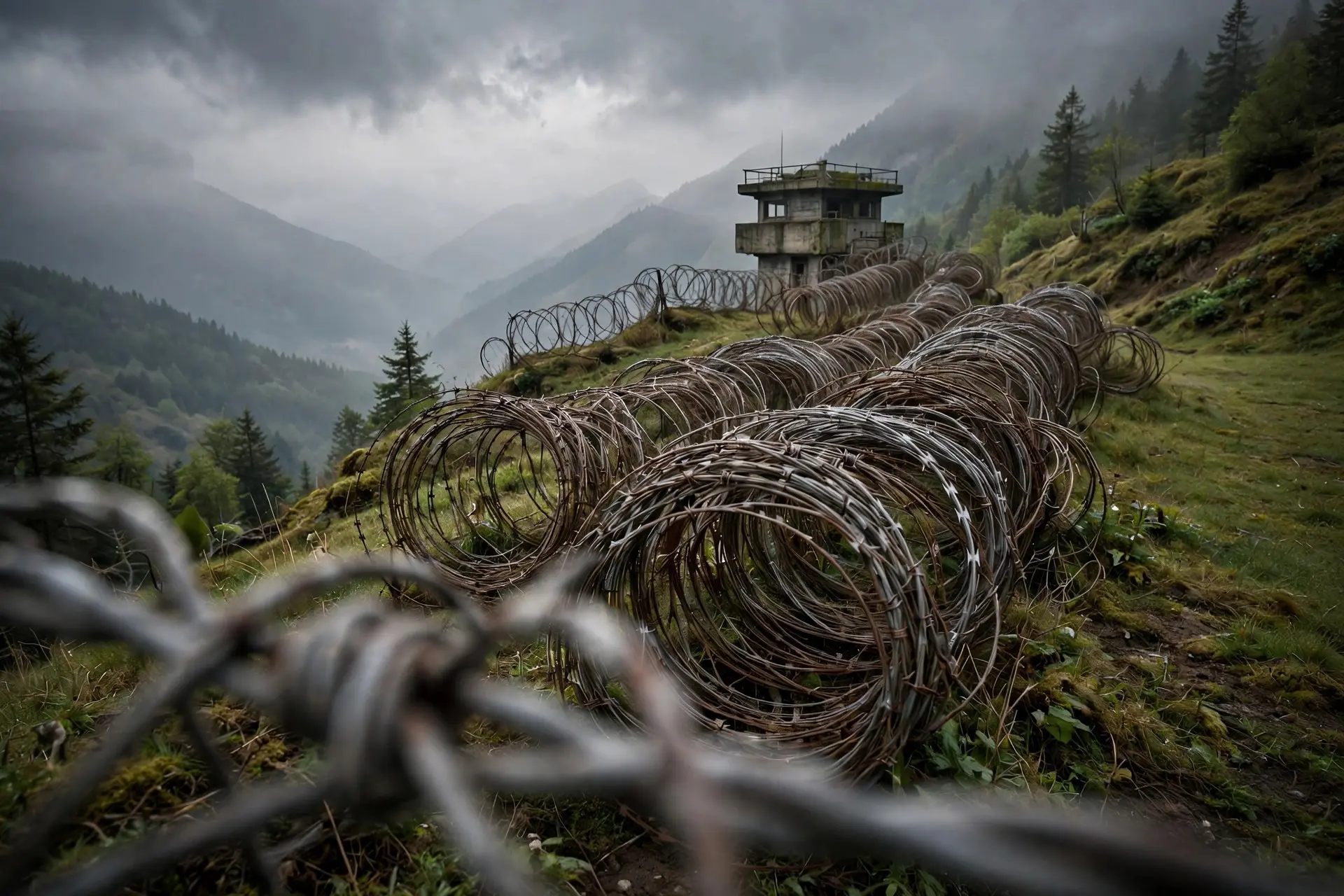
The Korean War ran from 1950 to 1953, and the armistice that took effect on July 27, 1953 kept the terms simple: stop shooting, pull troops back about 2 km (1.2 miles) on each side of a new line, and leave the 4 km (2.5 miles) in between empty. The armistice terms banned large troop placements and heavy weapons like tanks and artillery inside the strip. A fence marks the center along the MDL, and the wider zone became known as the Demilitarized Zone. (NASA) An armistice is a pause, not a peace treaty. As NASA's Earth Observatory account puts it, the July 1953 agreement "brought fighting, though not the war itself, to an end." With no treaty ever signed, both sides spent the decades after 1953 preparing for a war that never officially ended. South of the DMZ's southern edge, Seoul added another layer, the Civilian Control Zone, a 5-to-10 km (3-to-6 mile) buffer strip where civilian access is limited. (Space Daily) The result is a paradox only a frozen conflict could produce. The strip's legal name promises demilitarization, while its two edges hold some of the densest fortifications on the planet. Even an island that switches countries every six months settles its disputes with a calendar, not a minefield.
What actually sits inside the DMZ?
Start with the mines. Experts estimate that around 2 million landmines are buried in and around the DMZ, including those planted by South Korean forces. The number has been climbing fast. South Korean military data shared with lawmakers in October 2026 shows North Korea planted roughly 960,000 mines in the DMZ area since 2024, nearly half the estimated total. Unification Minister Chung Dong-young cited the same "2 million" figure during a parliamentary audit that month. (The Korea JoongAng Daily) The campaign goes well beyond mines. North Korea has been clearing stretches of land, erecting walls and barbed-wire fences, building military roads, and cutting off the Gyeongui and Donghae rail lines that once connected the two Koreas. The work began in April 2024, after Pyongyang declared the two Koreas "two states hostile to each other." North Korean troops have repeatedly crossed the MDL during the fortification work, and a North Korean mine exploded south of the MDL on September 21, seriously injuring three South Korean soldiers. (The Korea JoongAng Daily) Then there is what runs underneath. Four infiltration tunnels are known to run from North to South Korea beneath the DMZ, the first discovered in 1974. Some estimates suggest up to 200 more may remain undiscovered. Most observers believe North Korea dug them as invasion routes, though Pyongyang has claimed they were built for coal mining, despite the lack of coal in the region. The first and smallest tunnel, about 3 ft x 4 ft (0.9 m x 1.2 m), was fitted with electricity, weapons storage and sleeping areas, and was wide enough to move 2,000 soldiers per hour. The next three were all larger, roughly 7 ft x 7 ft (2.1 m x 2.1 m). None is large enough for vehicles. The second, third and fourth tunnels are open to visitors at their southern entrances. (Journeys International) Above ground, the Joint Security Area (JSA) at Panmunjom anchors the western end. The JSA straddles the MDL, its conference rooms bridging the line as the meeting space for North Korea and the United Nations Command. It is the only place in the DMZ where North and South Korean forces stand face to face. (Journeys International; European Journal of International Security)
Why are so many troops still facing each other?
Because the war never ended, both Koreas keep the bulk of their military strength near the line. A 2019 study in the European Journal of International Security put the figure at up to two million troops facing each other across the border, with roughly 70 percent of the forces on both sides stationed in close proximity to it. Seoul itself sits less than 35 miles (56 km) from the border, which is why every incident on the DMZ registers in the South Korean capital within the hour. (European Journal of International Security; Journeys International)
The standoff has hardened, not eased. North Korea's April 2024 declaration that the two Koreas are "two states hostile to each other" was followed by the mine-laying and fortification campaign, repeated MDL crossings, and the September 2026 explosion that injured three South Korean soldiers. Pyongyang has denounced South Korea's warning shots and loudspeaker warnings as threats to its troops, while the South keeps firing warning shots when North Korean troops cross the line during fortification work. (The Korea JoongAng Daily)
| Year | What happened |
|---|---|
| July 27, 1953 | The Korean Armistice Agreement takes effect, halting the fighting and creating the 4 km-wide buffer zone. |
| 1974 | The first of four known North Korean infiltration tunnels is discovered beneath the DMZ. |
| April 2024 | North Korea declares the two Koreas "two states hostile to each other" and begins a full-scale border fortification campaign. |
| October 2026 | South Korea's military reports North Korea has laid roughly 960,000 landmines since 2024, bringing the estimated DMZ total to about 2 million. |
What do most people get wrong about the DMZ?
First, it is not a wall. Unlike the former Berlin Wall, the DMZ is a 4 km (2.5-mile) band of mined no-man's-land; the fences mark the edges of the buffer and the MDL at its center, not a single barrier. (NASA; Space Daily) Second, "demilitarized" is a legal fiction. The armistice text did ban heavy weapons and large troop placements inside the strip, and that part was honored: there are no large troop placements in the area. But the same agreement could not stop either side from fortifying the ground right up to the limit lines, which is how the world's most heavily militarized border ended up wrapped around a zone whose name means the opposite. (NASA) Third, the zone is not empty. Two villages sit inside the DMZ. On the southern side, Daeseong-dong is a farming village of about 200 direct descendants of the pre-war residents; they are exempt from taxes and mandatory military service but live under an 11 pm curfew. On the northern side, North Korea claims a 200-resident "Peace Village," which the South calls a propaganda village of empty buildings with painted windows. (Journeys International) The strangest fact of all may be what the emptiness produced. With no farming, development or permanent settlement for more than 70 years, the strip became one of Asia's most biodiverse refuges. Surveys cited by the Natural History Museum in London have documented about 6,168 species in the DMZ and the adjacent Civilian Control Zone, including 102 listed as endangered on the Korean Peninsula register, more than a third of the peninsula's total endangered species. The red-crowned crane, with only about 3,000 individuals left globally, winters in the DMZ wetlands. (Space Daily) Borders elsewhere are odd in quieter ways: the India-Bangladesh border was redrawn by partition deals, Kaliningrad sits cut off from mainland Russia, and the Darien Gap stops roads cold between two continents. The DMZ stands in a category of its own: a border drawn by a war that paused in 1953 and never finished. How we made this article: FactSpire researched and drafted it with AI assistance and checked every fact against the sources listed above.
Frequently asked questions
Is the Korean DMZ actually demilitarized?
No. The armistice bans large troop placements and heavy weapons inside the 4 km buffer itself, but both sides packed the flanks with mines, fencing, guard posts and artillery. The name describes the strip's legal status, not its reality, which is why it is called the most heavily militarized border on Earth.
How many landmines are buried in the Korean DMZ?
Experts estimate around 2 million landmines in and around the DMZ, including those planted by South Korean forces. South Korean military figures shared with lawmakers in October 2026 put North Korea's plantings since 2024 at roughly 960,000, meaning nearly half the total was laid in just over two years.
What is the Joint Security Area at Panmunjom?
The JSA is the facility on the western end of the DMZ where the armistice was negotiated. It straddles the Military Demarcation Line, with conference rooms built bridging the line, and it is the only place where North and South Korean forces stand face to face.
Why is the DMZ a wildlife refuge?
With no farming, development or permanent settlement for over 70 years, the roughly 1,000 sq km strip became an accidental sanctuary. Surveys cited by the Natural History Museum in London have documented about 6,168 species there, including 102 listed as endangered, among them the red-crowned crane.
Sources
- North Korea plants nearly 1 million land mines along DMZ in just over two years: Lawmakers, The Korea JoongAng Daily
- The most heavily militarized border on Earth, a hundred-and-fifty-mile strip of barbed wire and landmines cutting across the Korean Peninsula, has been sealed off from human contact for seventy years — and quietly become one of the most biodiverse wildlife refuges in Asia., Space Daily
- Korean Demilitarized Zone: Image of the Day, NASA / DVIDS
- Travel to South Korea: What is the DMZ?, Journeys International
- Visual autoethnography and international security: Insights from the Korean DMZ, European Journal of International Security (Cambridge University Press)