How Tall Was the Lighthouse of Alexandria?
The Lighthouse of Alexandria may have stood 100 to 118 meters tall — but with no surviving blueprint, scholars still argue. Its stones now rest on the seabed.
Key takeaways
- The Lighthouse of Alexandria likely stood between 103 and 118 meters tall — second in antiquity only to the pyramids of Giza.
- No original blueprint survives; the famous three-tier form comes from a 1909 synthesis of ancient sources.
- Earthquakes in 956, 1303, and 1323–24 destroyed it; the August 1303 quake was the final blow.
- In 2025, the CNRS-led PHAROS program raised 22 massive blocks from the seabed for a digital twin — not a physical rebuild.
How tall was the Lighthouse of Alexandria? The honest answer is a range, not a number. Britannica puts the tower at more than 350 feet (110 metres) — second in antiquity only to the pyramids of Giza. The most-cited modern estimate, from Oxford scholar Judith McKenzie, refines the medieval Arab descriptions to roughly 103 to 118 meters on a base about 30 meters square. Why a range and not a number? Because no two medieval descriptions agree exactly — the Arab measurements that Oxford scholar Judith McKenzie analyzed vary by only about 15 percent, from roughly 103 to 118 meters, on a base she estimates at about 30 by 30 meters: the footprint of a city block. Fifteen percent disagreement across seven centuries of travelers' accounts is remarkably tight. McKenzie's analysis remains the standard reference for the tower's dimensions. For a building that no longer exists, it is the best answer we are likely to get — at least until the digital twin has its say. The Pharos — as it was called, after the island it stood on — was one of the Seven Wonders of the Ancient World and the archetype of every lighthouse that followed. Its height is debated precisely because the tower is gone and its plans were never copied down. What we know comes from ancient descriptions, medieval measurements, coins, and the stones themselves, dredged from the seabed.
How was the Lighthouse of Alexandria built?
Construction began around 280 BCE, commissioned under Ptolemy I and finished about twelve years later under his son Ptolemy II, from a design by Sostratus of Cnidus. The reported cost was 800 talents of silver — an enormous sum for any public work of the age.
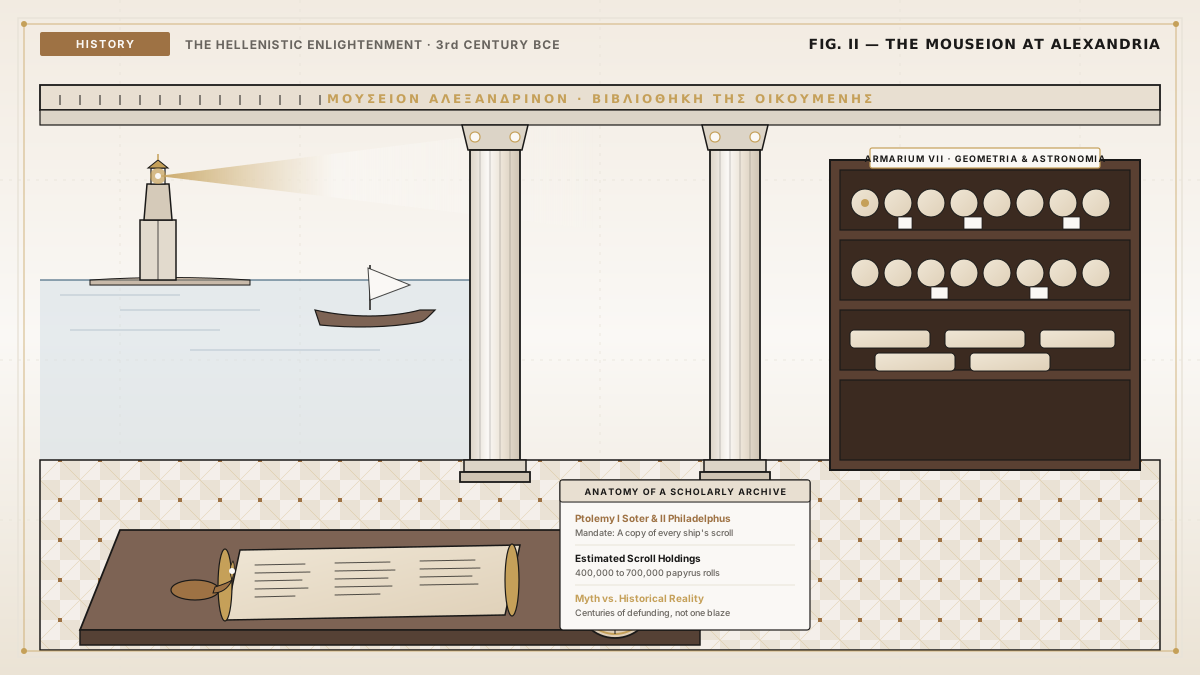
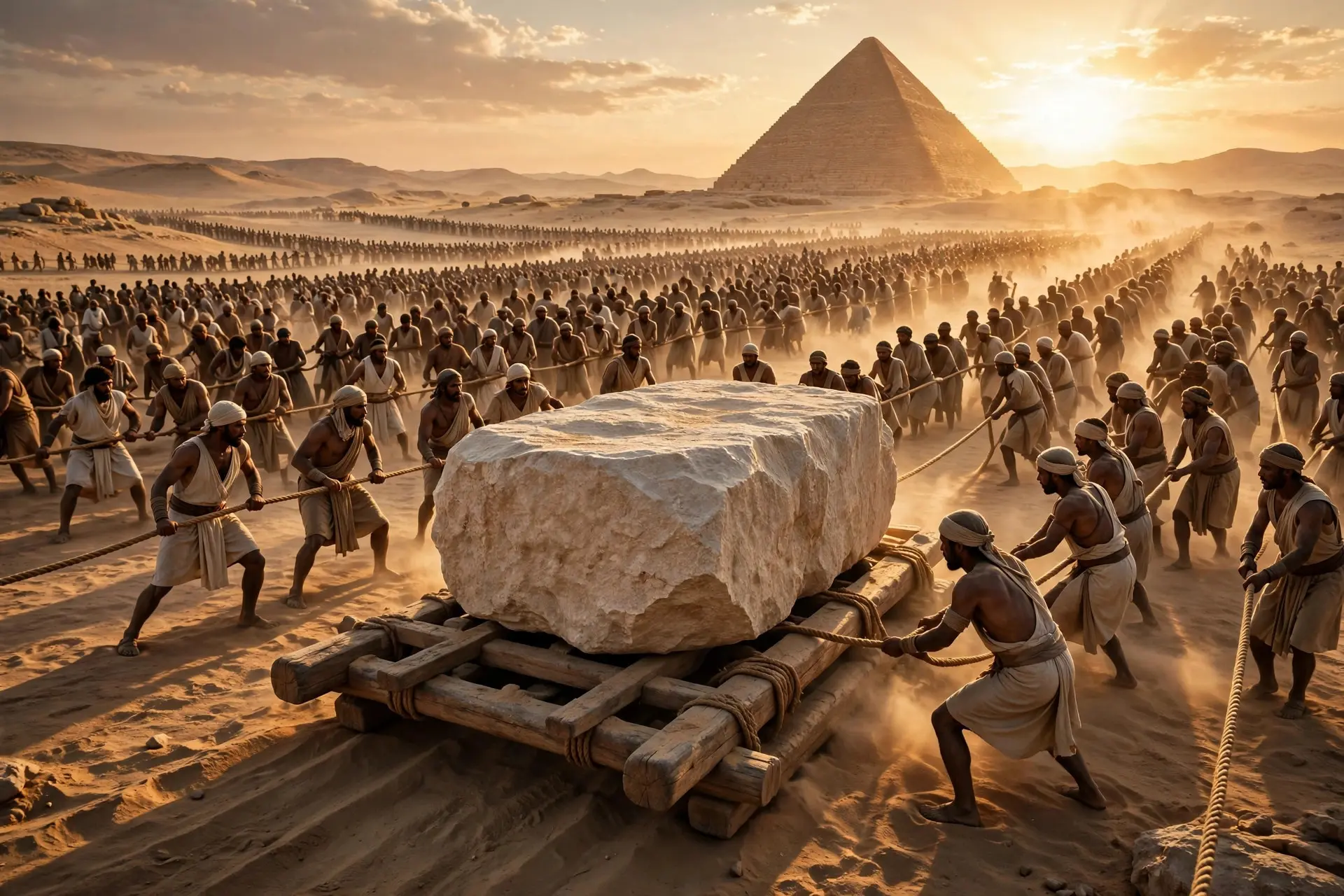
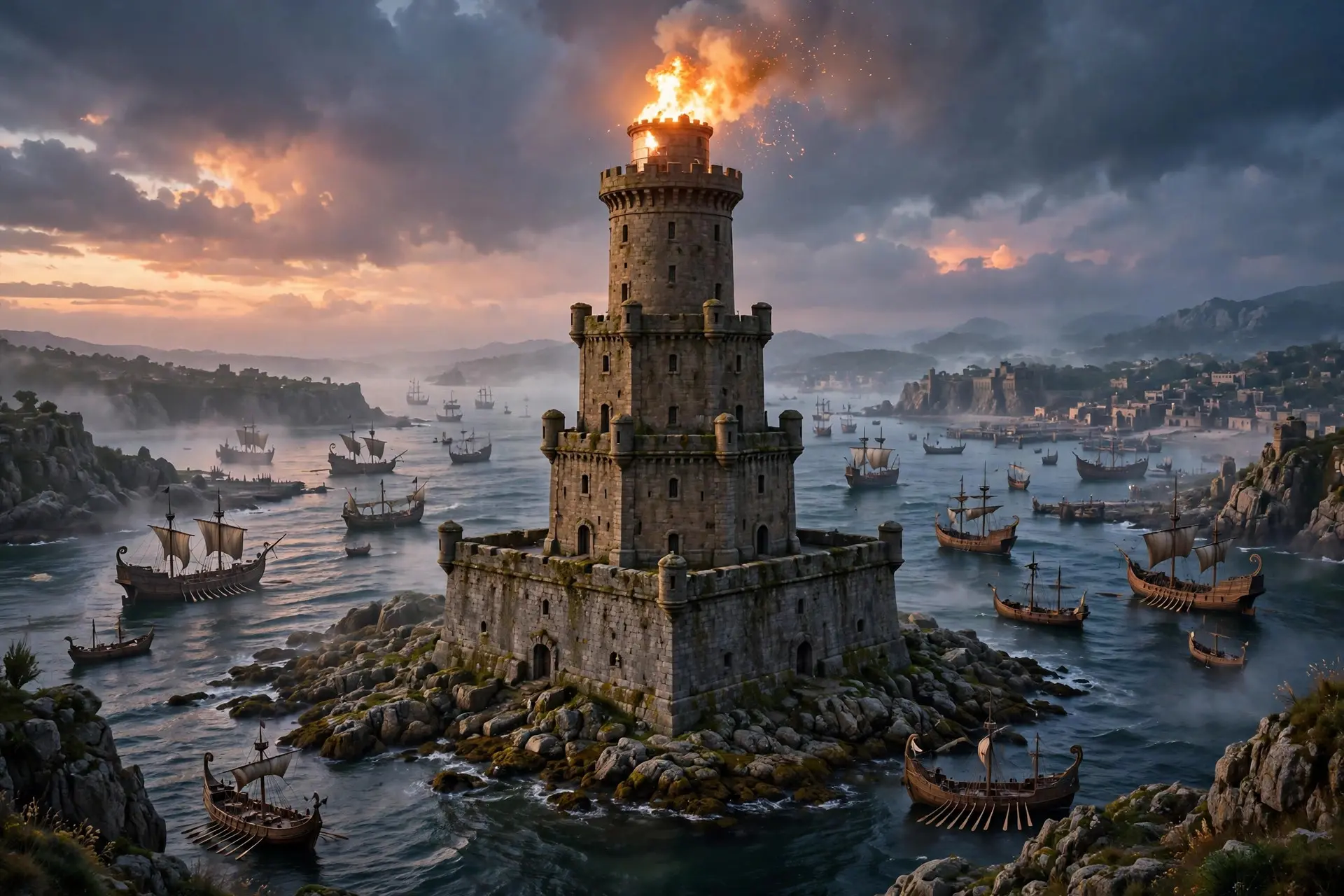
The tower rose in three tapering tiers: a square base, an octagonal middle section, and a cylindrical top — the form that has become the lighthouse's signature, though it largely comes from archaeologist Hermann Thiersch's 1909 synthesis of ancient sources rather than any single eyewitness. The masonry was of large, light-colored sandstone and limestone blocks, quarried at Wadi Hammamat, with molten lead poured between the joints to withstand the pounding of the waves. Getting to the top was an engineering problem of its own. A spiral ramp wound up through the interior, wide enough that supplies — and the considerable fuel the beacon needed — could be carried upward. Egypt lacked timber, so the fire burned whatever was at hand; animal dung is suggested as a likely fuel. Above the flame, later Arab sources describe a polished-bronze mirror that reflected the beacon seaward by night and possibly caught the sunlight by day. Pliny the Elder, writing in his Natural History, described its function plainly: fires by night "to give warning to ships, of the neighbouring shoals, and to point out to them the entrance of the harbour." Roman imperial coins from Domitian to Commodus show the tower crowned with a monumental statue — candidates include Poseidon, Zeus, Alexander the Great, or Ptolemy I himself — though whether the original tower carried such a figure is debated. The Ptolemies built Alexandria as a showcase of their power, and the lighthouse was its most visible advertisement, as much a monument as the Great Library of Alexandria was a statement of intellectual ambition.
What happened to the Lighthouse of Alexandria?
Stone endures until the ground moves. The lighthouse was destroyed by a series of earthquakes: in 956, in 1303, and again in 1323–24. The quake of August 8, 1303, which sent a tsunami through Alexandria and destroyed roughly a third of the city, was the final blow. The tower stood in some form into the 12th century, but after the earthquakes it was never restored. Its stones were not wasted. In 1477–79, the Mamluk sultan Qaitbay built his fortress on the same promontory, reusing the ruined masonry of the lighthouse — the citadel there still stands today, partly made of the ancient tower. By then the Pharos had been gone so long that its exact form had already become a subject of argument.
The ruins went underwater. Divers first spotted the huge blocks in 1968, and in 1994 Jean-Yves Empereur of the Centre for Alexandrian Studies mapped hundreds of massive masonry blocks and statues on the seabed — including a colossal third-century BCE king's statue identified with Ptolemy II, and a queen or Isis statue identified with Arsinoe. Egypt scrapped plans for a breakwater over the site in favor of an underwater archaeological park.
What do the underwater stones tell us?
The most exciting recent chapter is happening on the seabed. Divers first spotted the huge blocks in 1968, and in 1994 Jean-Yves Empereur of the Centre for Alexandrian Studies mapped hundreds of massive masonry blocks and statues — including a colossal third-century BCE king's statue identified with Ptolemy II, and a queen or Isis statue identified with Arsinoe. Egypt scrapped plans for a breakwater over the site in favor of an underwater archaeological park. In May and June 2025, the CNRS-led PHAROS program, directed by Isabelle Hairy, raised 22 massive blocks — each 70 to 80 tons — from the lighthouse's monumental doorway. Among them was a previously undocumented pylon that mixes Egyptian style with Greek building technique, a signature of Ptolemaic Alexandria's fusion of cultures. The blocks are being photogrammetrically scanned toward a digital twin of the tower — a virtual reconstruction, not a physical one. More than 3,000 objects have been catalogued on the seabed. That digital twin may finally settle the oldest question of all. For seven centuries, the lighthouse's height has been a matter of conflicting medieval estimates and scholarly judgment. The stones on the seabed are the only surviving witnesses — and they are, block by block, being asked to testify. Like the lost cities of the Silk Road, the Pharos reminds us that some of history's most famous monuments survive only as measurements, fragments, and arguments — and that the arguments can last longer than the stone.
Frequently asked questions
How tall was the Lighthouse of Alexandria?
Britannica puts it at more than 350 feet (110 metres). The most-cited modern estimate, from Oxford scholar Judith McKenzie, narrows medieval descriptions to a range of about 103 to 118 meters on a roughly 30-by-30-meter square base.
Who built the Lighthouse of Alexandria?
It was commissioned under Ptolemy I and completed around 279 BCE under Ptolemy II, designed by Sostratus of Cnidus, reportedly at a cost of 800 talents of silver.
What destroyed the Lighthouse of Alexandria?
A series of earthquakes — in 956, 1303, and 1323–24 — toppled the tower. The August 1303 quake, which also triggered a tsunami, destroyed about a third of Alexandria and finished the lighthouse. It was never rebuilt.
Can you see the lighthouse's remains today?
Its stones lie on the seabed off Alexandria. In May–June 2025, the CNRS-led PHAROS program raised 22 massive blocks from the monumental doorway for photogrammetric scanning toward a digital twin.