Photosynthesis: Nature's Most Important Chemical Reaction
Photosynthesis powers nearly all life on Earth — yet plants turn only a few percent of sunlight into food. How does this wasteful-looking chemistry really work?
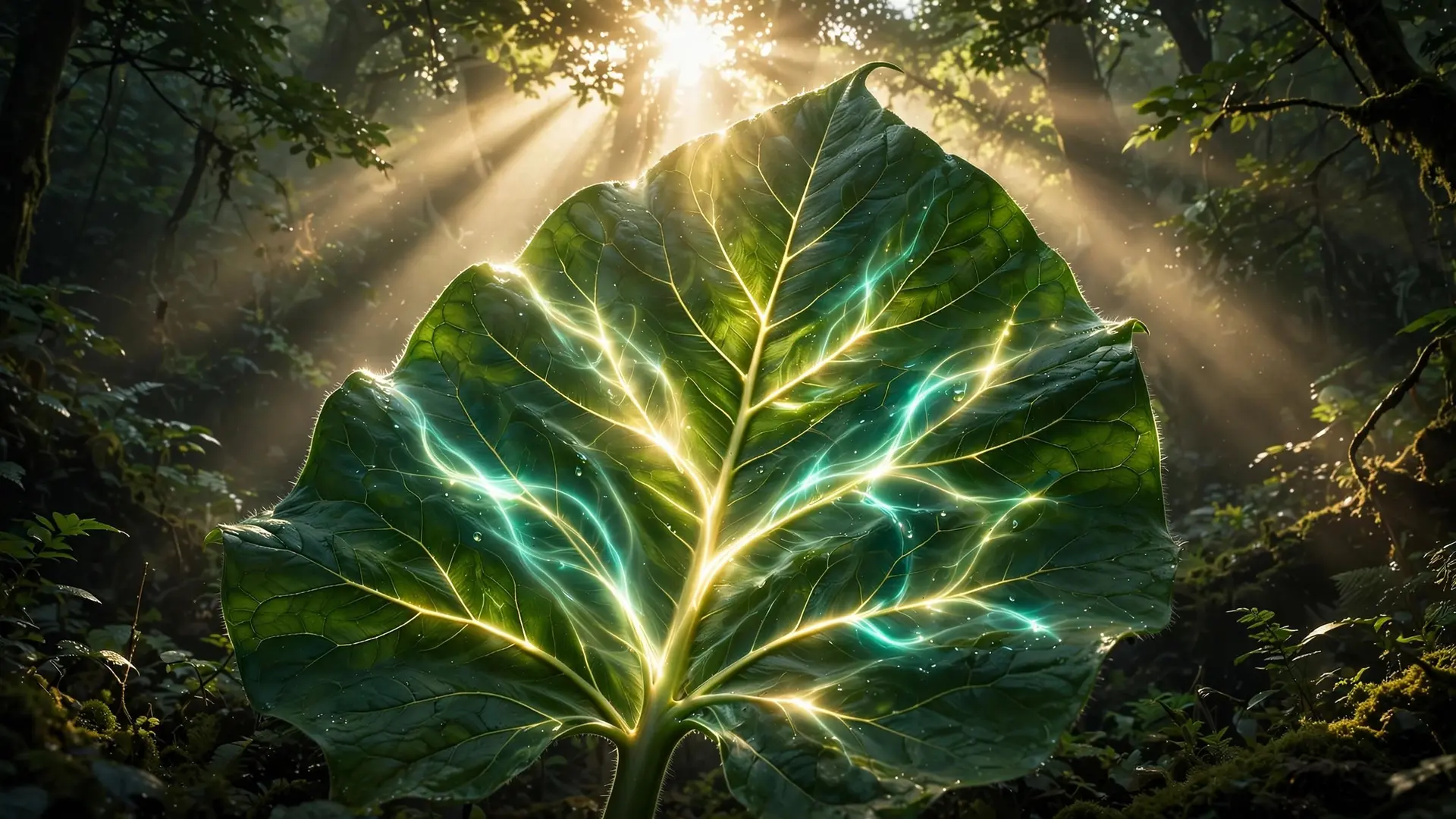
Key takeaways
- Photosynthesis converts sunlight into chemical energy via 6CO₂ + 6H₂O + light → C₆H₁₂O₆ + 6O₂ — the reaction behind nearly every calorie eaten on Earth.
- Real plants convert only 3–6% of total sunlight into biomass, though their light-capture machinery funnels absorbed energy with near-quantum perfection.
- Cyanobacteria invented oxygenic photosynthesis billions of years ago; the Great Oxidation Event, 2.4–2.1 billion years ago, filled Earth's air with oxygen.
- The oxygen we breathe is a byproduct of splitting water, and it was toxic to most living things when it first appeared.
- Chlorophyll absorbs red and blue light and reflects green — leaves look green because of the light they reject, not the light they use.
Almost every calorie you have ever eaten was once sunlight. Photosynthesis is the process that makes that conversion — splitting water, pulling carbon dioxide out of the air, and stitching the pieces into sugar. It is the most important chemical reaction in the history of life, and it is also embarrassingly wasteful with the sunlight it receives. What it does with the tiny sliver it keeps, though, is nothing short of astonishing.
What actually happens when a leaf catches light?
At its simplest, photosynthesis is one balanced equation: 6CO₂ + 6H₂O + light energy → C₆H₁₂O₆ + 6O₂. Carbon dioxide plus water, powered by sunlight, becomes glucose plus oxygen. The glucose is then reshaped into starches, cellulose, and all the other building materials of plants. Everything you eat — every grain, every fruit, every piece of meat — traces back to this reaction, either directly or through the long food chains it powers. But the simple equation hides an intricate machine. The work happens inside chloroplasts, tiny structures within plant cells, and it unfolds in two linked stages. First comes the light-dependent stage: chlorophyll and other pigment molecules act like antennae, catching photons and funneling their energy into reaction centers. There, the energy is used to split water molecules apart, releasing oxygen as a byproduct and harvesting the energetic electrons that remain. Then comes the light-independent stage, which uses those electrons to fix carbon dioxide into sugar. The second stage needs no light itself — it runs on the chemical energy the first stage banked. Chlorophyll is the star, but it is a picky absorber. It drinks in red and blue light greedily and largely ignores green. That selectiveness is why leaves look green: the color you see is the wavelength being bounced away, unused. To widen the net, plants keep an entourage of helper pigments — carotenoids and others — that catch the wavelengths chlorophyll misses and hand the energy over. Nature's solar panels are not single materials; they are whole committees of molecules tuned to different slices of the spectrum, much like how the atmosphere selectively scatters blue light to paint our sky.
Why is a near-perfect quantum process also so wasteful?
Here is the paradox. The first step of photosynthesis — moving the absorbed light energy to the reaction center — operates with near-100 percent efficiency. Research led by Berkeley Lab's Graham Fleming, published in Nature in 2007, found that the energy transfer exploits wavelike quantum coherence, letting the system sample many possible paths at once and take the most efficient one. It is one of the clearest hints that biology sometimes borrows tricks from quantum mechanics, a theme explored in the strange quantum effects life may exploit. And yet a real plant in a real field converts only 3 to 6 percent of total sunlight into biomass, and typically just 1 to 2 percent of the sunlight its leaves absorb. Where does the rest go? Some is reflected off the leaf. Much of it never had a chance: only about 45 percent of sunlight falls in the photosynthetically active spectrum at all, which caps the theoretical maximum for solar energy conversion at roughly 11 percent. On top of that, photosynthesis demands at least eight photons to fix a single molecule of carbon dioxide, and a large share of the captured energy is spent on the plant's own metabolism — growing roots, repairing damage, respiring. Calculations of the maximum solar-to-biomass conversion put the ceiling at 4.6 percent for C3 plants and 6 percent for C4 plants, according to work by Xin-Guang Zhu, Stephen Long, and Donald Ort. Excess light is not just wasted; it is dangerous. Sunlight carries more energy than the machinery can handle, and an overload would fry the photosynthetic apparatus. So plants dump the surplus as heat, a process called non-photochemical quenching, or re-emit it as a faint red glow known as chlorophyll fluorescence. Photosynthesis is a machine that deliberately throws away most of its fuel — because the fuel is free, and the machine has survived three billion years by being robust rather than efficient.
How did one microbe's waste gas rebuild the planet?
Photosynthesis did not always make oxygen. The earliest versions used other electron sources and left no free oxygen behind. Then, somewhere around 3.4 billion years ago, a lineage of bacteria made one of the most consequential innovations in Earth's history: oxygenic photosynthesis, which uses water as the electron source and releases oxygen as the waste product. Those bacteria became the cyanobacteria, and their oxygen began to transform the world.
For hundreds of millions of years, the oxygen never reached the sky. It was swallowed by chemistry first — reacting with dissolved iron in the oceans, which precipitated out as rusty sediments now preserved as banded iron formations. Only when that chemical sponge was saturated, between 2.4 and 2.1 billion years ago, did oxygen start accumulating in the atmosphere. This was the Great Oxidation Event. It was catastrophic: oxygen displaced methane, a potent greenhouse gas, and Earth plunged into the Huronian ice ages. High above, ultraviolet light split oxygen molecules apart, and the atoms recombined into ozone, forming the ozone layer that shields surface life to this day. And for the anaerobic life of the time, oxygen was poison — the first great pollution crisis, unleashed by microbes. There was also a second, quieter legacy. At some point, a eukaryotic cell swallowed a cyanobacterium and, instead of digesting it, kept it as a live-in solar panel. That endosymbiotic partnership became the chloroplast, the photosynthetic engine of algae and plants. Every oak tree, every blade of grass, every forest linked by underground fungal networks runs on a bacterium captured in a single ancient embrace.
What do people get wrong about photosynthesis?
The most common misunderstanding is that plants "eat" sunlight, or that they breathe in carbon dioxide the way we breathe in oxygen. In truth, plants are master chemists that rearrange their raw materials: light provides the energy, but the mass of a tree comes overwhelmingly from air and water, not from the soil. Van Helmont hinted at this in the 17th century when he found a willow tree could gain enormous weight while its soil barely lost any. Another surprise: the oxygen you are breathing right now did not come from carbon dioxide. It came from water. The splitting of water — photolysis — is what frees the oxygen atoms that pair up and drift into the air. The carbon dioxide, meanwhile, is dismantled and rebuilt into sugar. Oxygen is the exhaust; sugar is the product. And photosynthesis is not a plant monopoly. Cyanobacteria still do it, algae do it, some sea slugs have famously stolen chloroplasts for themselves. The chemistry is older than plants by more than a billion years, and it remains a distributed, cooperative enterprise — pigment teams inside chloroplasts, chloroplasts inside cells, cells inside leaves, leaves inside forests.
The reaction that sets the ceiling
Step back far enough and photosynthesis looks less like plant trivia and more like the operating budget of the entire biosphere. Every joule of energy that moves through a food web entered as a photon and was banked by this reaction. Civilization runs on it twice over: our crops are fresh photosynthesis, and our fossil fuels are ancient photosynthesis, stockpiled carbon from long-dead forests. The machine that wastes 97 percent of the sunlight it receives has still managed to bankroll everything that lives. Sometimes the most important chemistry on Earth is not the most efficient — it is the most persistent.
Frequently asked questions
Is photosynthesis efficient?
At the whole-plant level, no: real plants convert 3–6% of total sunlight into biomass at best. But the light-capturing machinery inside leaves funnels absorbed energy to its reaction centers with near-perfect efficiency.
Where does the oxygen from photosynthesis come from?
From splitting water, not from carbon dioxide. Light energy is used to pull water molecules apart to harvest electrons, and the oxygen is released as a byproduct.
How did photosynthesis change Earth's atmosphere?
Oxygenic photosynthesis by cyanobacteria drove the Great Oxidation Event between 2.4 and 2.1 billion years ago, displacing methane and eventually forming the protective ozone layer.
Why are plants green?
Chlorophyll absorbs red and blue light most strongly and reflects green. Green is the wavelength leaves reject — it is the portion of sunlight they cannot use.