How the Floppy Disk Rose, Ruled, and Vanished
From IBM's 1967 invention to a 1.44 MB icon, the floppy disk carried personal computing on its back. Discover how CDs, email, and the iMac ended its reign.
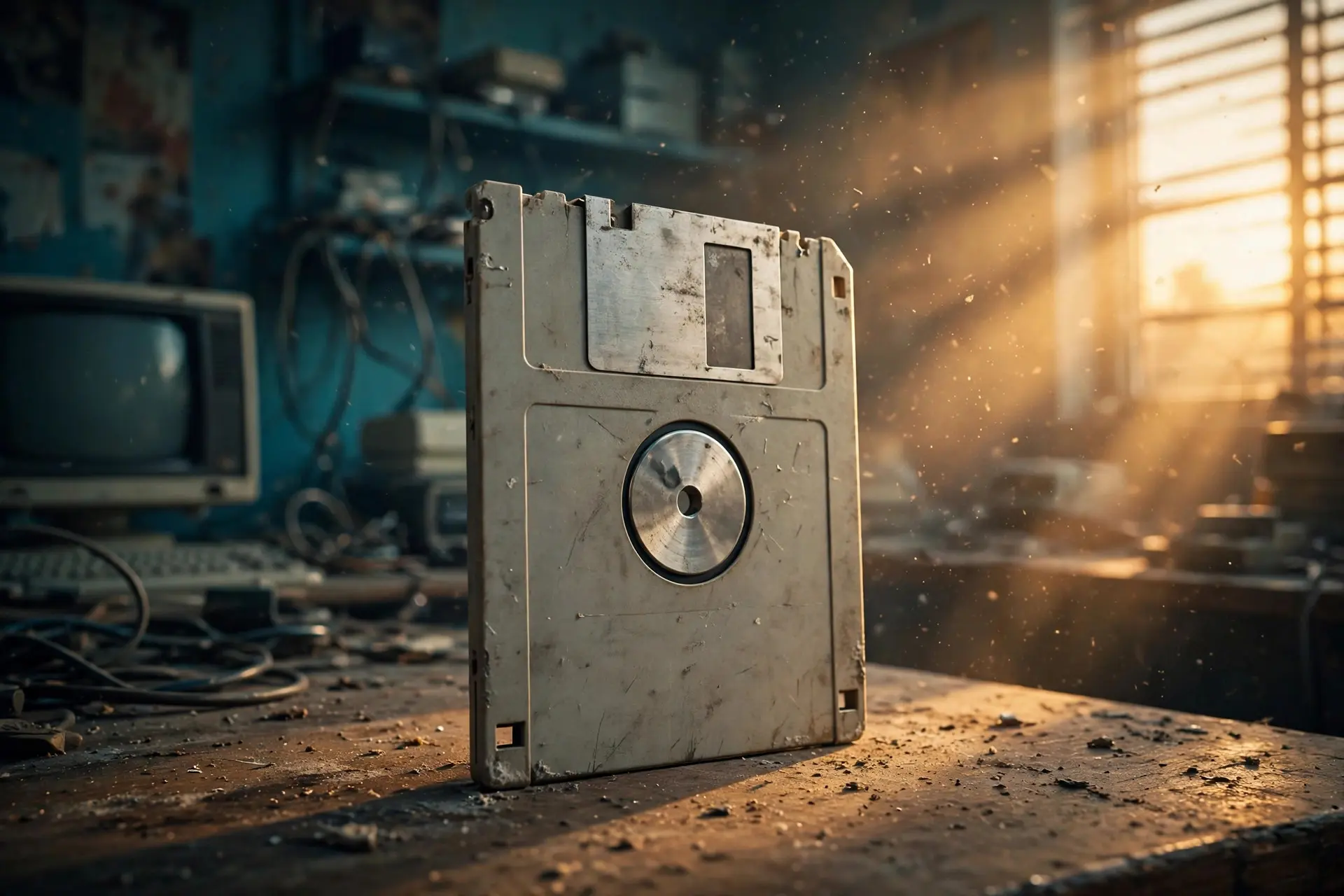
Key takeaways
- The floppy disk began in 1967 at an IBM facility in San Jose, where Alan Shugart's team needed a portable, rewritable, random-access medium for mainframe microcode.
- The 8-inch disk was commercialized in 1971; the 5.25-inch arrived in 1976, and Sony's 3.5-inch format — adopted by IBM in 1986 — froze at 1.44 MB.
- Windows 95 shipped on 13 floppy disks; a 650 MB CD-ROM held the equivalent of more than 400 floppies.
- Apple's 1998 iMac shipped with no floppy drive; Sony, the last manufacturer, ceased production entirely in March 2011.
The floppy disk held about 1.44 megabytes — not enough for a single modern phone photo. Yet for nearly forty years, it was how the entire computing world moved information: software shipped on floppies, documents traveled in pockets, and a tiny save icon that still lives in your software toolbar began life as a real object you could hold.
Born to serve a mainframe
The floppy disk did not start with personal computers — those barely existed. It started in 1967, at an IBM development facility in San Jose, California, where a team led by engineer Alan Shugart faced a mundane but expensive problem: loading microcode into the company's System/370 mainframes during installation and servicing. The existing options were clumsy. Punch cards were bulky and unforgiving — one bad punch and the whole card was trash. Magnetic tape held more data but was sequential: to read a file at the end of a tape, you had to spool through everything in front of it, like fast-forwarding a cassette. IBM wanted something portable, rewritable, and random-access — a medium that could jump straight to any piece of data. The answer, commercialized in 1971, was an eight-inch disk: a thin, flexible magnetic medium in a plastic envelope, genuinely floppy to the touch. That flexibility is literally where the name came from. The first version stored about 80 kilobytes — tiny even by the standards of the day — but it was removable, reusable, and could fetch any record instantly. Within a couple of years, Shugart had left IBM for Memorex, which released the first commercially available read-write floppy drive. A new storage category had been born.
The shrink-and-grow years
Once the concept existed, the disk kept getting smaller while holding more. Shugart Associates introduced the 5.25-inch drive in 1976, and when IBM chose that format for the IBM PC in 1981, the floppy became the default storage of the personal computer era. This was the crucial leap: before hard drives were standard equipment, the floppy was where the operating system, the applications, and your documents lived. Software companies could write a program, press it onto disks, and sell it — an independent software industry grew up on floppy distribution. The 3.5-inch disk arrived in 1982, with Sony as its champion, and it fixed the format's biggest annoyances: a rigid plastic shell (earning it the nickname "stiffy"), a sliding metal shutter to protect the media, and a hard case that survived pockets and backpacks. IBM adopted the 1.44-megabyte high-density version for its PS/2 line in 1986. By the mid-1990s, the format was at its absolute peak, with IBM reporting more than five billion disks sold annually. Offices kept stacks of them like stationery. There was even a word for carrying files between non-networked computers by hand: the "sneakernet." A single disk could hold a term paper, a game, or a friend's entire collection of shareware utilities.
The math stopped adding up
The floppy's downfall was not a sudden catastrophe. It was arithmetic. Software kept growing while the disk stayed frozen at 1.44 megabytes. Windows 95 shipped on a stack of thirteen floppy disks. A CD-ROM, holding roughly 650 megabytes, could store the equivalent of more than four hundred floppies — and blank CD-ROMs were becoming cheap. Email made it possible to attach documents and send them in seconds rather than hand-carrying a disk across town. By the late 1990s, the floppy's greatest strength — portability — had become its weakness: why fumble with a fragile disk when files could fly through the network? The fragility was real, too. The magnetic medium was vulnerable to dust, moisture, magnets, and plain bad luck — a jolted drive could ruin a disk mid-write, and urban legends of stapled or folded floppies were funny because everyone had seen some version of the disaster. Like the quirks of early keyboards that outlived their original purpose, the floppy lingered long past its technical prime — but the capacity gap kept widening, and no format revision could close it.
The killing blow and the long goodbye
The beginning of the end arrived in 1998, when Apple released the iMac — a mass-market computer with no floppy drive at all. Apple bet that hard drive capacity and the internet had made the disk obsolete. It was a gamble: many called it premature, but the industry gradually fell in line. Dell made the floppy drive optional in 2003, Hewlett-Packard followed years later, and by the late 2000s new computers rarely shipped with one. Sony, by then the last manufacturer still making the disks, announced the end of domestic sales in 2010 and ceased production entirely in March 2011. Yet the floppy refused to die completely. One of the strangest holdouts was the United States military: a 2016 Government Accountability Office report revealed that the Strategic Automated Command and Control System — which coordinates nuclear bombers and missiles — still ran on 1970s IBM computers using eight-inch floppy disks. The military replaced those drives with a solid-state storage solution in June 2019. The logic was oddly sound: systems that never touch the internet are hard to hack, and nothing forces you to upgrade something that works. Meanwhile, the floppy's ghost survives in the most unexpected place — the save icon. Decades after the last disk rolled off a Sony production line, software still renders a tiny 3.5-inch floppy to mean "save your work." Like the first computer bug, immortalized as a real moth, the disk has become pure symbol. The floppy's story carries a lesson about how technology really dies. It was not defeated by a single rival or a fatal flaw. The world simply outgrew it: files got bigger, networks got faster, and a format that once seemed like infinite room became a thimble. Most obsolete technologies end the same way — not with a bang, but with a capacity limit. The floppy disk just happened to do it more visibly, and more universally, than almost anything before or since. So the next time you click a save icon shaped like a tiny plastic square, remember: it once carried an entire revolution — thirteen disks at a time.
Frequently asked questions
Why is it called a floppy disk?
The original 8-inch disk was a thin, flexible magnetic medium in a plastic envelope — genuinely floppy to the touch. That flexibility is literally where the name came from.
When did the floppy disk die?
Apple's 1998 iMac was the first mass-market computer with no floppy drive; Dell made it optional in 2003, and Sony, the last manufacturer, ceased production in March 2011.
Did the military really use floppy disks until recently?
Yes — a 2016 GAO report revealed the U.S. nuclear command system ran on 1970s IBM computers using eight-inch floppies; the drives were replaced with solid-state storage in June 2019.