The Berlin Conference and the Scramble for Africa
The 1884-85 Berlin Conference never drew Africa's borders - but its effective-occupation rule launched the scramble that colonized 90% of the continent.
Key takeaways
- The Berlin Conference met from 15 November 1884 to 26 February 1885; no African representative was invited.
- It did not carve up Africa — a 2025 peer-reviewed study concludes dividing the continent 'was not even on the agenda.'
- Its 'effective occupation' rule forced European powers to demonstrate real administration, driving the military scramble inland.
- When it met, about 80% of Africa was under local control; by WWI about 90% was colonized.
Everyone learns that European diplomats carved up Africa with rulers and pencils at the Berlin Conference of 1884–85. It is one of the most vivid images in the history of colonialism — and it never happened. A 2025 peer-reviewed study concludes that Africa was "not only not divided at Berlin, but the subject of dividing the continent was not even on the agenda." What the conference really did was arguably worse. Instead of drawing borders, the delegates wrote the rules of conquest — and those rules launched the military scramble that colonized 90 percent of Africa within a generation.
What was the Berlin Conference?
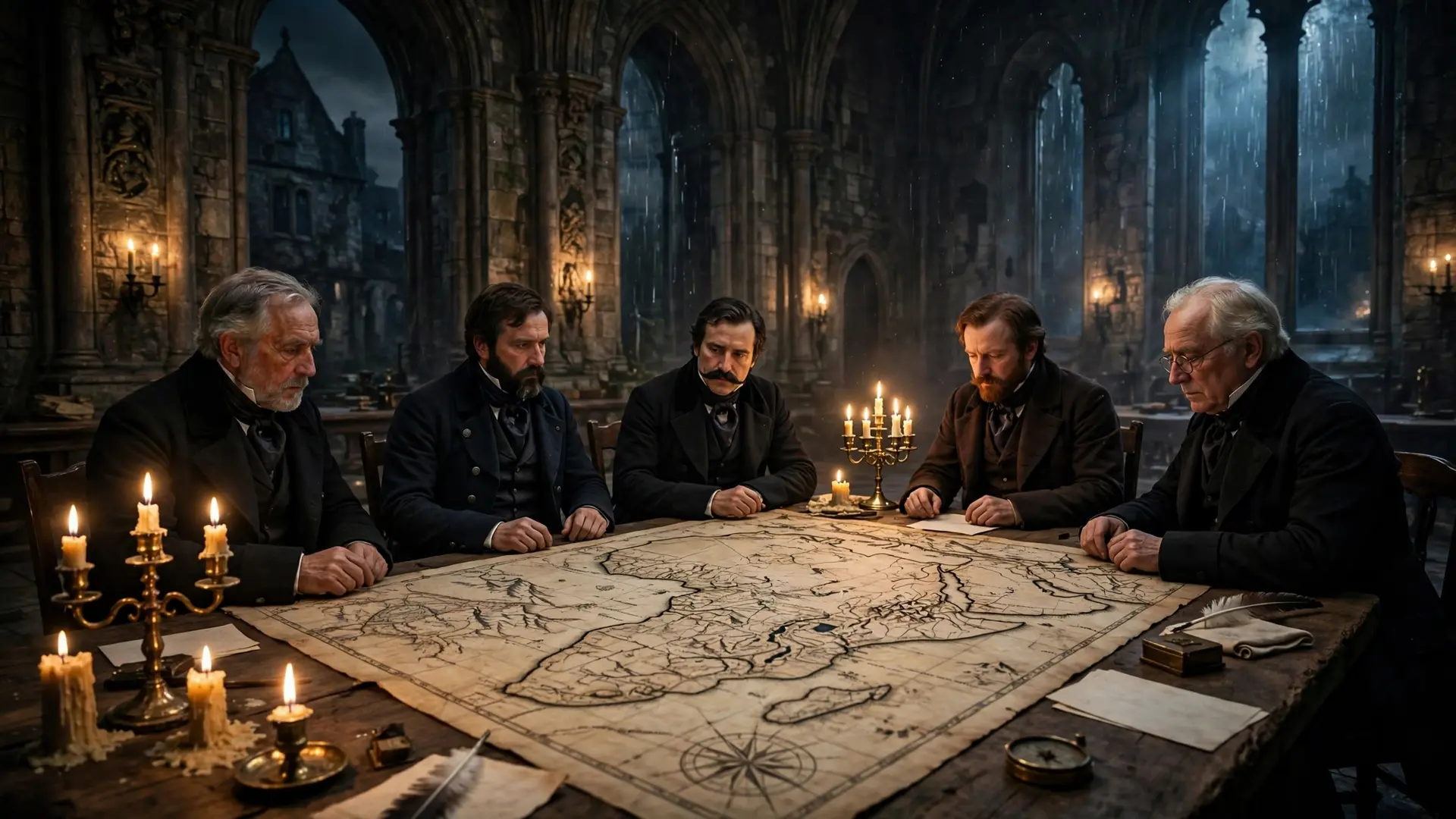
The conference met at German Chancellor Otto von Bismarck's official residence in Berlin from 15 November 1884 to 26 February 1885, ending with the General Act signed on February 26. It was convened at Portugal's initiative, as rivalry in the Congo Basin mounted between Leopold II of Belgium, France, Portugal, Germany, and Britain. Fourteen powers attended: every European state except Switzerland, plus the United States and the Ottoman Empire. No African representative was invited. The Sultan of Zanzibar — whose territory the Europeans were discussing — asked to attend and was dismissed by Britain. Bismarck's opening remarks set the tone by refusing to discuss sovereignty at all. The question of whose land was being taken was deliberately off the table. The delegates were there to regulate European competition, not to ask Africans anything.
What did the General Act actually say?
The Act's principles were a framework for orderly plunder: a free-trade regime across the Congo Basin, free navigation for all nations on the Niger and Congo rivers, and a prohibition on the slave trade. Two articles mattered most. Article 35 required that any new coastal possession be notified to the other signatories. Article 36 — "effective occupation" — required that claims be backed by real administrative authority, not just a flag planted on a beach. The conference also coined the first formal reference to "spheres of influence," and it recognized Leopold II's personal Congo Free State — roughly two million square kilometers of today's Democratic Republic of Congo — as essentially his private property. The effective-occupation rule had a perverse effect. To make a claim stick, a European power had to demonstrate real administration — which meant pushing inland with soldiers, administrators, and tax collectors. The rule designed to prevent paper claims became the engine of conquest, driving the military scramble into the continent's interior.
How did the rules become a war?
The effective-occupation rule was written to prevent a specific embarrassment: rival powers claiming the same coastline with nothing but a flag and a treaty. But the cure was worse than the disease. To make a claim stick under Article 36, a European power had to demonstrate real administrative authority — which meant soldiers, administrators, tax collectors, and railways pushed inland by force. A flag was no longer enough; the flag had to be followed by an army. That is how a conference that drew no borders launched the scramble. The "rules" told every European capital the same thing: claim it fast, occupy it visibly, or lose it to a rival who will. The result was a decade-long race into the interior, waged with maxim guns against societies the delegates had never consulted. The guest list is worth pausing on. The United States attended — an American delegation helped write the rules of a scramble the US never joined as a colonizer. The Ottoman Empire attended. Switzerland was the only European state that stayed away. Fourteen powers, and not one African voice. The Sultan of Zanzibar, whose own territory sat on the table, asked to attend; Britain dismissed the request.
Why is the "carve-up" story wrong?
The 2025 study by Paine, Qiu, and Ricart-Huguet in the American Political Science Review went through the archives and found that dividing Africa was simply not discussed at Berlin. Only the borders of Leopold II's Congo Free State were settled there — and even those were revised later.
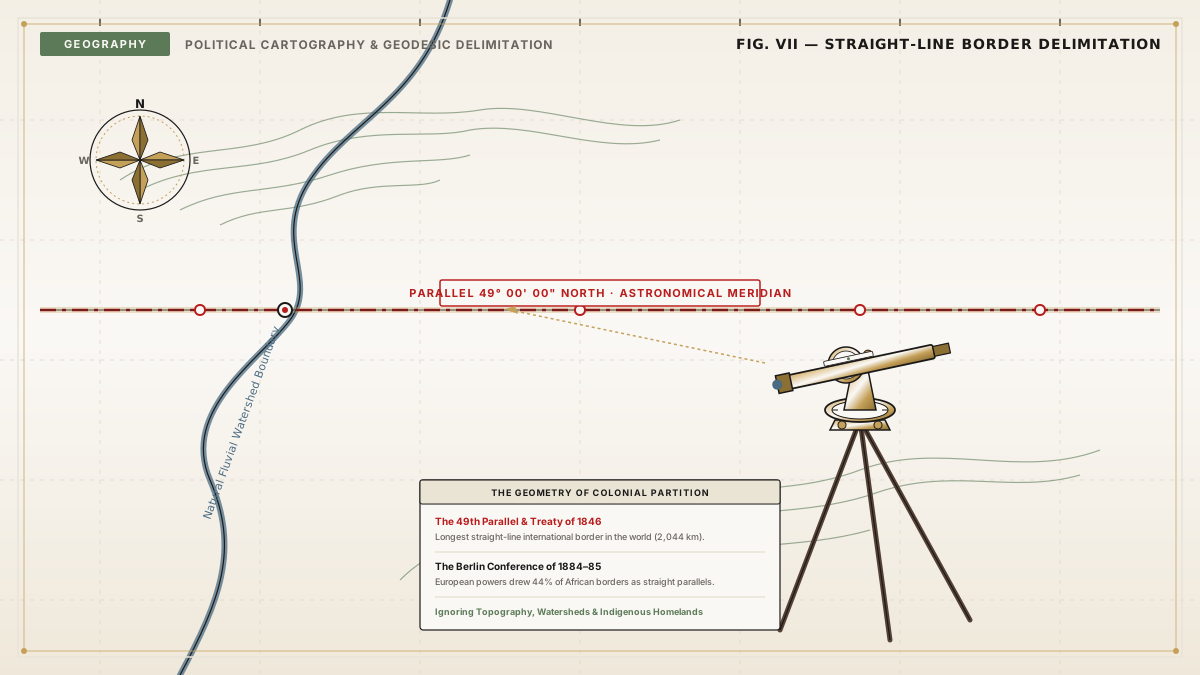
Real borders took decades of bilateral negotiation: half of Africa's international borders did not exist in any form until 1891, and half were substantially modified after 1908. And the borders were less arbitrary than the myth claims. About 62 percent of bilateral borders followed precolonial African states, earlier settlements, or nomadic migration zones; straight-line borders dominate only about 37 percent, mostly in the Sahara. One example: the 1890 British–French division in today's northwestern Nigeria began as an arbitrary straight line, but was redrawn in 1898 and 1904 to reflect Yoruba states and the Sokoto Caliphate. This does not make the colonial borders benign — it makes them deliberate. They were the product of negotiation between empires, not mistakes by ignorant mapmakers. As straight-line borders elsewhere show, every line on the map is a political decision, and the ones in Africa were made without a single African at the table.
What did it cost Africa?
The numbers tell the story the conference refused to discuss. When the delegates met, about 80 percent of Africa remained under traditional or local control. By the First World War, about 90 percent of the continent was colonized, with only Ethiopia and Liberia independent. The historian Wm. Roger Louis conceded that "the Berlin Act did have a relevance to the course of the partition" — its rules structured the race even without drawing a single border. Contemporaries understood what was happening. A week before the conference closed, the Lagos Observer wrote that the world had "perhaps… never witnessed a robbery on so large a scale." The delegates in Bismarck's residence were writing the legal architecture of that robbery: not a map, but a rulebook. The borders came later, drawn in treaties between empires, over land that was never theirs to divide — a process as systematic as the unclaimed spaces of Bir Tawil are accidental. And the myth of the Berlin map endures because it is simpler than the truth: the scramble was not drawn at a table, but licensed by one.
Frequently asked questions
What did the Berlin Conference decide?
The General Act established free trade in the Congo Basin, free navigation on the Niger and Congo rivers, and two key rules: new coastal claims had to be notified to signatories (Art. 35) and had to demonstrate 'effective occupation' (Art. 36). It also recognized Leopold II's Congo Free State.
Did the Berlin Conference divide Africa?
No — that is the myth. A 2025 peer-reviewed study (Paine, Qiu & Ricart-Huguet, American Political Science Review) found dividing the continent was not even on the agenda; only the Congo Free State's borders were settled there, and those were later revised. Africa's borders were negotiated in decades of later bilateral treaties.
Who was invited to the Berlin Conference?
Fourteen powers — every European state except Switzerland, plus the United States and the Ottoman Empire. No African representative was invited; the Sultan of Zanzibar's request to attend was dismissed by Britain.
What was the 'Scramble for Africa'?
The rapid colonization of Africa between roughly 1881 and 1914. When the Berlin Conference met, about 80% of Africa was under traditional or local control; by the First World War about 90% was colonized, with only Ethiopia and Liberia independent.