Tardigrades: The Animals That Survive Outer Space
In 2007, thousands of tardigrades endured 10 days of open space vacuum and came home alive. Inside the tun state, the Dsup protein, and their extreme limits.
Key takeaways
- In 2007, tardigrades survived 10 days of open space vacuum in ESA's FOTON-M3 TARDIS experiment — the first animals confirmed to do so.
- Vacuum alone was almost a non-event; unfiltered solar UV was the killer, with only three M. tardigradum individuals surviving the full spectrum.
- As a desiccated 'tun,' a tardigrade drops its metabolism below 0.01% of normal while glass-like TDP proteins lock cells in place.
- The Dsup protein shields DNA from radiation, letting tardigrades survive 5,000-6,000 grays versus ~4-5 grays lethal to humans.
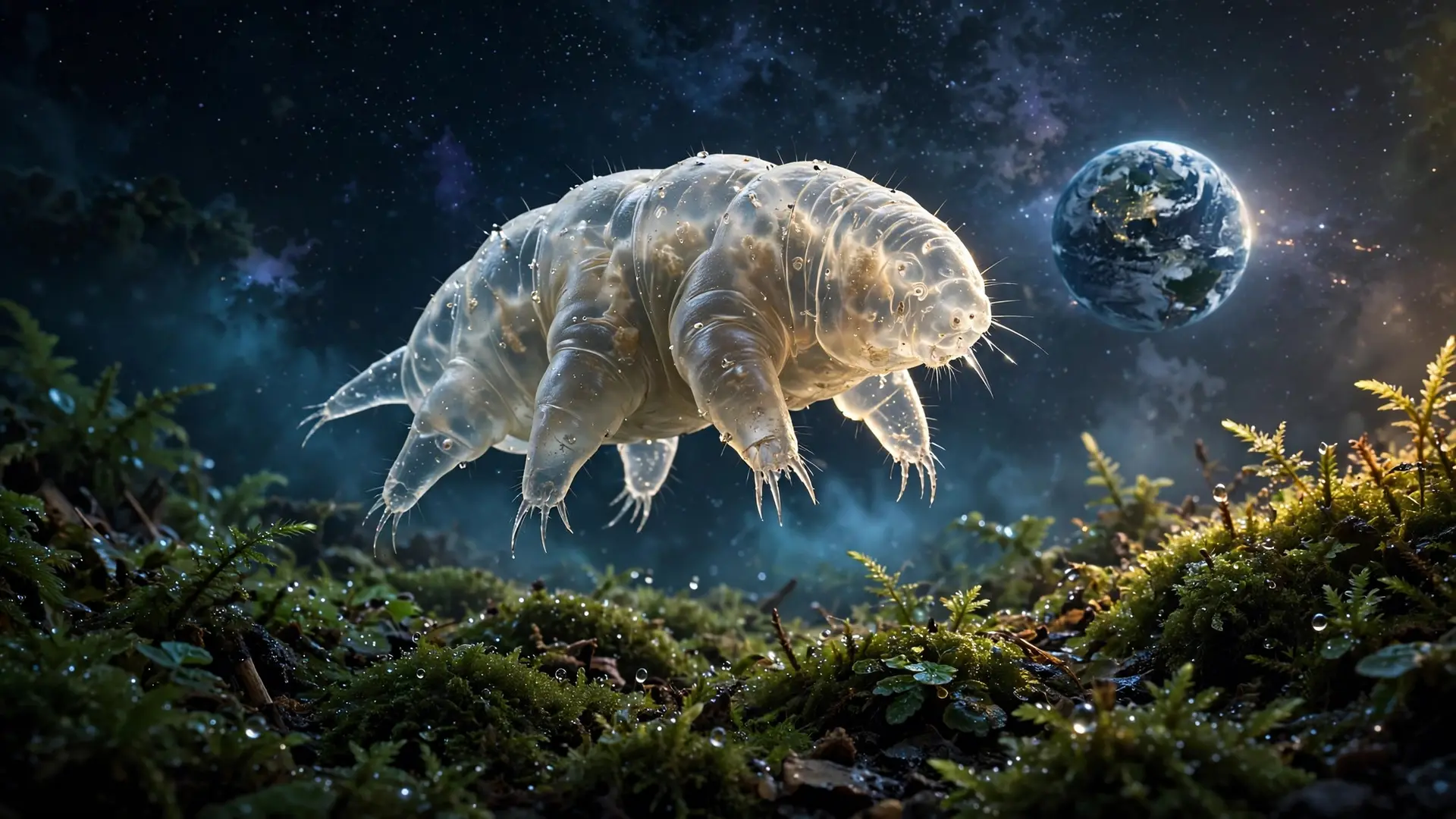
In September 2007, about three thousand animals rode into orbit on the outside of a spacecraft — no cabin, no shielding, no spacesuit. They were bolted to trays, dried into shriveled husks, and exposed to the open vacuum of low Earth orbit for ten days: zero pressure, wild temperature swings, unfiltered solar radiation. When the capsule came home, the researchers added water. Most of the animals woke up — and some went on to lay viable eggs. The tardigrade, a microscopic eight-legged creature barely a millimeter long, became the first animal ever confirmed to survive direct exposure to open space.
Ten days with the lid open
The experiment was called TARDIS — Tardigrades in Space — and it flew as part of the European Space Agency's FOTON-M3 mission, launched from Baikonur Cosmodrome on September 14, 2007. Desiccated adults of two species, Richtersius coronifer and Milnesium tardigradum, were placed in trays on the exterior of the capsule; once in orbit, the lids slid open at an altitude of roughly 258 to 281 kilometers, and the animals spent ten days in the void. The design isolated the killers one at a time. One group faced vacuum and cosmic radiation alone, shielded from the Sun. A second got vacuum plus ultraviolet-A and ultraviolet-B. A third received the full solar ultraviolet spectrum, down through the short vacuum-UV wavelengths that Earth's atmosphere normally absorbs. Ground-based control samples, dried the same way, waited out the flight in the lab. Vacuum, it turned out, was almost a non-event. Tardigrades exposed only to space vacuum revived at rates comparable to the ground controls, and the recovered adults laid eggs that hatched normally. Sunlight was the executioner. Of the animals hit with the full UV spectrum, only three individuals of M. tardigradum survived at all. Under UV-A and UV-B alone, about 68 percent of M. tardigradum revived within thirty minutes of rehydration, though many died in the days that followed — while only a single R. coronifer recovered. The animals were later flown again: in 2011, tardigrades aboard the Space Shuttle Endeavour's STS-134 mission reached the International Space Station and survived microgravity plus cosmic radiation, and in 2019 a capsule of desiccated tardigrades crashed onto the Moon with Israel's Beresheet lander — though whether anything survived that impact is unknown. The honest headline is narrower than the popular one: tardigrades survived open space, but sunlight nearly killed them all.
The tun: biology's pause button
What makes the trick possible is anhydrobiosis — life without water. When its moss or lichen habitat dries out, a tardigrade retracts its eight stubby legs, curls into a barrel-shaped husk called a tun, and pumps out nearly all of its internal water. Metabolism collapses to less than a hundredth of one percent of normal. The animal becomes, for all practical purposes, a grain of sand with a pulse waiting to resume. In that state it can wait out a decade of drought, and some reports suggest dry specimens many decades old have shown signs of revival. For years, scientists assumed the sugar trehalose — the classic desiccation protectant in plants and insects — was doing the heavy lifting. Tardigrades, though, make surprisingly little of it. Instead, they manufacture their own survival kit: tardigrade-specific intrinsically disordered proteins, or TDPs, that are floppy and unstructured during normal life but snap into a glass-like matrix as the animal dries. This vitrified scaffolding locks membranes and cellular machinery in place, stopping the molecular chaos that dehydration usually causes. A landmark 2017 study in Molecular Cell by Thomas Boothby and colleagues showed these proteins forming the protective glass; later work found that desiccation flips on more than 1,400 genes in Hypsibius exemplaris, hundreds of them unique to tardigrades. The animal doesn't resist drying — it reorganizes itself around it.
Dsup and the thousandfold radiation shield
Dehydration explains the vacuum. Radiation demanded a separate answer, and it arrived in 2016, when Takekazu Kunieda's team reported a protein found in no other animal: Dsup, short for damage suppressor. Dsup binds directly to the nucleosomes — the spools around which DNA is wound — and forms a protective shield that suppresses the single- and double-strand breaks ionizing radiation inflicts on the genome. Human cells engineered to express Dsup in culture gained a measure of the same resistance, a finding that has researchers eyeing applications in cancer therapy and radiation medicine.
A supercomputer simulation at the Centre for Plant Biotechnology and Genomics in Madrid later suggested why Dsup works so well: the protein is intrinsically disordered and highly flexible, able to mold itself precisely to DNA's shape, like a custom-fitted sheath — a striking example of physics operating at biology's smallest scales. Crucially, Dsup defends the genome even when the animal is fully hydrated — proof that tardigrade radioresistance isn't just a side effect of being a dry husk. The numbers are stark. Depending on species and radiation type, tardigrades have survived doses of 5,000 to 6,000 grays; a whole-body dose of around four to five grays is considered lethal to a human. The oft-quoted "a thousand times more radiation" is a useful shorthand rather than a precise clinical equivalence — grays measure absorbed energy, and biological effect depends on the organism — but the gap in tolerance is genuinely enormous. The same tun-state machinery handles everything else space can throw at it. In laboratory tests, tardigrades have endured temperatures from near absolute zero — around −272°C — up to brief exposures near 150°C, and pressures as high as 7,500 megapascals, roughly six thousand times atmospheric pressure. These are short, carefully controlled exposures of dormant animals, not conditions in which anything could live or reproduce — but no other known animal even approaches that envelope.
Tough, not immortal
The legend now writes itself — indestructible, immortal, colonizing the Moon — and the legend outruns the evidence. The TARDIS results themselves are the corrective: unfiltered solar UV killed nearly every animal exposed to it. The famous tolerance numbers all describe the desiccated tun, never the active animal padding through wet moss. A hydrated, feeding tardigrade is comparatively fragile — still an ordinary invertebrate that can be eaten, infected, and killed. Even the tun has limits. Cell damage accumulates during long dormancy; biologists describe a "Sleeping Beauty" model in which animals that fail to wake from very long anhydrobiosis die from the slow buildup of damage, not from aging — desiccation pauses the aging clock but not the decay. And the Beresheet Moon-crash headlines, which asked whether tardigrades might now colonize the lunar surface, ignore a basic fact: revival requires water, and there is none on the Moon's surface to wake them. Tardigrades join a short list of organisms that push chemistry to its limits — from bioluminescence to the glass-state proteins of a drying water bear — but hardiness is not invincibility. That is precisely what makes them scientifically precious. Tardigrades show that survival of the un-survivable isn't a matter of brute strength; it's a matter of controlled retreat. They don't conquer the vacuum, the radiation, or the cold. They dry out, vitrify their insides, wrap their DNA in a custom sheath, drop their metabolism to a whisper, and simply refuse to participate until conditions improve. It is arguably the most elegant survival strategy in biology: when the environment becomes lethal, stop being alive in it — and start again later.
Frequently asked questions
Can tardigrades really survive in space?
Yes — in 2007 they endured 10 days of open vacuum aboard the FOTON-M3 mission and revived after rehydration. But unfiltered solar UV killed nearly every animal exposed to it.
How do tardigrades survive dehydration?
Through anhydrobiosis: they curl into a barrel-shaped 'tun,' shed nearly all internal water, and their TDP proteins form a glass-like matrix that locks membranes and machinery in place.
What is the Dsup protein?
A tardigrade-only protein that binds DNA's nucleosomes and suppresses radiation-induced strand breaks, defending the genome even when the animal is fully hydrated.